
c. 800 – 867·Feast November 13
St. Nicholas I
Pope who defended marriage against kings
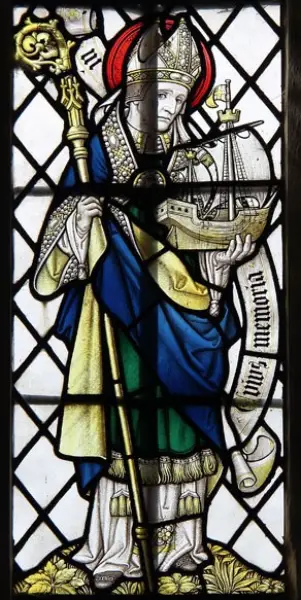
Overview
Nicholas I, honoured by history as Nicholas the Great, governed the Roman church from 24 April 858 down to 13 November 867, the day he died, and he stands as the last pope whom the Annuario Pontificio styles 'the Great' alongside Leo I and Gregory I. Born at Rome around 800 to a distinguished family, the son of the defensor Theodore, he rose through the clerical ranks as subdeacon and deacon before his election in the presence of Emperor Louis II. His pontificate fell in a West battered by Muslim and Norse raids, and he met disorder with a commanding vision of Roman primacy, teaching that the bishop of Rome held authority over all Christians, royalty included, in matters of faith and morals. He disciplined wayward archbishops, defended the indissolubility of marriage against King Lothair II despite a Carolingian siege of his city, backed the deposed Patriarch Ignatios of Constantinople against Photius, and shepherded the young Bulgarian church through Prince Boris's hundred and six questions. The Eastern church, provoked by his claims and by the filioque, excommunicated him at a council of 867, though news of it reached Rome only after his death. Esteemed by the Romans for piety and ascetic living, he was honoured as a saint soon after he died.
The Complete Life
A Roman of Good Family
Nicholas came into the world at Rome around the year 800, the son of a Roman defensor named Theodore, and his family stood among the distinguished households of the city. The boy received an excellent education, and contemporaries marked him out early for piety, benevolence, competence, knowledge, and eloquence. Such gifts had a natural destination in the Rome of his day: he entered the service of the Church while still young and climbed the grades of the clerical hierarchy under successive popes. Sergius II raised him to the order of subdeacon, and Leo IV later advanced him to the diaconate. He therefore belonged to the professional clergy of the Roman church for many years before any thought of the papacy could attach to him, learning its administration and its laws from within. When Benedict III died on 17 April 858, the young emperor Louis II of Italy came to Rome to watch over the succession. The choice fell quickly. On 24 April Nicholas was chosen, consecrated, and seated upon the papal throne in St. Peter's Basilica with the emperor present — a rare public role for a secular ruler in a Roman election. Three days later the new pope held a farewell banquet for Louis, and afterwards, escorted by the Roman nobility, he visited the imperial camp outside the walls; there the emperor honoured him by leading his horse for some distance, a small scene that nonetheless showed the mutual respect with which pope and emperor began their common work.
§ Early career
Conscience of a Broken West
Nicholas assumed the see of Peter at a moment when Western Europe lay spiritually exhausted and politically uncertain, harried by Muslim fleets from the south and Norse raiders from the north. Rather than shrink before the disorder, he appeared as a conscientious representative of the Roman primacy, convinced that the pope bore a mission to vindicate Christian morality and defend the law of God throughout the Church. From that conviction flowed the whole shape of his nine-year pontificate. He cooperated with Emperor Louis II and with Byzantine forces to check, at least for a time, the Muslim advance in southern Italy, and he strengthened the fortifications at Ostia against future raids. Within the Church he insisted that bishops answer for their conduct: John of Ravenna, who oppressed the people of the Papal States, abused his suffragans, extorted money, imprisoned priests unlawfully, and forged documents to support his claims, ignored three summons to the papal tribunal and suffered excommunication; the pope then travelled to Ravenna in person to investigate and settle the affairs of that church. When the archbishop later allied himself with the excommunicated prelates of Trier and Cologne, Nicholas excommunicated him again and forced a second submission. In the dispute with Hincmar of Reims over the deposed Bishop Rothad of Soissons, and again over the elevation of Wulfad to Bourges, the pope upheld the right of the Roman see to judge causes of importance, and Hincmar in the end submitted to the decrees of the Apostolic See.
§ Papacy
Marriage, Kings, and the Christian East
No struggle displays Nicholas's character better than his defence of the marriage bond against King Lothair II of Lotharingia. The king, wanting an heir, had abandoned his wife Teutberga for his mistress Waldrada, and the bishops of Lotharingia obliged him at the Synod of Aachen in 862. When bribed papal legates confirmed that verdict at the Council of Metz in 863, Nicholas brushed the council aside: he declared it deposed, excommunicated its messengers, and annulled its decisions, then condemned and deposed the archbishops of Cologne and Trier at a Lateran synod. Lothair marched on Rome and besieged the city while Emperor Louis II championed the fallen bishops; the pope took refuge two days in St. Peter's before Empress Engelberga brokered a reconciliation, and the king's annulment was never granted. In the same spirit Nicholas ordered the excommunication of Ingiltrud, who had left Count Boso for a paramour, and urged leniency toward Judith, who had married Baldwin of Flanders without her father's consent, so that the freedom of marriage might stand. In the East he defended the deposed Patriarch Ignatios, denounced the elevation of Photius as unlawful, and excommunicated Photius at a Roman synod in 863. When Prince Boris of Bulgaria sent a hundred and six questions about the faith, Nicholas answered them in writing and dispatched missionaries under the legate Formosus, labouring to root the young Bulgarian church in Roman obedience.
§ Marriage laws
Ascetic at the Summit
Authority of the kind Nicholas exercised can corrupt, yet the sources present a man who governed from a deeply interior life of faith. The sources sketch a personal life that was pious and ascetical in the Christian manner, and he never treated the papal household as a court of ease: he rebuilt and endowed several churches in Rome and constantly sought to encourage religious life among clergy and people alike. His rulings reveal the same temper. To the Bulgarian khan who wondered whether trousers were a hindrance to salvation, he answered that neither wearing nor not wearing them impedes salvation or increases virtue, and he turned the question toward the true garment of a temperate life that restrains disordered passions — the 'spiritual' discipline he cared about far more than dress. His legislation on fasting carried the same logic: in 866 he bade every Christian forgo the meat of warm-blooded creatures — flesh, blood, or marrow — on Wednesdays and Fridays, a discipline whose echo survives in the Catholic custom of abstaining from meat on the Fridays of Lent. He also decreed that a rooster figure should stand upon every church, so that the bird on the steeple would remind every passer-by of Peter's tears after his denial of Christ. Questions later arose over whether he leaned on the forged pseudo-Isidorian decretals, but scholarly investigation concluded that he knew them, if at all, only dimly and built his doctrine of the law upon other foundations.
§ Legacy
The Last Quarrel
The final years of the pontificate were shadowed by the widening quarrel with Constantinople. Nicholas had stood by Patriarch Ignatios, deposed in 858 in favour of Photius, and his legates to the council of 861 had disobeyed their instructions. In 862 he wrote to the Eastern patriarchs demanding that Photius be refused recognition, and in April 863 a Roman synod excommunicated him. Constantinople regarded Photius as canonically elected and resented the pope's posture: his claims of rulership over the Church, the insertion of the filioque into the creed, and his pressure to keep Bulgaria under Roman rather than Byzantine obedience. In 867 a synod at Constantinople, presided over by Photius, excommunicated Nicholas in turn, repudiated his primacy, and condemned his Bulgarian policy and the filioque. The breviary of his life closed before the blow could land: the news of his excommunication did not reach Rome until after his death. Nicholas died at Rome on 13 November 867, aged about sixty-seven, having reigned a little over nine years. Regino of Prüm records that he had been held in the highest honour by Rome's own citizens and by his generation at large, and the affection outlived him — after his death the Romans regarded him as a saint, and Adrian II succeeded to a papacy whose authority Nicholas had done more than any predecessor of his century to consolidate.
§ Relations with the Eastern Church
Honour of the Altars
Nicholas never passed through the formal processes that later canon law would require; the Church's memory claimed him by acclamation. After his death in 867 he was regarded as a saint, and Regino of Prüm's chronicle testifies to the esteem in which the Romans and his own generation held him. Formal liturgical recognition came much later. The Catholic Church has venerated him as a saint from the seventeenth century onward, and in 1630 Pope Urban VIII re-affirmed his cult, a decisive confirmation of a devotion that had never lapsed. His feast was long kept on 6 December, but from 1883 the Roman calendar assigned it to 13 November, the day of his death, and the Martyrologium Romanum of 2001 still inscribes him there under the name of Nicholas I. He belongs to that small company of bishops of Rome whom tradition has called Great — only Leo I and Gregory I share the title in the Annuario Pontificio — and he stands among the pre-congregation popes whom both the Catholic Church and Eastern Orthodoxy honour as saints of the undivided Church, even though his quarrel with Photius helped open wounds that would never wholly close. His cult thus rests where it began: on the judgement of the Christian people that a pope who feared no king in defence of God's law must have been a friend of God.
§ Legacy
The Shaping of the Medieval Papacy
Nicholas left the papacy a different institution from the one he inherited. Historians remember him as a consolidator of papal authority who decisively shaped the office's standing among the Christian nations of Western Europe, for he taught — and forced Europe to reckon with the teaching — that the bishop of Rome bore suzerainty over every Christian, royalty included, wherever faith and morals were concerned. His victory over Lothair II became the classic demonstration that no synod of bribed bishops could dissolve what God had joined. His disputes with the archbishops of Ravenna, Cologne, Trier, and Reims established that the great causes of the Church could be carried to Rome and judged there. In the missions he was equally a builder: he approved the merging of the sees of Bremen with Hamburg and confirmed to Archbishop Ansgar, together with his successors as papal legates to the Danes, Swedes, and Slavs, and sent missionaries to the Bulgarians, encouraging the Church's expansion toward the north and east. Two of his rulings entered the daily life of every later generation of Catholics — the rooster upon the church steeple in memory of Peter's denial, and the abstention from meat on the Fridays of Lent that descends from his decree of 866. The East remembered him otherwise, as the pope whose claims strained communion toward breaking; yet even there his reign marks the first great articulation of the positions Rome would carry into the medieval centuries.
§ Legacy
Timeline
- 800
Born at Rome into a distinguished family, son of the defensor Theodore
§ Early career
- 24 Apr 858
Chosen pope that day, consecrated, and enthroned within St. Peter's Basilica before Emperor Louis II
§ Early career
- 860
Cited Archbishop John of Ravenna before a Roman synod after repeated warnings failed to curb his oppression
§ Bishops
- Nov 861
John of Ravenna submits to the pope at the Roman Synod of November
§ Bishops
- 28 Apr 862
Bishops at the Synod of Aachen approve King Lothair II's union with Waldrada, contrary to ecclesiastical law
§ Marriage laws
- 8 May 862
Writes to the Eastern patriarchs urging them and their bishops to refuse recognition to Photius
§ Relations with the Eastern Church
- 863
Prince Boris of Bulgaria undertakes baptism through western clergy supplied by Louis the German, before a Byzantine invasion forces peace
§ Relations with the Eastern Church
- Apr 863
A Roman synod excommunicates Photius of Constantinople
§ Relations with the Eastern Church
- Jun 863
Bribed papal legates at the Council of Metz assent to the Aachen decision and condemn the absent Teutberga
§ Marriage laws
- Oct 863
The Lateran Synod condemns and deposes archbishops Günther of Cologne and Thietgaud of Trier, with John of Ravenna and Hagano of Bergamo
§ Marriage laws
- 866
Commands every Christian to forgo the meat of warm-blooded creatures — flesh, blood, or marrow — on Wednesdays and Fridays
§ Legacy
- Aug 866
Boris sends an embassy with 106 questions on Church teaching and discipline; Nicholas answers in the Responsa ad consulta Bulgarorum
§ Relations with the Eastern Church
- 867
A synod at Constantinople under Photius excommunicates Nicholas and rejects his claims of primacy
§ Relations with the Eastern Church
- 13 Nov 867
Dies at Rome at about sixty-seven years of age; the news of his Greek excommunication arrives only afterwards
§ Relations with the Eastern Church
- 1630
Pope Urban VIII re-affirms the saintly cult of Nicholas
§ Legacy
In Their Own Words
For whether you or your women wear or do not wear pants neither impedes your salvation nor leads to any increase of your virtue.
The Record
- Major works
- Responsa Nicolai ad consulta Bulgarorum, replies to Prince Boris's 106 questions·Letter of 8 May 862 to the Eastern patriarchs against Photius·Decree placing the figure of the rooster on churches in memory of Peter's denial·Decree of 866 prescribing abstinence from warm-blooded meat on Wednesdays and Fridays·Sanction of the union of the sees of Bremen and Hamburg and of Ansgar's legation to the northern peoples·Rebuilding and endowment of several Roman churches
- Symbols
- rooster on church steeples, a reminder of Peter's denial of Christ
- Canonization
- Pre-congregation: venerated as a saint from the seventeenth century, his cult re-affirmed by Pope Urban VIII in 1630
Prayer
Bibliography
Show 7 sources
- Will Durant. The Age of Faith. New York: Simon and Schuster, 1972.
- O'Malley SJ, John W. A History of the Popes: From Peter to the Present. Government Institutes, 2009.
- Williston Walker. History of the Christian Church. Simon and Schuster, 2014. ISBN 9781476794679.
- d'Avray, D. L., ed. 'Case 10: Nicholas I Reports on His Deposition of Two Archbishops (863)', Debating Papal History, c. 250–c. 1300: Responsive Government and the Medieval Papacy. Cambridge University Press, 2025, pp. 118–124. doi:10.1017/9781009597494.012. ISBN 978-1-009-59753-1.
- Dvornik, Francis. The Photian Schism: History and Legend. Cambridge University Press, 1948.
- Schrörs, Johann Heinrich. 'Papst Nikolaus I. und Pseudo-Isidor', Historisches Jahrbuch, XXV (1904), 1 sqq.
- Martyrologium Romanum. Vatican Press, 2001. ISBN 978-88-209-7210-3.
Profile text adapted from the Wikipedia article, licensed CC BY-SA 4.0.
Pray with this saint every day
Save St. Nicholas I to your favorites, read the full profile, and get feast-day reminders in the Saints app.
Get the Saints AppFree on the App Store for iPhone and iPad