
died 11 February 824·Feast February 11
St. Paschal I
Builder pope of the Roman mosaics
Overview
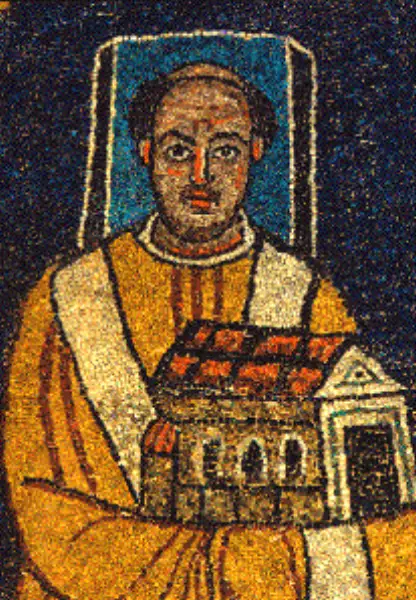
Paschal I was bishop of Rome and ruler of the Papal States from 25 January 817 until his death on 11 February 824. A native Roman of the aristocratic Massimi line, son of Bonosus and Theodora, he had governed the monastery of St Stephen of the Abyssinians, caring for the pilgrims who thronged the city, before his sudden elevation the day after Stephen IV died. His pontificate walked a careful line between the Roman nobility and the Carolingian court: he obtained from Louis the Pious a guarantee of free papal elections, sent missionaries to the Danes, and in 823 crowned the emperor's son Lothair I — a coronation soon followed by a revolt of Roman aristocrats, the execution of two of its leaders, and a papal oath of purgation before thirty-four bishops. Paschal's enduring monument is artistic rather than political. He gave refuge to Byzantine monks fleeing the iconoclast persecution, set their mosaicists to work upon Roman walls, and rebuilt three great basilicas — Santa Prassede, Santa Maria in Domnica, and Santa Cecilia in Trastevere — together with two oratories at old St. Peter's and significant works at Santa Maria Maggiore. He discovered Cecilia's remains in the Catacomb of Callixtus and translated them to her rebuilt church. The Roman Curia, resenting his harsh government, denied him burial in St. Peter's; he rests instead in Santa Prassede, beneath the mosaic portrait of his mother, honoured as a saint since the late sixteenth century.
The Complete Life
A Son of the Massimi
Paschal was a native of Rome, born Pascale Massimi, the son of Bonosus and of Theodora, the woman whose mosaic face still gazes from the apse of Santa Prassede. The Liber Pontificalis records these family details, and the Liber Censuum places the future pope in the Massimi branch of the old Massimo family — the same stock, it says, as his predecessor Stephen IV. He grew to manhood among the clergy and monasteries of the city rather than in its violent politics. Pope Leo III entrusted him with the monastery of St Stephen of the Abyssinians, a foundation whose special charge was the welfare of the pilgrims who came from across the Christian world to pray at the apostolic tombs; there Paschal learned administration, hospitality, and the daily rhythm of Roman liturgy. Some early modern accounts add that Leo III also raised him to the cardinal priesthood of Santa Prassede, the titulus whose fortunes would be bound to his own; a modern scholar suspects that story was invented later precisely to explain the lavish attention the pope paid that church in his pontificate. Whatever the truth of the cardinalate, the connection to Santa Prassede was real and lifelong. When Stephen IV died suddenly in January 817, the assembled clergy and people of Rome turned to this experienced abbot of aristocratic blood, and within a day of the old pope's death Paschal wore the pallium.
§ Early life
A Pope Who Apologized for His Election
Paschal's election of 25 January 817, coming a bare day after Stephen IV died, was calculated breach of the protocol that required imperial consent, and Paschal did not pretend otherwise. He opened his pontificate by apologizing to Emperor Louis the Pious for the slight, insisting the office had been thrust upon him and that such speed of the choice had been necessary to avert factional strife in a city where papal elections had too often ended in blood. To repair relations he sent legates to the Frankish court, and according to the Liber Pontificalis his representative Theodore came back bearing a document known as the Pactum cum Paschali pontifice: in it the emperor congratulated the new pope, acknowledged his sovereignty over the Papal States, and promised that future elections would be free — terms historians have since suspected to be a forgery. Whatever the document's authenticity, the working relationship with Louis was real and mostly cooperative. The emperor confirmed the agreement struck at Rheims with Paschal's predecessor, the Pactum Ludovicanum, which secured free elections and kept the Franks from interfering in Church affairs unless help was formally requested. On that foundation pope and emperor acted together in the Church's mission, most visibly in 822, when they jointly dispatched Archbishop Ebbo of Rheims northward to preach the gospel to the Danes. Paschal had entered the papacy by an irregular door, but he left it with the throne's independence acknowledged and the alliance with the empire on a settled footing.
§ Accession
Coronation and Revolt
The decisive political act of the pontificate came on Easter Sunday of 823, when Paschal crowned and anointed Lothair I, son of Louis the Pious, as Holy Roman Emperor in Rome. The ceremony bound the imperial office to the apostolic see, but the young emperor proved a less pliable partner than his father. He held court near the city and declared Farfa Abbey, north of Rome, exempt from papal taxation, a judgement that emboldened Paschal's aristocratic enemies within the papal palace itself — above all the pope's former legate Theodore and Theodore's son-in-law Leo, who looked to the young Frankish ruler for backing. The opposition broke into open revolt against the authority of the Roman Curia across northern Italy, led by the same two men. Paschal's government crushed the uprising swiftly, and its brutality shocked contemporaries: two of the captured leaders were blinded and then beheaded by members of the papal household. The pope denied all personal involvement, but the emperor remained suspicious and dispatched two commissioners to investigate. Paschal refused to place himself under the jurisdiction of the imperial court — a refusal itself an assertion of papal sovereignty — yet he did consent to clear his name by oath of purgation before a synod made up of thirty-four bishops. Those commissioners returned to Aachen, and Louis the Pious let the whole affair fall into silence. Paschal emerged weakened but uncondemned, and he reigned until his death the following winter.
§ Papacy
Refuge of the Iconophiles
While emperors argued over his election and nobles conspired in his palace, Paschal opened the gates of Rome to the Church's persecuted. In the Byzantine Empire the iconoclast controversy raged, and monks who defended the holy images were driven from their monasteries; Paschal gave them shelter in the city of Peter. He did more than house them. The exiles included mosaicists trained in the great artistic schools of the East, and the pope put these masters to work decorating the churches of Rome, so that the theology of the icons — condemned in Constantinople — blazed from the apses and triumphal arches of the papal city in gold tesserae. He carried the defence beyond Rome's walls as well, writing both to Louis the Pious in the West and to the Byzantine emperor Leo the Armenian on behalf of those who opposed iconoclasm, lending the authority of the apostolic see to the embattled confessors of the East. The mosaics those refugees made preserve the pope's own face at Santa Prassede, Santa Cecilia in Trastevere, and Santa Maria in Domnica, lifelike portraits with the square halo of the living. In them scholars read his deepest conviction: that church-building was the way he chose, as one historian puts it, to voice the papacy's authority as a state independent of empire — a theology rendered not in decrees but in gold, glass, and translated bones.
§ Construction projects
Death and a Refused Tomb
Paschal died at Rome on 11 February 824, after seven years in which he had crowned an emperor, outfaced a revolt, and rebuilt half the sacred topography of his city. Yet the judgement of the Roman Curia on its own pope was cold. Because of the harshness of his government of the Roman people — the executions of the aristocratic rebels were not forgotten — the Curia denied him burial inside St. Peter's Basilica, resting place of his predecessors. His body was instead laid in the Basilica of Santa Prassede, the church he had rebuilt and loved, where the famous mosaic of his mother Episcopa Theodora still shines. It is a burial that has kept its irony across twelve centuries: the pope excluded from the Vatican rests in a church that is itself one of the supreme masterpieces of medieval Rome, and the city that denied him one honour preserved him a greater one. His cause before God was settled differently from his reputation at the Curia, for within a few generations the Church was honouring Paschal as a saint, and the Orthodox East keeps his memory as a confessor who stood for the right faith against the iconoclast heresy in the days of the emperor Leo the Armenian, around the year of his death.
§ Death
From the Curia's Disfavour to the Altar
The path from a disputed burial to the calendar of the saints was a long one, but it ended in recognition. Formal enrolment among the saints came late: Paschal was canonized only in the closing years of the sixteenth century enrolled among the saints the pope whom Eastern tradition already venerated as a confessor of orthodoxy against iconoclasm. In the Roman calendar his feast was kept for centuries on 14 May, the date under which it stood before 1963; since then the memorial has been transferred to 11 February, the day of his death. The Orthodox Church honours him on 14 May as pope and patriarch of Rome, a confessor who confessed the right faith in the face of the imperial heresy around the year 824. He is thus one of the rare ninth-century popes claimed by both East and West: the communion his era strained did not break until long after, and both traditions remember the refugee shelterer of icon-worshippers. In art he is shown in papal vestments with the pallium, and nearly always against the mosaics of his own making, the square-haloed figures of Santa Prassede and Santa Cecilia serving as his biography in glass. The man the Roman court would not bury beside Peter is now invoked at the altar as Peter's fellow citizen in heaven, and his feast stands in the calendar the Curia keeps.
§ Death
The City Rebuilt in Gold
Paschal's pontificate left a mark on Rome out of all proportion to its seven years. He rebuilt three of the city's ancient basilicas entire — Santa Prassede, Santa Maria in Domnica, and Santa Cecilia in Trastevere — filling them with mosaics whose lifelike portraits of the pope still look down on worshippers, and he undertook significant renovations at the Basilica of Santa Maria Maggiore. At Old St. Peter's he added two oratories, dedicated to SS. Processus and Martinianus and to SS. Xistus and Fabianus, which stood until the great sixteenth-century rebuilding swept them away. A chapel he is sometimes said to have renovated at Santo Stefano del Cacco belongs in fact to the work of the later Paschal II. His devotion to the saints of the catacombs renewed a Roman tradition: crediting him with the finding of Cecilia's body in the Catacomb of Callixtus and its solemn translation to the basilica that bears her name, he set a pattern of relic translation that shaped the piety of the early ninth century, as historians of his Rome have abundantly shown. Politically his reign secured the principles of free papal election against imperial veto and asserted the Papal States' sovereignty in the face of Carolingian power. Six of his letters survive, confirming the possessions of Farfa, the privileges of the church of Ravenna, and his correspondence with the archbishop of Reims — a slender but precious record of a builder pope at work.
§ Construction projects
Timeline
- 25 Jan 817
Chosen pope a bare day after Stephen IV's sudden death, without the prior sanction of Emperor Louis the Pious
§ Accession
- 822
Joins Emperor Louis the Pious in sending Archbishop Ebbo of Rheims to evangelize the Danes
§ Papacy
- 823
Crowns and anoints Lothair I as Holy Roman Emperor on Easter Sunday
§ Papacy
- 823
An uprising of Roman aristocrats led by Theodore and Leo is suppressed; two leaders are blinded and beheaded, and Paschal purges himself by oath before a synod of thirty-four bishops
§ Papacy
- 11 Feb 824
Dies at Rome; the Curia refuses him burial in St. Peter's and he is laid to rest in Santa Prassede
§ Death
The Record
- Major works
- Rebuilding of the basilicas of Santa Prassede, Santa Maria in Domnica, and Santa Cecilia in Trastevere·Translation of the relics of Saint Cecilia from the Catacomb of Callixtus to her basilica·Renovations of the Basilica di Santa Maria Maggiore·Two oratories added to Old St. Peter's Basilica: SS. Processus et Martinianus and SS. Xistus et Fabianus·Six surviving letters (Jaffé 2546, 2547, 2548, 2550, 2551, 2553)·Shelter for Byzantine monks exiled for opposing iconoclasm
- Symbols
- papal vestments·pallium
- Canonization
- Canonized in the late sixteenth century; feast formerly kept on 14 May, now on 11 February
Prayer
Bibliography
Show 7 sources
- Osborne, John, ed. 'Paschal I, the Church of Santa Prassede and the Question of a "Carolingian Renovatio" in Rome', Rome in the Ninth Century: A History in Art, British School at Rome Studies. Cambridge University Press, 2023, pp. 51–85. doi:10.1017/9781009415422.003. ISBN 978-1-009-41542-2.
- Goodson, Caroline J. The Rome of Pope Paschal I: Papal Power, Urban Renovation, Church Rebuilding and Relic Translation, 817–824. Cambridge University Press, 2010.
- O'Brien, Richard P. Lives of the Popes. New York: Harper Collins, 2000, pp. 132–133. ISBN 0-06-065304-3.
- Kelly, John N.D. Gran Dizionario Illustrato dei Papi. Edizioni Piemme S.p.A., 1989, Casale Monferrato. ISBN 88-384-1326-6.
- Rendina, Claudio. I papi. Ed. Newton Compton, Roma, 1990.
- Duchesne, Louis Marie Olivier. 'Paschal, s.v. Paschal I', in Chisholm, Hugh (ed.), Encyclopædia Britannica, Vol. 20 (11th ed.). Cambridge University Press, 1911, pp. 881–882.
- Jaffé, Philipp. Regesta pontificum romanorum ab condita ecclesia ad annum post Christum natum MCXCVIII (secunda ed., in Latin). Leipzig: Veit, 1885, pp. 318–320.
Profile text adapted from the Wikipedia article, licensed CC BY-SA 4.0.
Pray with this saint every day
Save St. Paschal I to your favorites, read the full profile, and get feast-day reminders in the Saints app.
Get the Saints AppFree on the App Store for iPhone and iPad