
1897-1978·Feast May 29
St. Pope Paul VI
Pope
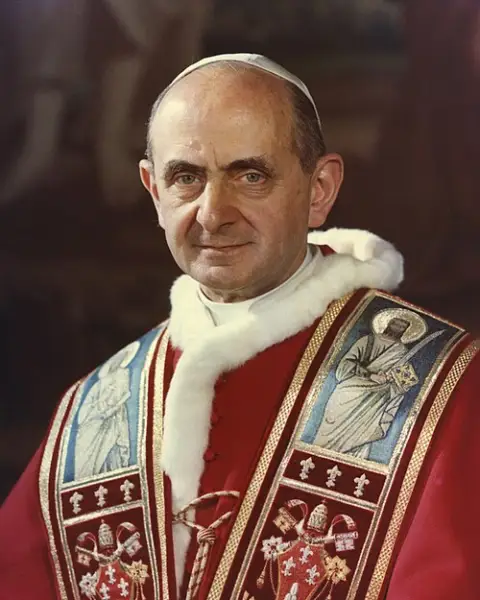
Overview
Giovanni Battista Montini was born at Concesio near Brescia in 1897, son of a lawyer-parliamentarian active in Catholic Action, and ordained a priest in Brescia on 29 May 1920. He spent a single foreign posting at the nunciature in Warsaw before entering the Secretariat of State in 1922, where over three decades he became, with Domenico Tardini, the closest and most influential advisor of Pius XII. During the war he ran the office answering millions of inquiries about missing persons and helped organize shelter and food for refugees and escaped prisoners. Named Archbishop of Milan in 1954 — 'his personal gift to Milan,' said Pius — he threw himself into the pastoral care of a de-Christianized industrial city, preaching in factories and squares, and was raised to the cardinalate by John XXIII in December 1958. Elected pope on 21 June 1963, he reconvened the Second Vatican Council, guided it to its close in 1965, and then spent fifteen years implementing its reforms: a reformed Roman Missal, the liturgy in the vernacular, the renunciation of papal regal splendor, and a deliberate dismantling of the papal court. He was the first reigning pontiff in over a century to leave Italy, flying to Jordan in January 1964, and he declared Mary Mother of the Church during the Council. His 1968 encyclical Humanae vitae, reaffirming the Church's teaching against artificial birth control, won him hostile headlines and, he predicted, a prophet's vindication. He died at Castel Gandolfo on 6 August 1978.
The Complete Life
Early Life
Giovanni Battista Enrico Antonio Maria Montini was born on 26 September 1897 at Concesio in the province of Brescia, Lombardy, and baptized the next day. His father Giorgio Montini practiced law, wrote as a journalist, directed Catholic Action, and sat in the Italian Parliament; his mother Giudetta Alghisi came of rural nobility; one brother became a physician, the other a lawyer and politician. Educated at the Jesuit-run Cesare Arici school, his schooling often interrupted by illness, he entered the seminary in 1916 and was ordained on 29 May 1920 at Brescia, celebrating his first Mass at Santa Maria delle Grazie. He took a laurea in canon law at Milan in 1922 and studied at the Gregorian, at La Sapienza, and at the Pontifical Academy of Ecclesiastical Nobles, entering the Secretariat of State that same year at twenty-five, where he worked under Giuseppe Pizzardo with Tardini, Ottaviani, and Spellman. He never held a parish appointment; in 1925 he helped found the Morcelliana publishing house in Brescia for Christian-inspired culture.
§ Early life
Mission and Ministry
Montini's whole career was curial and pastoral by turns. His one foreign posting was as secretary to the nuncio in Poland in 1923, where the nationalism he saw taught him a lasting suspicion of the thing. He rose through the Secretariat of State under Pius XII to be the effective deputy for ordinary affairs during the war years, was made Archbishop of Milan in 1954, and a cardinal by John XXIII in 1958. Elected pope on 21 June 1963, eight months into the Second Vatican Council, he chose to reconvene and complete it, directing its three remaining sessions to their close in 1965 and then carrying the implementation of its reforms. He created the Synod of Bishops, reformed the curia, reformed the liturgy, promoted the universal call to holiness as the council's teaching, and gave the papacy its modern ecumenical and interreligious practice, supporting Augustin Bea's unity secretariat and the passage of Nostra aetate. His encyclicals, above all Humanae vitae of 1968, set the church's teaching on marriage against the sexual revolution at bitter personal cost. He was the first pope to travel widely abroad, to the Holy Land in 1964 and to the United Nations in 1965 among other journeys, survived an attempted assassination at Manila in 1970, and during the kidnapping and killing of Aldo Moro in 1978 appealed, in vain, to the Red Brigades for his friend's life.
§ Introduction
Spirituality and Teaching
Montini's mind was marked by the dialogue between faith and the modern world, and his papacy by the effort to hold together the council's openness with the church's continuity. His private notes show a self-questioning man: in 1978 he asked whether he was Hamlet or Don Quixote, on the left or the right, adding that he was filled with great joy amid all affliction. His confessor, the Jesuit Paolo Dezza, judged that if he was not a saint at his election he became one through the suffering of his pontificate. The persona he left is that of a pope who believed himself misunderstood, governing a church in turmoil with patience rather than force.
§ Death
Trial and Final Years
Paul VI's health declined through the 1970s; a prostate operation in 1967, delayed by his own procrastination, was performed in an improvised theatre in the papal apartments. He left the Vatican for Castel Gandolfo on 14 July 1978, stopping to pray at the tomb of Cardinal Pizzardo, who had brought him into the Vatican half a century earlier. Though sick, he received the new Italian President Sandro Pertini for more than two hours, and that evening he watched a Western on television, happiest when horses appeared — the most beautiful animals, he thought, that God had created. On Sunday 6 August, the Feast of the Transfiguration, he was too ill to say the Angelus. He participated in Mass from his bed at six in the evening, suffered a massive heart attack after communion, and died at 21:41 at Castel Gandolfo, with Cardinals Villot and Caprio, his secretary, two nuns, and his physician present. He had asked for a simple burial and the destruction of his personal papers, and he rests in a grave under the floor of Saint Peter's Basilica rather than in an ornate sarcophagus.
§ Final days
Canonization
Paul VI's cause moved with the speed now usual for modern popes. Pope Francis beatified him on 19 October 2014, once a miracle worked through his intercession had been recognized, and canonized him on 14 October 2018, in the same ceremony that declared Oscar Romero a saint. His canonization was read as completing the arc of the council popes: John XXIII, whose cause was joined to John Paul II's in 2014, and Paul VI, who had finished the council and borne the aftermath.
§ Canonisation
Legacy
Paul VI's legacy is the Second Vatican Council in its final form and the church's implementation of it: the liturgy in the vernacular as most Catholics now know it, the Synod of Bishops, the new ecumenical relationships, and the travel-diplomacy of the modern papacy. Humanae vitae made him, in his lifetime, the most criticized pope of the century, and its teaching has remained the fixed point of the church's sexual ethics. The states that declared mourning at his death, from Syria to the Philippines, measured the diplomatic reach he had built. His self-description as a pilgrim, and his refusal of pomp in death, set the tone for his successors' simpler style.
§ Legacy
Timeline
- 26 Sep 1897
Born Giovanni Battista Enrico Antonio Maria Montini at Concesio in the Province of Brescia, Lombardy.
§ Early life
- 30 Sep 1897
Baptised with the name Giovanni Battista Enrico Antonio Maria Montini.
§ Early life
- 1916
Earned his school diploma in Brescia and entered the seminary to prepare for the Catholic priesthood.
§ Early life
- 29 May 1920
Ordained a priest in Brescia by Giacinto Gaggia and celebrated his first Mass at Santa Maria delle Grazie.
§ Early life
- 1922
Entered the Secretariat of State at age twenty-five at the request of Giuseppe Pizzardo.
§ Early life
- 1923
Posted to Warsaw as Secretary of the nunciature, his only foreign assignment in papal diplomacy.
§ Diplomatic service
- 19 Oct 1925
Named a papal chamberlain, entering the ranks of the papal household.
§ Roman Curia
- 16 Dec 1937
Named Substitute for Ordinary Affairs under Cardinal Pacelli, the Secretary of State.
§ Roman Curia
- 12 Dec 1954
Consecrated a bishop by Cardinal Eugène Tisserant in St. Peter's Basilica after appointment as Archbishop of Milan.
§ Archbishop of Milan
- 5 Jan 1955
Formally took possession of his Cathedral of Milan.
§ Archbishop of Milan
- 15 Dec 1958
Raised to the cardinalate by John XXIII, becoming Cardinal-Priest of Ss. Silvestro e Martino ai Monti.
§ Cardinal
- 1962
Made an African tour that took in Ghana, Sudan, Kenya, the Congo, Rhodesia, South Africa and Nigeria.
§ Cardinal
- 21 Jun 1963
Elected pope on the sixth ballot of the conclave and took the name Paul VI in honour of Paul the Apostle.
§ Papal conclave
- 30 Jun 1963
Crowned in what proved to be the last papal coronation ceremony.
§ Reforms of papal ceremony
- 29 Sep 1963
Reconvened the Second Vatican Council, giving it four key priorities including Christian unity and dialogue with the world.
§ Council priorities
- Jan 1964
Flew to Jordan in January, becoming the first pope in over a hundred years to leave Italy.
§ Introduction
- 6 Aug 1964
Issued his inaugural encyclical Ecclesiam suam at St. Peter's Basilica on the Feast of the Transfiguration.
§ Ecclesiam suam
- 21 Nov 1964
Concluded the council's third session by proclaiming Mary Mother of the Church and promulgating Lumen Gentium.
§ Third and fourth sessions
- Oct 1965
Visited the Americas for the first time as pope, pleading for peace at the UN in New York.
§ Foreign travels
- 8 Dec 1965
Concluded the Second Vatican Council on the Feast of the Immaculate Conception.
§ Third and fourth sessions
- 26 Mar 1967
Released Populorum progressio, teaching that the world's economy should serve humanity rather than a few.
§ Populorum progressio
- 24 Jun 1967
Promulgated Sacerdotalis caelibatus, defending the Church's Western tradition of priestly celibacy.
§ Sacerdotalis caelibatus
- 25 Jul 1968
Published Humanae vitae, reaffirming the Church's prior condemnation of artificial birth control.
§ Humanae vitae
- 21 Nov 1970
Extended retirement requests to cardinals in Ingravescentem aetatem, barring those over eighty from papal conclaves.
§ Age limits and restrictions
- 27 Nov 1970
Survived a knife attack by Benjamín Mendoza y Amor Flores shortly after landing at Manila International Airport.
§ Attempted assassination
- 1975
Composed the apostolic exhortation Evangelii nuntiandi on evangelisation from the materials of the 1974 synod.
§ Evangelism
- 16 Mar 1978
His friend Aldo Moro was kidnapped by the Red Brigades; the Pope later begged the terrorists in writing to free him.
§ Kidnapping and killing of Aldo Moro
- 6 Aug 1978
Died at Castel Gandolfo after a massive heart attack, on the Feast of the Transfiguration.
§ Death
- 11 May 1993
Diocesan beatification process opened in Rome under Pope John Paul II, with Camillo Ruini presiding.
§ Canonisation
- 20 Dec 2012
Declared Venerable when Benedict XVI recognised his life of heroic virtue.
§ Canonisation
- 19 Oct 2014
Beatified by Pope Francis before a vast crowd in St. Peter's Square after approval of a healed unborn child.
§ Canonisation
- 14 Oct 2018
Canonised by Pope Francis in St. Peter's Square, alongside the assassinated Archbishop Oscar Romero.
§ Canonisation
In Their Own Words
This form of nationalism treats foreigners as enemies, especially foreigners with whom one has common frontiers... Peace becomes a transient compromise between wars.
The post is unique. It brings great solitude. I was solitary before, but now my solitariness becomes complete and awesome.
If evils increase, the devotion of the People of God should also increase.
Priestly celibacy has been guarded by the Church for centuries as a brilliant jewel, and retains its value undiminished even in our time when the outlook of men and the state of the world have undergone such profound changes.
It is as if from some mysterious crack, no, it is not mysterious, from some crack the smoke of Satan has entered the temple of God.
The transmission of human life is a most serious role in which married people collaborate freely and responsibly with God the Creator.
Don't be afraid... in twenty years' time, they'll call me a prophet.
The Record
- Major works
- Ecclesiam suam (1964)·Mense maio (1965)·Mysterium fidei (1965)·Sacerdotalis caelibatus (1967)·Humanae vitae (1968)
- Canonization
- Proclaimed venerable by Pope Benedict XVI on 20 December 2012; beatified by Pope Francis on 19 October 2014; canonized by Pope Francis on 14 October 2018
Prayer
Bibliography
Show 7 sources
- ↑ Latin : Paulus PP. VI ; Italian : Paolo VI ; Brescian : Pàol VI .
- ↑ Italian pronunciation: [ dʒoˈvanni batˈtista enˈriːko anˈtɔːnjo maˈriːa monˈtiːni ] .
- ↑ In theory any male Catholic is eligible for election to the papacy. In fact, his photograph was published in Life magazine with the other potential candidates for the papacy in 1958. However, the cardinals in modern times almost always el
- ↑ 28 October 1965.
- ↑ As a gesture of goodwill, the Pope gave to the UN two pieces of papal jewellery, a diamond cross [ 109 ] [ 110 ] and ring, [ 111 ] [ 112 ] with the hopes that the proceeds from their sale at auction would contribute to the UN's efforts to
- ↑ And John XXIII.
- ↑ In 1984, Paul Hofmann , a former correspondent for The New York Times , repeated the allegations. [ 164 ]
Profile text adapted from the Wikipedia article, licensed CC BY-SA 4.0.
Pray with this saint every day
Save St. Pope Paul VI to your favorites, read the full profile, and get feast-day reminders in the Saints app.
Get the Saints AppFree on the App Store for iPhone and iPad