
died c. 154·Feast July 11
St. Pius I
Second-century bishop of Rome against the Gnostics
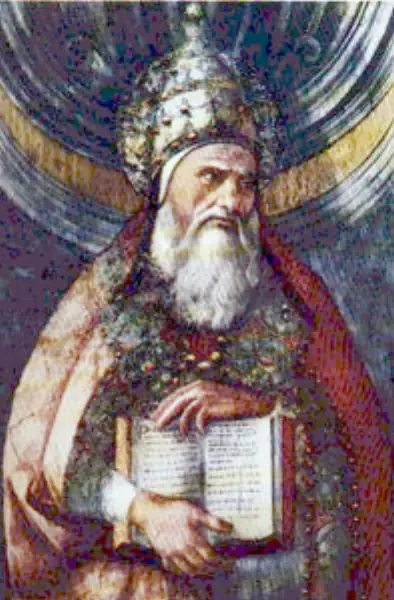
Overview
Pius I was bishop of Rome from about 140 until his death around 154, reckoned by the Annuario Pontificio — though other lists give 142 or 146 to 157 or 161 — and held by tradition to be the ninth successor of Saint Peter. He was born at Aquileia in northern Italy in the late first century, the son of an Italian called Rufinus, and the second-century Muratorian Canon and the Liberian Catalogue identify him as the brother of Hermas, the freedman or low-born plebeian who wrote The Shepherd of Hermas. His pontificate fell under the emperors Antoninus Pius and Marcus Aurelius, a generations of relative peace that also let strange doctrines travel freely: tradition holds that Pius opposed the Valentinians and the Gnostics, and that the heretics Valentinus, Cerdon, and Marcion all came to Rome in his day and were excommunicated by him — a fact Catholic apologists cite as evidence of the Roman see's primacy in the second century. He is credited with decreeing that Easter should be kept only on a Sunday and with building one of Rome's oldest churches, Santa Pudenziana. Justin Martyr taught openly in the city during his episcopate. An old conjecture made Pius a martyr, and the Tridentine Breviary said so, but the study behind the 1969 calendar reform found no grounds for it, and the current Roman Martyrology does not present him as one. His feast is kept on 11 July.
The Complete Life
A Brother of Aquileia
Pius came from Aquileia, the great city at the head of the Adriatic in northern Italy, where he was born late in the first century. His father was an Italian named Rufinus, whom the Liber Pontificalis also calls a native of Aquileia, and the family appears to have moved in the modest ranks of Roman society rather than among the great. The oldest witnesses bind Pius to a remarkable sibling: the second-century Muratorian Canon and the Liberian Catalogue both identify him as the brother of Hermas, author of The Shepherd of Hermas, one of the most beloved Christian writings of the age. Hermas describes himself in that book as a former slave, which has led scholars to wonder whether both brothers were freedmen; but others caution that a claim to servile origin may simply mark a family of low-ranking plebeian standing, respectable but undistinguished. Either way, the picture is striking — from a household of no rank in a provincial town came two men, one whose vision literature would circle the churches of the empire, and one whom the Roman church would choose as its bishop. By the middle of the second century Pius stood at the head of a community that gathered in the houses of the city under the eyes of the imperial authorities, successor in the ninth degree to the fisherman of Galilee, in an age when the memories of the apostles were still near enough to touch.
§ Early life
Bishop in the Age of Antoninus
Catholic tradition places Pius's governance of the Roman church in the middle of the second century, under the emperors Antoninus Pius and Marcus Aurelius. These were years of quiet for the persecuted: the state did not seek out Christians, though the law against them stood ready, and the community could grow, argue, and build. Pius succeeded Hyginus in the episcopate around the year 140 — the Annuario Pontificio gives his term as c. 140 to c. 154, while other authorities list 142 or 146 down to 157 or 161 — and he led a church still learning to define itself. It was an age when the Christian message attracted philosophers as readily as slaves, and with the philosophers came systems that cut the faith's heart out while keeping its language. Rome drew them all, as the capital drew everything. During Pius's episcopate Justin Martyr himself taught Christian doctrine openly in the city, a public intellectual defence of the faith conducted under the bishop's watch. The tradition also credits Pius with practical and liturgical care: a decree that Easter, the feast of feasts, should be kept only on a Sunday, fixing the day of resurrection as the sole fitting date; and the raising of one of Rome's oldest churches, Santa Pudenziana, upon the spot where the household of Pudens was said to have sheltered Peter. A later legend that he ordered the publication of the Liber Pontificalis cannot stand, for that book was not begun before the sixth century.
§ Pontificate
Guardian Against the Gnostics
The defining work of Pius's pontificate was the defence of the apostolic faith against the first great internal crisis of the Church. In his day the heretics came to Rome themselves: Valentinus, the brilliant Egyptian whose gnostic mythology of aeons and pleromas threatened to remake Christianity into a mystery cult for the spiritual elite; Cerdon, who taught that the God of the Old Testament could not be the Father of Jesus Christ; and Marcion, Cerdon's more famous successor, who rejected the whole Hebrew inheritance and mutilated the Gospel to match. Tradition holds that Pius opposed the Valentinians and the Gnostics, and that he excommunicated both groups — a decisive act of discipline by which the Roman church declared that these teachers stood outside the faith they claimed to purify. Catholic apologists have seen in that episode an argument for the primacy of the Roman see in the second century: the bishop of the apostles' city judging, and his judgement counting, in a controversy that touched the whole Christian world. The irony of the age is that the same Rome harboured Justin's orthodox philosophy and the gnostics' counterfeit at once, and it fell to the bishop to tell them apart. That Pius did so, and that the church of his city emerged with its confession of the Creator and Redeemer intact, is the achievement on which his memory chiefly rests.
§ Pontificate
Death, and a Martyr's Crown Withdrawn
Pius died at Rome around the year 154, after some fourteen years as bishop, and was succeeded by Anicetus. Very early the Christians of Rome appear to have wondered whether he had died a martyr, and the conjecture took deep root: it entered the older editions of the Roman Breviary, and in the Tridentine calendar his feast of 11 July was kept with the rank of Simple and celebrated expressly as the feast of a martyr. The modern Church has weighed that tradition and declined it. The study that stood behind the 1969 reform of the General Roman Calendar declared flatly that no grounds existed for considering Pius a martyr, and the current Roman Martyrology does not present him as one. His feast was progressively simplified — reduced to a Commemoration in the calendars of 1955 and 1960 — and it survives today as an optional memorial on 11 July. The withdrawal of the martyr's crown is not a diminishment of the man. It restores him to the company of bishops who shepherded the Church through danger without shedding blood, who held the line of doctrine against teachers more clever than faithful, and whose sanctity lay in fidelity. Both the Catholic Church and the Eastern Orthodox Church keep his memory with honour as a saint of the undivided early Church.
§ Pontificate
Saint of the Undivided Church
Pius belongs to the earliest generation of bishops of Rome, honoured before any process of canonization existed. the Eastern Orthodox Church and the Catholic Church alike number him among the saints, sharing a common feast on 11 July — a rare point of convergence for churches otherwise divided over the very primacy his episcopate is cited to support. The history of his liturgical observance tracks the Church's deepening historical conscience. In the Tridentine calendar his day was a Simple feast of a martyr; the reforms of the twentieth century lowered its rank, first to a Commemoration under Pius XII in 1955 and in the calendar of 1960; and the great reform of 1969, having examined the evidence, removed the martyr title altogether, a judgement reflected in the Roman Martyrology of 2004. What remains is older and more certain than the legend it displaced: a bishop of the second century, brother of the author of The Shepherd, successor of Peter in the ninth degree, who kept the Easter feast on the Lord's day, raised one of Rome's first churches over the memories of the apostolic age, and excommunicated the teachers who would have unmade the faith. His name appears in every list of the popes, from the Liberian Catalogue to the Annuario Pontificio of our own day, and churches as far away as Zollstock in Germany are dedicated under his invocation.
§ Feast day
Timeline
- 140
Begins his pontificate as bishop of Rome, according to the Annuario Pontificio
§ Pontificate
- 154
Dies at Rome after roughly fourteen years as bishop
§ Pontificate
- 1955
His feast is reduced to a Commemoration in the General Roman Calendar of Pope Pius XII, and again in that of 1960
§ Feast day
- 1969
The study behind the revised General Roman Calendar finds no grounds for considering him a martyr
§ Pontificate
The Record
- Major works
- Decree that Easter should be kept only on a Sunday·Building of the church of Santa Pudenziana, among the oldest in Rome·Traditional attribution of the ordering of the Liber Pontificalis, though that work was not actually begun before the sixth century
- Canonization
- Pre-congregation: venerated from antiquity by the Catholic Church and the Eastern Orthodox Church; the martyrdom once conjectured for him is no longer affirmed
Prayer
Bibliography
Show 8 sources
- Herbermann, Charles, ed. "Pope St. Pius I", Catholic Encyclopedia. New York: Robert Appleton Company, 1913.
- Annuario Pontificio per L'anno 2012. Vatican City, 2012, p. 8. ISBN 978-88-209-8722-0.
- Hoever, Hugo, ed. Lives of the Saints, For Every Day of the Year. New York: Catholic Book Publishing, 1955, p. 263.
- Platina. D'Elia, Anthony F. (ed.). Lives of the Popes: Antiquity, Volume 1. Harvard University Press, 2008, p. 79. ISBN 978-0674028197.
- Catholic University of America. New Catholic Encyclopedia, Volume 11. New York: McGraw-Hill, 1967, p. 393.
- Levillain, Philippe. Dictionnaire historique de la papauté. Fayard, 1994, pp. 1042–1043.
- Calendarium Romanum. Libreria Editrice Vaticana, 1969, p. 129.
- Martyrologium Romanum. Typis Vaticanis, 2004. ISBN 88-209-7210-7.
Profile text adapted from the Wikipedia article, licensed CC BY-SA 4.0.
Pray with this saint every day
Save St. Pius I to your favorites, read the full profile, and get feast-day reminders in the Saints app.
Get the Saints AppFree on the App Store for iPhone and iPad