
1504 – 1572·Feast April 30
St. Pius V
Dominican pope of Trent and Lepanto
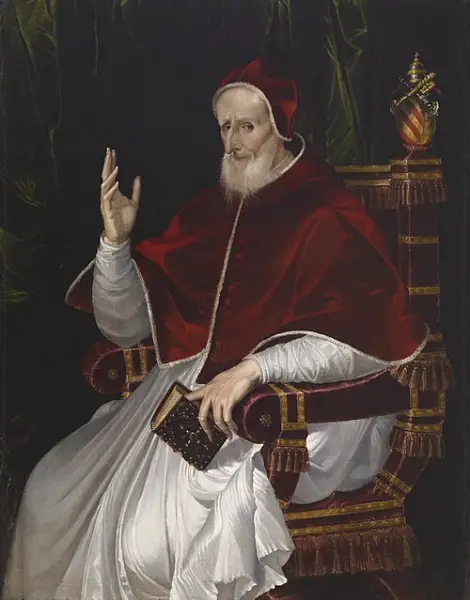
Overview
Pius V, born Antonio Ghislieri and from 1518 known as Michele Ghislieri, was head of the Catholic Church and ruler of the Papal States from 7 January 1566 until his death on 1 May 1572. A Dominican friar from Bosco in the Duchy of Milan, he entered the order at fourteen, lectured for sixteen years at Pavia, and rose through the inquisitorial machinery of the age — commissary of the Holy Office, bishop of Sutri, cardinal, and grand inquisitor — building a reputation for placing orthodoxy above personalities even at the cost of offending popes. Elected with the backing of Cardinal Charles Borromeo, he brought the austerity of his order into the papal court: he cut its expenses, dismissed the court jester, compelled clerical residence, and enforced the decrees of the Council of Trent with unflinching rigour. He standardized the Roman Rite in the 1570 Missal that gave the Tridentine Mass its name, declared Thomas Aquinas a Doctor of the Church and printed his works, founded the Congregation of the Index, excommunicated Elizabeth I of England by the bull Regnans in Excelsis, and forged the Holy League whose fleet, outnumbered, destroyed the Ottoman armada at Lepanto on 7 October 1571 — a victory he ascribed to the Virgin's intercession. Ascetic to the end, worn out by fasting and bladder stones, he died at Rome in 1572. Clement X beatified him in 1672 and Clement XI canonized him in 1712.
The Complete Life
The Shepherd Boy of Bosco
Antonio Ghislieri was born on 17 January 1504 at Bosco in the Duchy of Milan — the town now called Bosco Marengo, in the Piedmontese province of Alessandria — to Paolo Ghislieri and Domenica Augeri, a family of modest means in the hill country of southern Piedmont. At fourteen the boy left home for the Dominican Order, taking the religious name Michele, and passed through the priories of Voghera and Vigevano to Bologna, formed in the order's strict tradition of study, preaching, and poverty. He was ordained a priest at Genoa in 1528 and sent by his superiors to Pavia, where for sixteen years he lectured; at Parma he put forward thirty propositions defending the papacy and attacking the Protestant novelties then splitting the Church. Within his order he served as master of novices and was repeatedly elected prior, and in an age of notorious moral laxity he insisted on discipline and laboured to restore the practice of the monastic virtues. His own life was the argument for his reforms: he fasted, did penance, passed much of the night in meditation and prayer, and went about on foot without a cloak, keeping deep silence or speaking with his companions only of the things of God. Such zeal provoked resentment, and in 1550 his enemies forced his return to Rome — where the Church's need of exactly such men placed him, after several inquisitorial missions, in the commissariat of the Holy Office.
§ Early life
Inquisitor, Bishop, Cardinal
Rome confirmed what the priories had known: Michele Ghislieri was a man for the Church's hardest work. Paul IV made him Bishop of Sutri in 1556, then chosen as inquisitor of the faith for Milan and Lombardy; on 15 March 1557 came the cardinal's hat and the office of inquisitor general for all Christendom. Even as grand inquisitor he refused to be merely a hammer: his defence of Bartolomé Carranza, Archbishop of Toledo, whom the Spanish Inquisition suspected of heresy, brought a papal reprimand down on him — evidence that orthodoxy, not personalities, governed his judgements. Under Pius IV he became Bishop of Mondovì in Piedmont, and his unflinching zeal followed him to Rome whenever he was consulted. As a cardinal he prosecuted eight French bishops for heresy, and when Pius IV wished to make a cardinal of thirteen-year-old Ferdinand de' Medici and pension a nephew out of the papal treasury, Ghislieri rebuked the pontiff to his face; the reward was dismissal from the palace and limits on his authority as inquisitor. Pius IV died before the bishop could return to his diocese. In the conclave that followed, a courier from Spain arrived with rumours that King Philip II favoured Ghislieri's election, and Cardinal Charles Borromeo and his allies pressed the candidacy. The votes gathered steadily, and on the afternoon of 8 January 1566 the friar from Bosco was elected pope, taking the name Pius V and receiving the crown ten days later, on his sixty-second birthday.
§ Papal election
The Front Lines of Christendom
Pius V inherited a Christendom breaking apart: Protestantism had overrun England and Scotland, held half of Germany, the Netherlands, and swaths of France. Spain, Ireland, Portugal, and Italy alone held firm; behind the eastern frontier the Ottoman armies advanced. His response was the Counter-Reformation in action. He pressed the decrees of the Council of Trent into law and life, dispatched the Jesuit Vincenzo Lauro as nuncio to press Mary, Queen of Scots, to bring Catholicism back to her realm, and in France, where his influence ran strongest, secured the dismissal of Cardinal Odet de Coligny and seven bishops, nullified the edict tolerating the Reformers' extramural services, and opposed all compromise with the Huguenot nobility. Against Elizabeth I, who had assumed the supreme governorship of the Church of England and persecuted her Catholic subjects, he supported the imprisoned Queen of Scots and, after the failure of the Rising of the North, issued on 27 April 1570 the bull Regnans in Excelsis, declaring Elizabeth a heretic and releasing her subjects from allegiance — a sentence that provoked, rather than prevented, harsher persecution. Against the Turk he built the Holy League, an alliance of Catholic states, and its combined fleet under Don John of Austria, outnumbered, annihilated the Ottoman armada at Lepanto on 7 October 1571. To the Virgin he gave the glory, instituting the feast of Our Lady of Victory in thanksgiving.
§ Pontificate
A Monastery Would-Be City
Pius V governed as a friar, and Romans felt it. Among his first acts was the dismissal of the papal court jester — no pope since has employed one — and he forbade the horse races in St. Peter's Square, cut the court's expenses after the Dominican manner, and imposed severe sanctions against blasphemy, adultery, and sodomy. The Romans hated him for it, accusing him of trying to turn their city into a vast monastery; the charge was unjust only in its tone, for the pope's severity was directed at disorder, not at the poor. He planned distributions of alms, imported cheap grain in time of famine, and broke the power of hired killers and brigands — part, as one historian describes it, of a programme aimed at restoring Rome as the ideal city of the Church. He even ordered public works to better the water supply and sewers, mercy of a practical kind in the low quarters where typhoid and malaria came with every summer. Hypocrisy was the one vice no one laid at his door: beneath the plain habit of a Dominican he wore a hair shirt, he was often seen in bare feet, and the fasting and serving of his last years wore him toward death. The psalm verse he chose as his motto and kept asked only that his ways be directed to keep thy justifications. The famous white of the papal wardrobe, long credited to his refusal to change out of his Dominican habit, in fact predates him; but the legend endures because it fits the man.
§ Character and policy
Dying in the Habit of St. Dominic
The last years of the pontificate consumed its owner. Pius had always been ascetic, and he added to fasting an unrelenting labour — the Missal, the breviary, the Index, the League, the endless bulls — until, as the sources say, great weakness overtook him. He suffered from bladder stones and refused the operation that might have relieved him; after his death on 1 May 1572, three stones were found in his bladder, the silent testimony of years of endured pain. He died at Rome at sixty-eight, having reigned barely six years, and was laid to rest in the S. Andrea chapel, close by the tomb of Pius III in the Vatican. His will had asked for burial at Bosco, the village of his birth, but Rome was not done with him: Pope Sixtus V, whom Pius himself had made a cardinal, erected a monument in Santa Maria Maggiore's chapel of SS. Sacramento, and on 9 January 1588 the pope's remains were transferred there. Two centuries of investigation into his life and virtues followed — the Master of the Dominican Order, Antonin Cloche, began the process in 1696 and commissioned from Pierre Le Gros the Younger the splendid tomb in Santa Maria Maggiore's Sistine Chapel, into which the body was placed in 1698. Its gilded bronze lid, showing the dead pope's likeness, is customarily left open for the veneration of his relics.
§ Death and canonization
The Altars of Clement XI
The Church moved formally and slowly toward the sanctity everyone had long assumed. Clement X beatified Pius V on 1 May 1672, the anniversary of his death, in St. Peter's Basilica; Clement XI completed the work, canonizing him on 22 May 1712 in the same basilica. In the following year the new saint's feast entered the General Roman Calendar on 5 May, ranked as a Double; the reforms of the twentieth century lowered its rank and in 1969 moved the celebration to 30 April, the vigil of his death day, where the calendar now keeps him as a memorial. The holiness thus ratified had been visible from the first: his canonization process formally recorded among its proofs the marvel by which, at the hour Lepanto was won, the pope in Rome knew of the victory while it still hung in the balance far off at sea. Judgements of the man have always held his severity and his sanctity together. Cardinal Newman, no flatterer of inquisitors, wrote that stern and severe though Pius was, a heart burning with divine love underlay it all, and that such energy was necessary in a time of insurrection, when in a spiritual sense the whole Church lay under martial law. The Catholic Church has accepted that verdict, enrolling among its saints the Dominican who wore the tiara as though it were a habit.
§ Death and canonization
The Mass, the Doctor, and the Rosary
Pius V's monuments are liturgical, doctrinal, and naval at once. Implementing the Council of Trent, he promulgated the Roman Missal of 1570 and made it mandatory throughout the Latin Church except where a liturgy older than 1370 could be shown; that form of the Mass then stood essentially frozen for four full centuries, until Paul VI's reform in 1969–70, and is known to this day as the Tridentine Mass. In 1567 he declared Thomas Aquinas the fifth Doctor of the Church and commissioned the first edition of the Angelic Doctor's complete works, the editio Piana, printed in 1570 at the Dominican studium of Santa Maria sopra Minerva — the house that grew into the College of Saint Thomas and, in the twentieth century, the Pontifical University of Saint Thomas Aquinas. He created the Congregation of the Index in 1571, reformed the breviary, enforced the canonical hours, and canonized Ivo of Chartres. The Holy League's victory at Lepanto on 7 October 1571 checked the Ottoman advance in the Mediterranean, and the feast of Our Lady of Victory, founded in thanksgiving, carried the rosary into the Church's annual memory. Malta remembers him as a father: he helped finance the building of Valletta and sent his military engineer Francesco Laparelli to design its fortifications, where a bronze bust has stood at the city gate since 1892 — one of many places, from Bosco Marengo to Pietrelcina, that keep his patronage.
§ Thomism
Timeline
- 17 Jan 1504
Born Antonio Ghislieri at Bosco in the Duchy of Milan, son of Paolo Ghislieri and Domenica Augeri
§ Early life
- 1518
Enters the Dominican Order at fourteen, taking the name Michele
§ Early life
- 1528
Ordained a priest at Genoa, then sent to lecture at Pavia for sixteen years
§ Early life
- 1550
Driven back to Rome by resentment of his reformist zeal and appointed to the commissariat of the Holy Office
§ Early life
- 1556
Made Bishop of Sutri by Pope Paul IV and picked as faith-inquisitor for Milan and Lombardy
§ Early life
- 15 Mar 1557
Created cardinal by Paul IV and named inquisitor general for all Christendom
§ Early life
- 1560
Appointed Bishop of Mondovì in Piedmont under Pope Pius IV
§ Early life
- 8 Jan 1566
Elected pope in the afternoon conclave and takes the name Pius V; crowned ten days later on his sixty-second birthday
§ Papal election
- 1567
Declares Thomas Aquinas the fifth Doctor of the Church and issues the bull prohibiting bullfighting
§ Pontificate
- Jul 1568
Reforms the Roman Breviary by papal bull
§ Papal bulls
- 1569
Orders the Jews expelled from every ecclesiastical dominion apart from Rome and Ancona
§ Papal bulls
- 27 Apr 1570
Issues Regnans in Excelsis, declaring Elizabeth I of England a heretic and absolving her subjects of allegiance
§ Elizabeth I
- 18 Dec 1570
Canonizes Ivo of Chartres, the one saint raised to the altars in his reign
§ Canonizations
- Mar 1571
Establishes the Congregation of the Index, formalizing the censorship of books judged heretical or immoral
§ Church discipline
- 7 Oct 1571
The Holy League fleet under Don John of Austria destroys the Ottoman armada at Lepanto; Pius, in Rome, attributes the victory to Our Lady's intercession
§ Holy League
- 1 May 1572
Dies at Rome aged sixty-eight, worn by fasting and bladder stones; buried in the Vatican chapel of S. Andrea
§ Death and canonization
- 9 Jan 1588
Remains transferred to the monument built by Sixtus V in the chapel of SS. Sacramento in Santa Maria Maggiore
§ Death and canonization
- 1 May 1672
Beatified by Pope Clement X in St. Peter's Basilica
§ Death and canonization
- 1698
Body placed in the tomb sculpted by Pierre Le Gros the Younger in the Sistine Chapel of Santa Maria Maggiore
§ Death and canonization
- 22 May 1712
Canonized by Pope Clement XI at St. Peter's Basilica
§ Death and canonization
- 1713
His feast inserted into the General Roman Calendar for 5 May with the rank of Double
§ Death and canonization
- 1969
Celebration transferred to 30 April, its date now the eve of his death day
§ Death and canonization
In Their Own Words
A truce to business; our great task at present is to thank God for the victory which He has just given the Christian army.
St. Pius V was stern and severe, as far as a heart burning and melted with divine love could be so ... Yet such energy and vigour as his were necessary for the times. He was a soldier of Christ in a time of insurrection and rebellion, when in a spiritual sense, martial law was proclaimed.
The Record
- Major works
- Roman Missal of 1570, standardizing the Mass of the Latin Church (the Tridentine Mass)·Editio Piana, the first printed edition of Aquinas' opera omnia, produced at Santa Maria sopra Minerva in 1570·Bull Regnans in Excelsis (1570), excommunicating Elizabeth I of England·Bull Super prohibitione agitationis Taurorum & Ferarum (1567), prohibiting bullfighting·Reform of the Roman Breviary (1568) and enforcement of the daily recitation of the Canonical Hours (1571)·Congregation of the Index, created March 1571·Feast of Our Lady of Victory, instituted to commemorate Lepanto·Creation of 21 cardinals in three consistories, among them the future Sixtus V
- Patron of
- Malta·Valletta·Bosco Marengo·Pietrelcina·Roccaforte Mondovì·Diocese of Alessandria·Urbiztondo, Pangasinan
- Symbols
- Dominican habit·papal vestments·papal tiara·crucifix·book
- Canonization
- Beatified by Pope Clement X on 1 May 1672; canonized by Pope Clement XI on 22 May 1712 at St. Peter's Basilica
Prayer
Bibliography
Show 8 sources
- Lataste, Joseph. "Pope St. Pius V", The Catholic Encyclopedia, Vol. 12. New York: Robert Appleton Company, 1911.
- Durant, William; Durant, Ethel. Age of Reason Begins, The Story of Civilisation, vol. 7. Simon & Schuster, 1961, pp. 238–239.
- Braudel, Fernand. The Mediterranean and the Mediterranean World in the Age of Philip II, Vol. 2. University of California Press, 1995, p. 1027. ISBN 978-0-520-20330-3.
- Anderson, Robin. St. Pius V: A Brief History of His Life, Times, Virtues and Miracles. Rockford, IL: TAN, 1978. ISBN 978-0-89555-068-2.
- Kelly, John Norman Davidson. A Dictionary of Popes (2nd ed.). Oxford University Press, 2010, p. 271. ISBN 9780199295814.
- Mendham, Joseph. The life and pontificate of Saint Pius the Fifth. London: J. Duncan, 1832.
- Mullett, Michael. The Catholic Reformation. Routledge, 1999, p. 113. ISBN 0415189152.
- Rinne, Katherine. Waters of Rome. Yale University Press, 2001. ISBN 978-0-300-15530-3.
Profile text adapted from the Wikipedia article, licensed CC BY-SA 4.0.
Pray with this saint every day
Save St. Pius V to your favorites, read the full profile, and get feast-day reminders in the Saints app.
Get the Saints AppFree on the App Store for iPhone and iPad