
1835 – 1914·Feast August 21
St. Pius X
Pope of the Eucharist and frequent Communion
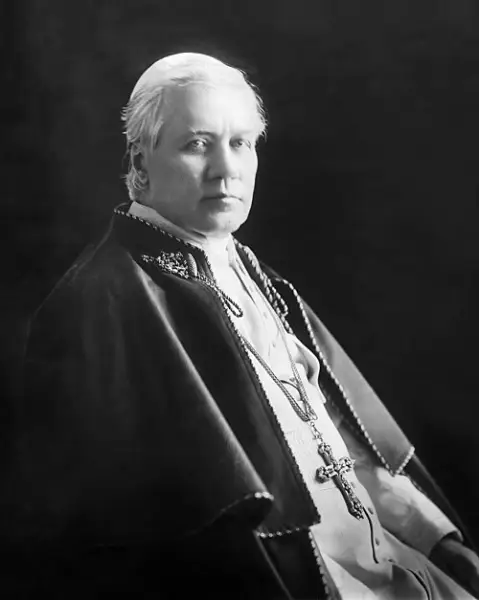
Overview
Pius X — in baptism Giuseppe Melchiorre Sarto — led the Catholic Church from 4 August 1903 to 20 August 1914, and one of the most consequential reformers ever to hold the office. The second of ten children of the village postman of Riese in the Austrian Empire's Venetian lands, he rose through country parishes — chaplain of Tombolo, archpriest of Salzano, chancellor of Treviso — to become bishop of Mantua, Patriarch of Venice, cardinal, and finally pope, elected after the Austro-Hungarian veto against Cardinal Rampolla. His motto, Instaurare omnia in Christo, to restore all things in Christ, governed everything he did. He launched the Liturgical Movement with Tra le sollecitudini and its principle of active participation, restored Gregorian chant, reformed the Breviary, and encouraged frequent and early Communion, lowering the age of First Communion to seven — devotion that earned him the title Pope of the Eucharist. He mandated a catechism class in every parish, commissioned the first Code of Canon Law, reformed the Roman Curia, and opposed modernism with decrees, an encyclical, and a compulsory oath. Plain in life and famously poor — he filled the Apostolic Palace with refugees after the Messina earthquake — he refused every favour to his family. Stricken as war broke out in 1914, he died mournful at the spectacle of Europe; Pius XII beatified him in 1951 and canonized him in 1954.
The Complete Life
The Postman's Son of Riese
Giuseppe Melchiorre Sarto was born on 2 June 1835 at Riese, a village in the Venetian mainland then belonging to the Kingdom of Lombardy–Venetia under the Austrian crown, the second of the ten children of Giovanni Battista Sarto, the village postman, and Margherita Sanson. The family was poor, but the parents prized learning, and the boy thought nothing of walking six kilometres to school each day, hearing Mass before breakfast during the years he trekked onward to the gymnasium at Castelfranco Veneto. He was an altar boy, an excellent student who finished his homework before his games, and a child who ended his evenings with ten minutes of prayer. At twelve he had exhausted the village school; at fifteen he received the tonsure, and his parish priest wrote to the Cardinal of Venice to win him a scholarship to the seminary of Padua, where he completed the classical, philosophical, and theological course with distinction. Ordained a priest on 18 September 1858 by Giovanni Antonio Farina, he was sent as chaplain to Tombolo, where he studied Aquinas and canon law under the ailing pastor he served, submitted his first sermons to that priest's blunt criticism, and earned such a name for holiness that the people simply called him Don Sarto. In 1867 he became archpriest of Salzano, rebuilding the church and expanding the hospital with funds he begged himself, and winning hearts forever by nursing the sick through the cholera years.
§ Early life and ministry
From Treviso to the Throne of Venice
Advancement found the country priest reluctantly. Made a canon of the cathedral and chancellor for the Diocese of Treviso in 1875, he also served as spiritual director of its seminary and examiner of the clergy, and as chancellor he opened religious instruction to the children of the public schools. When Bishop Zinelli died in 1879, the diocese chose Sarto as vicar capitular, and he taught dogmatic and moral theology until a successor arrived. On 10 November 1884 Leo XIII appointed him Bishop of Mantua; because he held no doctorate, a papal dispensation was required for his consecration — the last pope without a degree until Francis. Consecrated in Rome six days after the appointment, he hurried home first to his mother, who kissed his ring and told him: you would not have that fine ring, my son, had I not had this — and showed her wedding band. In 1893 came the double honour he dreaded: created cardinal in a secret consistory on 12 June and named Patriarch of Venice in the public one three days later. The Italian government's claim to nominate the patriarch stalled the appointment for a year, and Sarto confessed to a newspaper only that he felt anxious, terrified, humiliated. On the eve of departure for Venice he sought out his mother once more; she asked a last blessing, sensing they would not meet again. Enthroned on 24 November 1894, he shunned politics, built up the parochial credit unions, and preached obedience to the Pope in his first pastoral letter.
§ Cardinalate and patriarchate
A Conclave and a Veto
Leo XIII died on 20 July 1903, praising to the composer Perosi his conviction that the Patriarch of Venice would be his successor. Sarto wanted nothing of it — he had said he would rather be dead than pope, and when a French cardinal told him that a pope must speak French, he answered: Deo Gratias — I have no wish to be pope. The conclave nonetheless began with Cardinal Mariano Rampolla, the dead pope's secretary of state, as clear favourite, and the early ballots bore this out. Then, on the third day, the Polish cardinal Jan Puzyna de Kosielsko rose in the name of Emperor Franz Joseph of Austria-Hungary to proclaim a veto against Rampolla under the ancient jus exclusivae — a formal exclusion no future conclave would ever tolerate again. The assembly was scandalised; Sarto, saddened to the depths, reportedly vowed to excommunicate anyone who attempted such a veto hereafter. The votes migrated to the Venetian, and on 4 August 1903, after five ballots, he was elected. He declined at first, pleading unworthiness, then withdrew to the Pauline Chapel, prayed, and accepted. Cardinal Luigi Macchi announced the choice shortly after noon. He took the name Pius X in honour of the suffering popes of that name — as I shall suffer, he said, let me bear the name of popes who suffered likewise — and the coronation came on Sunday 9 August 1903.
§ Papal election of 1903
Restoring All Things in Christ
The programme of the pontificate was announced in its first days: Instaurare omnia in Christo, to restore all things in Christ. The first encyclical, E supremi apostolatus of 4 October 1903, declared the policy in a sentence — we champion the authority of God. But the restoration Pius sought began in the sanctuary and the pulpit rather than the chancellery. Within three months of his coronation came the motu proprio Tra le sollecitudini, which reclaimed Gregorian chant from the theatrical music that had buried it and formulated the principle of participatio actuosa, the active participation of the faithful in the liturgy — the seed of the twentieth century's liturgical renewal. The Eucharist stood at the centre of everything: he urged frequent Communion, extended it to children reaching the age of discretion, and in 1910 by the decree Quam singulari lowered First Communion from age twelve to seven, answering his critics only with Jesus's own words: let the little children come to me. He reformed the Breviary, mandated the Confraternity of Christian Doctrine in every parish, taught catechism to the children of Rome in the San Damaso courtyard with candy in his pockets, and published the plain, brief Catechism of Pius X. His Mariology flowered in the encyclical Ad diem illum; his personal devotion belonged to Our Lady of Confidence. For all this he is remembered as the Pope of the Blessed Sacrament.
§ Liturgical reforms and communion
The Pope Who Could Not Stay the Slaughter
In 1913 Pius suffered a heart attack, and from then on he lived in the shadow of failing health. On the feast of the Assumption, 15 August 1914, he fell ill with a fever and lung complications — and the world conspired with his weakness. The July crisis had ignited the Great War, and the report of nation after nation mobilising, culminating in the German march into Brussels, sank the seventy-nine-year-old pope into melancholy. Alarming symptoms came on 19 August; through that day he drifted in and out of consciousness, and waking he spoke the sentence that has fixed his death in memory: that in an age long past a pope's word could have stayed the slaughter, but that now he stood impotent. Last Rites were administered; an old bronchial infection returned and turned to pneumonia. His last act was to kiss the little crucifix clasped in his hands, and a few minutes past one in the morning of 20 August 1914 he died, his sister Anna praying at the bedside, only hours after the Jesuit general Franz Xavier Wernz had died. In a moment of lucidity he had said the Almighty wished to spare him the horrors Europe was undergoing. Laid in state in red pontifical vestments, he was buried in a simple, unadorned tomb in the crypt of St. Peter's, its stone inscribed: poor yet rich, lowly and humble of heart, an unconquerable champion of Catholic faith.
§ Death and burial
First Canonized Pope in Two Centuries
Devotion to the dead pope began almost at once. Pilgrims pressed toward the plain crypt tomb until a small metal cross had to be set into the basilica floor reading Pius Papa X, so the faithful could kneel directly above him; a bishop's letter of 1916 already called him a great saint and a great pope. The formal cause opened on the twentieth anniversary of his accession in 1923, and on 12 February 1943 he was declared Venerable, having practiced heroic virtues. On 19 May 1944 his coffin was opened for examination and the body was found remarkably well preserved — he had forbidden the embalmers' customary removal of organs, and had not been embalmed at all. Two cures carried him to beatification: the nun Marie-Françoise Deperras, cured of bone cancer in 1928 during a novena with a relic, and the nun Benedetta De Maria, cured of cancer in a novena begun in 1938. Pius XII approved both on 11 February 1951 and beatified him on 3 June that year before 100,000 people, styling him Pope of the Eucharist. Two further cures — the Neapolitan attorney Francesco Belsami and the nun Maria Ludovica Scorcia — opened the way to canonization on 29 May 1954 before a crowd of 800,000, making Pius X the first pope canonized since Pius V in 1712. His body rests in a glass and bronze sarcophagus beneath the altar of the Chapel of the Presentation.
§ Canonization
The Law, the Curia, and the Children
Pius X left the institutional Church reshaped as thoroughly as he left its worship. Canon law until his day varied from region to region; on 19 March 1904 he named a commission of cardinals — among them the future Benedict XV and Pius XII — to draft a single universal code, and the 1917 Code of Canon Law that resulted, promulgated by his successor, remained in force until 1983. He reorganised the Roman Curia by the constitution Sapienti consilio of 1908, raised the standard of seminary education, and elevated the College of St. Thomas to the rank that became the Angelicum. Against modernism he waged the campaign that defines him in controversy: the decrees of 1907, the encyclical Pascendi branding modernism the synthesis of all heresies, the compulsory Anti-Modernist oath — and, more darkly, the network of informants of the Sodalitium Pianum, whose excesses history has not excused. His name was later taken by Marcel Lefebvre's Society of Saint Pius X, though the saint never knew it. His political battles with France and the Italian state were uncompromising, yet to the United States he showed breadth, lifting it out of missionary status in 1908 and creating fifteen American dioceses. He beatified Joan of Arc and John Vianney, canonized four saints, created fifty cardinals, and founded the World Day of Migrants — the postman's son keeping faith with the wanderers. His birthplace renamed itself Riese Pio X.
§ Reform of canon law
Timeline
- 2 Jun 1835
Born at Riese in the Kingdom of Lombardy–Venetia, Austrian Empire, son of the village postman Giovanni Battista Sarto
§ Early life and ministry
- 1850
Receives the tonsure and wins a scholarship to the seminary of Padua
§ Early life and ministry
- 18 Sep 1858
Ordained a priest at Treviso by Bishop Giovanni Antonio Farina and made chaplain of Tombolo
§ Early life and ministry
- 1867
Named archpriest of Salzano, later tending the sick through the cholera outbreak of the early 1870s
§ Early life and ministry
- 1875
Made a canon of the cathedral and named chancellor of the diocese of Treviso
§ Early life and ministry
- 10 Nov 1884
Appointed Bishop of Mantua by Leo XIII; consecrated six days later in Rome by Cardinal Lucido Parocchi
§ Early life and ministry
- 12 Jun 1893
Created cardinal by Leo XIII, who three days later appoints him Patriarch of Venice
§ Cardinalate and patriarchate
- 24 Nov 1894
Formally enthroned as Patriarch of Venice after the Italian government's objections were settled
§ Cardinalate and patriarchate
- 4 Aug 1903
Elected pope in a conclave disrupted by the Austro-Hungarian veto against Cardinal Rampolla; crowned 9 August
§ Papal election of 1903
- 4 Oct 1903
Issues his first encyclical, E supremi apostolatus, dedicating his reign to restoring all things in Christ
§ Pontificate
- 26 Jan 1904
Receives Theodor Herzl in audience but declines to support the Zionist movement
§ Rejection of Zionism
- 19 Mar 1904
Names a commission of cardinals to draft the first universal Code of Canon Law
§ Reform of canon law
- 1905
Mandates the Confraternity of Christian Doctrine in every parish through the letter Acerbo nimis
§ Catechism of Saint Pius X
- 3 Jul 1907
Condemns 65 modernist propositions in the decree Lamentabili sane exitu, followed by the encyclical Pascendi Dominici gregis
§ Opposition to modernism
- 29 Jun 1908
Reforms the Roman Curia with the Apostolic Constitution Sapienti consilio
§ Reform of Church administration
- 1910
Issues the decree Quam singulari, lowering the age of First Communion from twelve years to seven
§ Liturgical reforms and communion
- 1913
Suffers a heart attack and lives thereafter in the shadow of failing health
§ Death and burial
- 20 Aug 1914
Dies in the Apostolic Palace at 1:20am as German forces march into Brussels and war engulfs Europe
§ Death and burial
- 19 May 1944
Body exhumed for the beatification process and found remarkably incorrupt
§ Exhumation
- 3 Jun 1951
Beatified by Pope Pius XII in St. Peter's Basilica before a crowd of 100,000
§ Canonization
- 29 May 1954
Canonized by Pope Pius XII before some 800,000 faithful, the first pope raised to the altars since Pius V in 1712
§ Canonization
- 1969
His feast, assigned in 1955 to 3 September, is fixed on 21 August in the reformed General Roman Calendar
§ Canonization
In Their Own Words
I have made them sisters of the Pope; what more can I do for them?
Holy Communion is the shortest and safest way to Heaven.
In ancient times, the Pope by a word might have stayed the slaughter, but now he is impotent
Now I begin to think the end is approaching. The Almighty in His inexhaustible goodness wishes to spare me the horrors which Europe is undergoing
The Record
- Major works
- Motu proprio Tra le sollecitudini (1903), restoring Gregorian chant and the active participation of the faithful·Encyclical Ad diem illum (1904) on the Blessed Virgin Mary·Decree Quam singulari (1910), lowering the age of First Communion to seven·Decree Lamentabili sane exitu (1907) and encyclical Pascendi Dominici gregis against modernism·Catechism of Pius X (1908), a plain popular catechism for uniform use·Commission for the 1917 Code of Canon Law, the first comprehensive codification·Apostolic Constitution Sapienti consilio (1908), reforming the Roman Curia·Sixteen encyclicals, including Vehementer nos (1906) against the French separation of Church and state
- Patron of
- catechists·pilgrims·First Communicants·emigrants from Treviso·Patriarchate of Venice·Archdiocese of Atlanta·Diocese of Des Moines·Diocese of Great Falls-Billings·Archdiocese of Kottayam·Diocese of Springfield-Cape Girardeau·Archdiocese of Zamboanga·Santa Luċija, Malta
- Symbols
- instruments of Holy Communion on prayer cards
- Canonization
- Beatified by Pope Pius XII on 3 June 1951 and canonized by him on 29 May 1954 at St. Peter's Basilica — the first pope canonized since Pius V in 1712
Prayer
Bibliography
Show 6 sources
- Kühner, Hans. 1960, p. 183.
- Lortz, Joseph. 1934, §113.
- Sarto. 1904, p. 5.
- "Pope joins faithful at altar of St. Pius X", Vatican Insider, 22 August 2015.
- "hSarto", Araldica vaticana. Retrieved 23 June 2013.
- "Why is St. Pius X the Society's patron?", 25 August 2014.
Profile text adapted from the Wikipedia article, licensed CC BY-SA 4.0.
Pray with this saint every day
Save St. Pius X to your favorites, read the full profile, and get feast-day reminders in the Saints app.
Get the Saints AppFree on the App Store for iPhone and iPad