
c. 650 – 701·Feast 8 September
St. Sergius I
Pope Who Rejected the Quinisext Canons
Overview
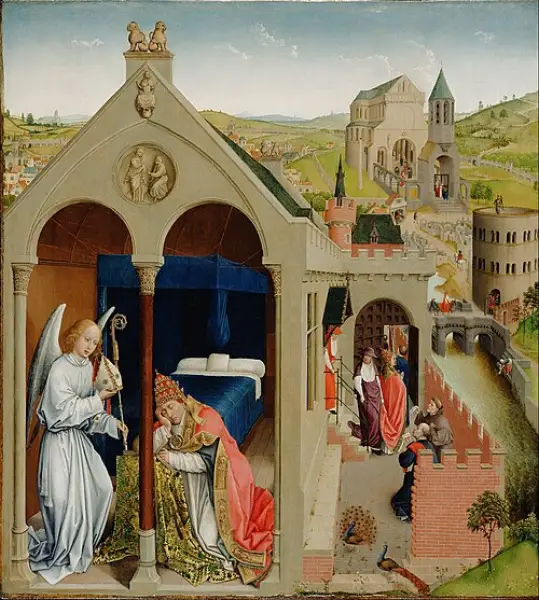
Sergius I, born in Palermus in Sicily around 650 to a family of Antiochene Syrian origin, served as bishop of Rome from 15 December 687 until his death on 8 September 701. The Roman Catholic Church venerates him as a saint. He came to Rome during the pontificate of Adeodatus II, part of the wave of Sicilian clergy who fled the Caliphate's assaults on their island, and in 683 Pope Leo II made him cardinal-priest of Santa Susanna. Elected pope as a compromise after rival factions backing Paschal and Theodore came to armed conflict in the Lateran, he ended the last disputed vacancy of the Byzantine papacy. His pontificate was defined by his firm refusal of the canons of the Quinisext Council of 692, an assembly of the Eastern church whose disciplines he judged contrary to Roman usage. Emperor Justinian II commanded that he be seized and shipped to Constantinople, yet neither the Roman populace nor the Italian troops of the Ravenna exarch would allow their bishop to be carried off. In his own city he baptized the West Saxon king Cædwalla, ordained Willibrord bishop of the Frisians, gave the pallium to Archbishop Berhtwald of Canterbury, healed the schism with Old Aquileia, and introduced the Agnus Dei chant into the Roman Mass.
The Complete Life
A Syrian Family in Sicily
Sergius came into the world around the year 650 at Panormus, the Palermo of today, where his family had settled after leaving its home among the Syrians of Antioch. He grew up as a child of two worlds: Greek-speaking and Eastern in its roots, yet living under Roman rule at the western edge of the Byzantine Empire. Mid-seventh-century Sicily knew the terror of the Caliphate's raids, and like many of his countrymen Sergius eventually left the island for Rome. He arrived there during the pontificate of Adeodatus II, joining the numerous Sicilian clergy who had taken refuge in the city, and he rose steadily through the ranks of the Roman church. On 27 June 683 Pope Leo II ordained him cardinal-priest of the title of Santa Susanna, one of the ancient churches of the city. He held that post for the rest of his pre-papal career, remaining cardinal-priest of Santa Susanna until the day he was chosen for the papal throne itself. The migrant boy from Palermo thus became a fully Roman figure, formed by the liturgy and clergy of the city that would one day entrust him with its highest office.
§ Early life
Elected Out of Chaos
The road to Sergius's election began with the death of Pope Conon on 21 September 687, worn out by sickness after barely a year on the throne. The interregnum at once descended into factional violence. The archdeacon Paschal sought the throne by bribing the exarch of Ravenna, John II Platyn, while a larger party backed the archpriest Theodore. The two factions fought armed battles, each holding part of the Lateran Palace, the residence of the popes. To break the deadlock, the civil authorities, army officers, clergy, and citizens gathered in the Palatine imperial palace and chose Sergius, then stormed the Lateran and compelled the rival candidates to yield. Paschal feigned submission while secretly promising Platyn a fortune in gold for military backing; the exarch came, saw that Sergius had been regularly chosen, demanded his money all the same, and withdrew after the new pope's consecration on 15 December 687. Paschal's plotting ended in confinement to a monastery on a charge of witchcraft. With Sergius's consecration the last disputed vacancy of the Byzantine papacy came to an end, and a compromise candidate born of civic consensus took up the government of the Roman church.
§ Election
Defiance of the Quinisext Council
The defining struggle of Sergius's pontificate came over the Quinisext Council, an assembly of 226 or 227 bishops held in 692 under Byzantine auspices, drawn overwhelmingly from the patriarchate of Constantinople. The council codified Eastern liturgical practice and condemned Western customs: Mass on Lenten weekdays, fasting on Saturdays, the omission of the Alleluia in Lent, and the depiction of Christ as a lamb. Sergius, who had not attended, dismissed its canons as void and vowed that he would sooner face death than approve erroneous novelties; still he stayed a loyal subject of the empire and refused to be its captive in matters of religion. Emperor Justinian II first arrested the papal counsellors, then ordered the pope himself seized by the protospatharios Zacharias and carried to Constantinople; the soldiers of the Ravenna exarch together with the men of Pentapolis blocked the operation, and Zacharias came close to losing his own life. Sergius quelled the uprising rather than exploit it. In his own city he baptized King Cædwalla of Wessex on 10 April 689, ordained Willibrord for the Frisian mission, received Berhtwald of Canterbury, ended the Three Chapters schism with Old Aquileia in 698, founded Santa Maria in Via Lata, and answered the council symbolically by introducing the Agnus Dei into the Mass.
§ Papacy
Death in the Eternal City
Sergius closed his life in the city he had governed for nearly fourteen years. He died in Rome on 8 September 701, at about fifty-one years of age, having led the church through an era in which its ties to Constantinople were strained almost to breaking. He was succeeded by John VI, a pope who inherited both the dignity and the tensions that Sergius's firmness had preserved. The attempt to drag him to the Byzantine capital had been the gravest crisis of his final years, and its failure demonstrated how thoroughly the armies and people of Italy identified their welfare with that of their bishop. He had refused to become a captive in matters of religion, and he died at home, uncondemned and unreplaced by any imperial nominee. The pope who had received an English king into the church, commissioned missionaries to the Low Countries, and reconciled an ancient schism left the Roman see at peace within itself. His death on the feast of the Nativity of the Mother of God fixed his memory in the calendar of the city whose faith he had defended at the risk of his liberty and his life.
§ Death
The Lamb of God Endures
Sergius's most enduring monument is sung at every Mass: the Agnus Dei, the plea that the Lamb of God show mercy and bear away the world's sins, which he inserted at the breaking of the Host. It was a deliberate, symbolically charged answer to the Quinisext Council's prohibition of portraying Christ as a lamb; the pope restored the damaged facade mosaic of the Worship of the Lamb in the atrium of Saint Peter's at the same time, and the chant would have been sung in both Greek and Latin. His buildings shaped the city as well: the diaconia of Santa Maria in Via Lata on the Via del Corso anchored a quarter of Rome that flourished in the following century, and the Eastern church of Santi Cosma e Damiano received his restoration and embellishment. His rejection of the eighty-five Apostolic Canons endorsed at Trullo, which admitted three Maccabees into the biblical canon, remains a standing difference between the Catholic and Orthodox canons to this day. Historians have seen in his stand the first great assertion that the Roman church would answer doctrinal novelty with martyrdom rather than compliance, a precedent his successors would invoke for a thousand years.
§ Papacy
Timeline
- 650
Born at Panormus in Sicily to a family of Antiochene Syrian descent.
§ Early life
- 27 Jun 683
Ordained cardinal-priest of Santa Susanna by Pope Leo II.
§ Early life
- 21 Sep 687
Pope Conon died after a reign of less than a year, opening a disputed vacancy.
§ Election
- 15 Dec 687
Consecrated bishop of Rome after civic leaders, soldiers, and clergy elected him to break the deadlock.
§ Election
- 10 Apr 689
Baptized King Cædwalla of Wessex in Rome.
§ Papacy
- 692
Refused to accept the canons of the Quinisext Council as invalid and unauthorized.
§ Papacy
- 698
Brought an end to the Schism of the Three Chapters with Old Aquileia.
§ Papacy
- 8 Sep 701
Died in Rome and was succeeded by John VI.
§ Death
In Their Own Words
Rather die than consent to erroneous novelties.
The Record
- Major works
- Introduction of the Agnus Dei chant into the Roman Mass·Diaconia of Santa Maria in Via Lata in Rome·Restoration of the church of Santi Cosma e Damiano·Restoration of the facade mosaic of the Worship of the Lamb at Saint Peter's
- Canonization
- Pre-congregation; revered as a saint by the Roman Catholic Church since ancient times
Prayer
Bibliography
Show 8 sources
- Richards, Jeffrey (2014). The Popes and the Papacy in the Early Middle Ages: 476–752. Routledge. p. 270. ISBN 9781317678175.
- Mann, Horace. The Lives of the Popes, Vol. I, Part 2. London, 1903, p. 80.
- Magill, Frank N., and Alison Aves. Dictionary of World Biography. Routledge, 1998. ISBN 978-1-57958041-4, vol. 2, pp. 823–825.
- Ekonomou, Andrew J. (2007). Byzantine Rome and the Greek Popes: Eastern Influences on Rome and the Papacy from Gregory the Great to Zacharias, A.D. 590–752. Lexington Books.
- Stephens, W. R. W., revised Henrietta Leyser (2004). "Berhtwald (c. 650–731)". Oxford Dictionary of National Biography. Oxford University Press. doi:10.1093/ref:odnb/3430.
- Davis, Leo Donald. The First Seven Ecumenical Councils (325–787). Collegeville: Liturgical Press, 1990, p. 194.
- Ostrogorsky, George, trans. Joan Hussey (1957). History of the Byzantine State. New Brunswick, N.J.: Rutgers University Press, pp. 122–23. ISBN 978-0-8135-0599-2.
- Herbermann, Charles, ed. (1913). "Pope St. Sergius I". Catholic Encyclopedia. New York: Robert Appleton Company.
Profile text adapted from the Wikipedia article, licensed CC BY-SA 4.0.
Pray with this saint every day
Save St. Sergius I to your favorites, read the full profile, and get feast-day reminders in the Saints app.
Get the Saints AppFree on the App Store for iPhone and iPad