
1923 – 2012·Feast Paremhat 8 (Coptic)
St. Shenouda III of Alexandria
One Hundred Seventeenth Patriarch Who Globalized the Coptic Church
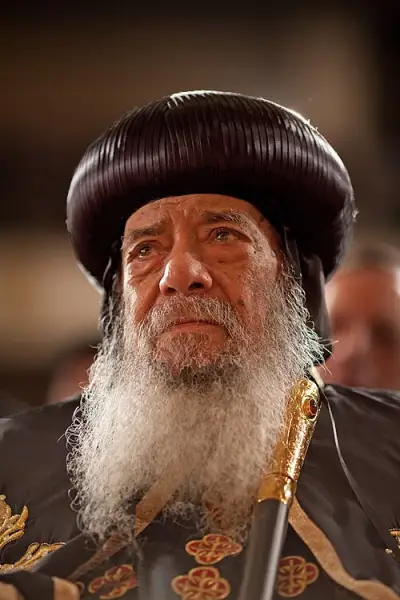
Overview
Pope Shenouda III, born Nazir Gayed Roufail on 3 August 1923 in Abnub, Asyut Governorate, served as the 117th Pope of Alexandria and Patriarch of the See of Saint Mark from 14 November 1971 until his death on 17 March 2012, a pontificate of forty years, four months, and four days. Raised by his older brother in Damanhur after his mother's death, he taught Sunday school as a teenager, earned a Cairo University degree in English and history, and studied at the Coptic Theological Seminary under the reformer Habib Girgis. He became a monk in 1954 at the Syrian Monastery in Wadi El-Natrun as Father Antonios el-Syriani, lived as a hermit in a desert cave from 1956 to 1962, and in 1962 was consecrated General Bishop for Christian Education and Dean of the Theological Seminary by Pope Cyril VI, who renamed him Shenouda. As patriarch he presided over a vast expansion of the church beyond Egypt, appointing the first bishops of North America, Europe, Australia, and South America, and built a reputation as a champion of ecumenism, signing a Christological declaration with Pope Paul VI in 1973. Banished in 1981 by President Anwar Sadat to the monastery of Saint Pishoy, he was restored by Hosni Mubarak in 1985. Honored with the UNESCO-Madanjeet Singh Prize in 2000, he died in Cairo and was buried at the Monastery of Saint Pishoy.
The Complete Life
The Boy from Salaam
Nazir Gayed Roufail was born on 3 August 1923 in the village of Salaam in Upper Egypt, administratively part of Asyut Governorate and ecclesiastically of the Diocese of Manfalut. He was the youngest of eight children, five sisters and three brothers, and his mother died shortly after his birth. The boy was raised by his older brother Raphael in Damanhur, in the north of the country, where he attended a Coptic elementary school, before moving on to the American Middle School in Banha and then to the Faith Senior Secondary in Shubra, a crowded suburb of Cairo. From the age of fourteen he read and composed poetry, a habit that produced hundreds of poems between 1946 and 1962, and by sixteen he was serving as a Sunday school teacher, first at Saint Anthony's Church in Shoubra and then at Saint Mary's Church in Mahmasha. In 1943 he entered what was then the University of King Fouad I, reading English and history while spending his summers at the Syrian Monastery in Wadi El-Natrun and training with the Egyptian Military Reserve Corps. In 1946 the seminary's dean, Archdeacon Habib Girgis, broke the rules admitting only graduates and allowed the undergraduate into evening classes, a decisive act of patronage; Girgis's personality shaped the future pope, who always spoke of him with reverence.
§ Early life
Monk, Hermit, Bishop
On 18 July 1954 Nazir Gayed left secular life behind and entered the Monastery of Saint Mary El-Souriani, the Syrian Monastery of the Nitrian Desert, receiving the name Father Antonios el-Syriani. Between 1956 and 1962 he dwelt as a hermit in a cave seven miles distant from his monastery, devoting himself to meditation, prayer, and asceticism with a rigor that was judged exceptional even by monastic standards. Ordained priest on 31 August 1958 by Bishop Theophilus, the monastery's abbot, he was among the candidates proposed for the papal throne in 1959, when Father Mina el-Baramosy was instead elected as Pope Cyril VI. His hour came in 1962, when Cyril VI summoned him and, by what contemporaries called force and surprise, consecrated him General Bishop for Christian Education and Dean of the Coptic Orthodox Theological Seminary, giving him the name Shenouda in honor of the great Coptic writer Shenoute the Archimandrite. Under his deanship the seminary's student body tripled. Yet his zeal for reform provoked conflict: in 1966 Cyril VI suspended him over campaigns for reform, which demanded that bishops and priests be chosen by popular vote, ideas he would later put into practice as pope. The quarrel between the aged patriarch and his restless bishop was eventually healed, and Shenouda remained a central figure of the church's educated elite.
§ Monastic life and educational service
Patriarch of a Global Church
When Cyril VI died on 9 March 1971, the selection process brought Bishop Shenouda to the throne of Saint Mark, and he was enthroned on 14 November 1971 as the 117th Pope of Alexandria, the third to bear the name. His forty-year pontificate transformed the Coptic Orthodox Church from a national church into a worldwide communion. He appointed the first bishops for the North American dioceses, which grew from four parishes in 1971 to more than 250, and consecrated the church's first bishops for Europe, Australia, and South America, among them Missael, enthroned in 1991 over the newly created Diocese of Birmingham. Ecumenism defined his public ministry: in October 1972 he visited the Ecumenical Patriarch and the Pope of Rome, the first Alexandrian pope to do so since the Chalcedonian schism, and on 10 May 1973 he signed a common declaration on the nature of Christ with Paul VI, a landmark step toward resolving the Christological dispute of fifteen centuries. He traveled ceaselessly: to Ethiopia under Haile Selassie in 1974, to North America as the first Coptic pope to do so in the same year, to Australia six times, and on a Silver Jubilee tour of four continents in 1996. Within Egypt he defended his people through decades of sectarian violence, publicly rejecting the acquittal of those charged in the Kosheh massacre of 2000.
§ Pope and Patriarch
Confessor in Exile
The deepest test of Shenouda's papacy came from the state itself. His relationship with President Anwar Sadat deteriorated through the 1970s as Sadat encouraged Islamist groups, promoted a constitutional amendment declaring Islamic Sharia the main source of legislation, and presided over escalating violence against Christians that culminated in a Cairo massacre in 1981. The pope judged Sadat's peace treaty with Israel ill-timed and refused to normalize relations or permit Coptic pilgrimage to Jerusalem until the occupation ended and church property, including the Deir El-Sultan monastery, was restored; the Holy Synod renewed that prohibition as recently as 2006. In September 1981 Sadat rescinded the decree recognizing Shenouda as pope and banished him to the ancient monastery of Saint Pishoy in the desert. The papacy of an exiled patriarch proved an exercise in spiritual authority: Egypt's Christians continued to regard him as their only leader, and he governed the church from the monastery, rendering Sadat's decree ecclesiastically void. He showed no appetite for revenge, quelling unrest rather than inflaming it. After Sadat's assassination by Islamic extremists on 6 October 1981, his successor Hosni Mubarak fully reinstated the pope in January 1985. Through those years Shenouda modeled the patient endurance of a confessor: obedient in person, unyielding in principle, and constant in prayer for his tormentors and his people alike.
§ Political stances
Death of a Father
Shenouda's last years were marked by failing health. He suffered from kidney disease and diabetes, flew regularly to the United States for treatment, and in his final months had grown too weak to continue his medication, though rumors of a coma were denied by the Holy Synod and a reporter who saw him near the end found him in good spirits. He died on 17 March 2012, the eighth day of Paremhat in the Coptic calendar, at his official residence in Cairo, shortly after returning from treatment abroad. What followed was among the largest outpourings of grief in modern Egyptian history. An estimated million or more mourners filed past his body as it lay seated on a ceremonial throne in gold and red vestments at Saint Mark's Cathedral in Abbasiya, and the queue stretched for more than a kilometer; in the crush three people were killed and 137 injured, and the viewing was closed. The funeral came after three days of lying in state, and on 20 March his body was laid to rest at the monastery of Saint Pishoy in Wadi el-Natrun, in keeping with his wishes. Condolences arrived from Pope Benedict XVI, President Barack Obama, the grand imam of al-Azhar, Armenian church leaders, and political figures across the Arab world, each honoring a man who had come to embody the unity of Egypt itself.
§ Illness and death
Teacher of Generations
Shenouda III left behind one of the largest literary corpora of any modern church leader: more than a hundred books, from the scholarly Comparative Theology and The Nature of Christ to meditations on the Psalms, commentaries on the liturgy, and spiritual classics such as The Life of Humility and Meekness, many translated into English and read far beyond the Coptic world. His thirty-eight years as a seminary dean and bishop of education, begun in 1962, formed generations of Coptic clergy and lay servants; the Sunday school movement he nurtured at Saint Anthony's in Shoubra spread youth ministry across Egypt and then across the world. The demographic transformation of his church is his most visible monument: a communion of four parishes outside Egypt in 1971 became a global body of hundreds of parishes with bishops on five continents. UNESCO honored him in 2000 with the Madanjeet Singh Prize for promoting exchange between Christianity and Islam, and Egypt decorated him with the Grand Collar of the Order of the Nile. He was also a controversial figure, a conservative who excommunicated theological opponents and involved himself deeply in Egyptian politics. Yet the million mourners of March 2012 testified to what his people knew: for forty years he had been, in the words of his style, the father of fathers and the shepherd of shepherds.
§ Church growth
Timeline
- 3 Aug 1923
Born at Salaam village in Upper Egypt's Asyut Governorate and named Nazir Gayed Roufail.
§ Early life
- 1943
Enrolled at Cairo University, then called the University of King Fouad I, studying English and history.
§ Early life
- 1946
Admitted to evening classes at the Coptic Theological Seminary by Dean Habib Girgis.
§ Early life
- 1947
Completed a history degree at Cairo University and took up secondary school teaching in the capital.
§ Early life
- 1949
Graduated from the Coptic Theological Seminary and was appointed to teach Old and New Testament studies there.
§ Early life
- 1950
Resigned from secular employment to lecture full time at the Theological Seminary.
§ Early life
- 18 Jul 1954
Joined the Syrian Monastery in Wadi El-Natrun, taking the name Father Antonios el-Syriani.
§ Monastic life and educational service
- 31 Aug 1958
Ordained a priest by Bishop Theophilus, abbot of the Syrian Monastery.
§ Monastic life and educational service
- 30 Sep 1962
Consecrated General Bishop for Christian Education and Dean of the Theological Seminary by Pope Cyril VI, who renamed him Shenouda.
§ Bishop
- 14 Nov 1971
Enthroned as the 117th Pope of Alexandria in the new Saint Mark's Cathedral in Cairo.
§ Pope and Patriarch
- Oct 1972
Visited the Ecumenical Patriarch of Constantinople and the Pope of Rome, the first Alexandrian pope to do so since the schism of 451.
§ Pope and Patriarch
- 10 May 1973
Signed a common declaration on the nature of Christ with Pope Paul VI and celebrated the return of relics of Saint Athanasius.
§ Pope and Patriarch
- 14 Apr 1974
Toured the United States and Canada through 23 May, the first visit by a Coptic pope to those lands.
§ Pope and Patriarch
- Sep 1981
Banished by President Anwar Sadat to the monastery of Saint Pishoy after their falling out, continuing his duties from exile.
§ Political stances
- Jan 1985
Fully reinstated by Sadat's successor Hosni Mubarak and returned from exile.
§ Political stances
- 1991
Established the first diocese of the Patriarchate in the lands of immigration, the Diocese of Birmingham, under Bishop Missael.
§ Church growth
- 18 May 1996
Began an extended Silver Jubilee tour through Europe, Canada, the United States, and Australia, ending 20 December.
§ Pope and Patriarch
- 2000
Awarded the UNESCO-Madanjeet Singh Prize for the Promotion of Tolerance and Non-Violence.
§ Awards
- 13 Jul 2007
Formal relations between the Coptic and Ethiopian churches resumed after decades of estrangement.
§ Ethiopian Church conflict
- 11 Apr 2008
Made a second historic visit to the Ethiopian church after relations between the two churches were resolved.
§ Pope and Patriarch
- 17 Mar 2012
Died in Cairo of lung and liver complications at the age of 88.
§ Illness and death
- 20 Mar 2012
Buried at the Monastery of Saint Pishoy in Wadi el-Natrun after three days of lying in state.
§ Illness and death
In Their Own Words
I will never go to Jerusalem except hand-in-hand with my Muslim brothers after the end of the Israeli occupation.
The whole Christian world is anxious to see the church unite. Christian people, being fed up with divisions, are pushing their church leaders to do something about church unity and I am sure that the Holy Spirit is inspiring us.
The Record
- Major works
- The Nature of Christ·Comparative Theology·The Divinity of Christ·The Life of Humility and Meekness·The Life of Repentance and Purity·The Spirituality of Fasting·Salvation in the Orthodox Concept·Sunday School Monthly Magazine (editor-in-chief)·Eight booklets on theosis
- Canonization
- Not formally canonized; mourned worldwide as a beloved patriarch after his death in 2012
Prayer
Bibliography
Show 7 sources
- Paul VI and Shenouda III (10 May 1973). "Common Declaration of Pope Paul VI and of the Pope of Alexandria Shenouda III". Vatican.va.
- Zaken, Hillary (18 March 2012). "Egyptian Copts mourn the death of pope". The Times of Israel.
- "Obituary: Pope Shenouda III". BBC News Online, 17 March 2012.
- "UNESCO-Madanjeet Singh Prize for the Promotion of Tolerance and Non-Violence (2009)" (PDF). UNESCO, 2009.
- "Thousands mourn Egypt's Coptic Pope Shenouda III". BBC News, 18 March 2012.
- "Egyptian Christians mourn Orthodox pope Shenouda III". The Guardian. London, 18 March 2012.
- Marten, Michael (18 March 2012). "The significance of Pope Shenouda III". Ekklesia.
Profile text adapted from the Wikipedia article, licensed CC BY-SA 4.0.
Pray with this saint every day
Save St. Shenouda III of Alexandria to your favorites, read the full profile, and get feast-day reminders in the Saints app.
Get the Saints AppFree on the App Store for iPhone and iPad