
died 2 December 537·Feast 20 June
St. Silverius
Pope Deposed and Starved on Palmarola
Overview
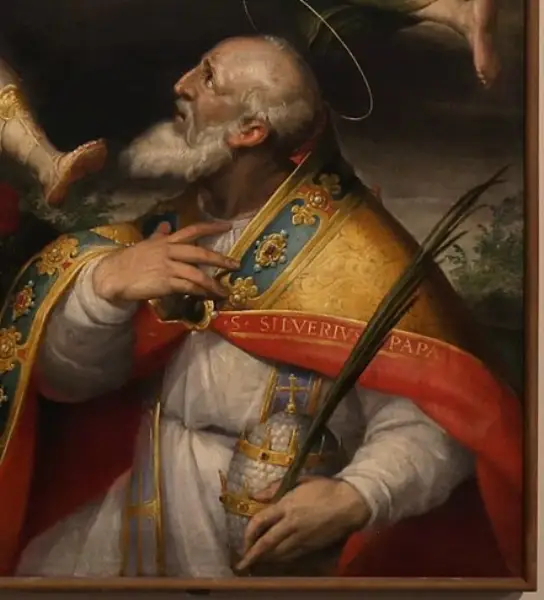
Silverius governed the Roman church from 8 June 536 until his removal from office a few months before his death, which came on 2 December 537, and is honored as a saint and martyr. A native of Frosinone in Lazio and the legitimate son of Pope Hormisdas, born before his father entered the priesthood, he was only a subdeacon when the Ostrogothic king Theodahad forced his election and consecration on the eve of the Gothic War, evidently preferring a compliant candidate and passing over the entire diaconate as untrustworthy. Within months the fortunes of war swept over Rome: the Byzantine general Belisarius entered the city with Silverius's approval in December 536, and the Gothic king Witiges responded by besieging Rome for months amid privation and starvation. Accused by Antonina, the wife of Belisarius, of conspiring with the Goths, Silverius was deposed in March 537, exiled first to Patara in Lycia, and after an order of recall handed over to his rival Vigilius, who banished him to the desolate island of Palmarola in the Pontine group. Deprived of sufficient sustenance, he starved to death there. The church of the island of Ponza later recognized him as a saint by popular acclamation, keeps his feast on 20 June, and venerates him as its patron.
The Complete Life
Son of a Pope
Silverius was born at Frosinone in Lazio, born to Hormisdas before that man took holy orders and rose to the Roman throne. That a pope should be the son of another pope is one of the curiosities of the early papacy, when clerical celibacy had not yet taken the form it later assumed, and it made Silverius a member of the most prominent ecclesiastical family in Rome. His own progress through the church's ranks, however, was modest: by the time history takes notice of him he was a subdeacon, one of the lower orders of the Roman clergy, and nothing suggests that he had been marked out for high office. The world that surrounded him was disintegrating. The Gothic kingdom of Italy, founded by Theodoric the Great, was ruled after Theodoric's death by his nephew Theodahad, and the armies of the Byzantine emperor Justinian were preparing to reclaim the peninsula in the war that would devastate Italy for two decades. In that collision of empires the papal throne itself became a prize, and the quiet subdeacon of Roman stock would be raised to it not by the choice of the church but by the command of a Gothic king.
§ Life
Enthroned by a Gothic King
The elevation of Silverius in 536 was an act of royal policy rather than ecclesiastical consensus. King Theodahad, facing the Gothic War and desperate to place a reliable man on the throne of Rome, forced the election and consecration of the subdeacon, probably on 8 June 536. The historian Jeffrey Richards reads the choice of so junior a cleric as evidence that Theodahad regarded the entire diaconate of the Roman church as untrustworthy and preferred an unknown who owed him everything. The Liber Pontificalis, the book of the popes, goes further and alleges that Silverius purchased his elevation from the king, an accusation that colors every later account of his reign. Whatever the truth, the new pope's position was precarious from the first hour. Before the year ended the Byzantine general Belisarius, advancing through southern Italy, entered Rome on 9 December 536 with Silverius's approval, and the Gothic succession passed to Witiges, who gathered an army and besieged the city for months, subjecting its people to privation and starvation. Silverius now presided over a Rome held by Byzantine arms and surrounded by Gothic besiegers, a pope whose Gothic patron could no longer protect him and whose Byzantine rescuers had every reason to doubt him.
§ Life
Deposition and Death on Palmarola
The end came swiftly and cruelly. In March 537 Silverius was deposed by Belisarius after Antonina, the general's wife, charged him with treacherous dealing with the Goths; several noted senators, one descended from an emperor, were exiled at the same time alongside him. Vigilius, the papal legate in Constantinople, was brought to Rome to replace him. The fullest contemporary narrative, the Breviarium of Liberatus of Carthage, reports that the fallen pope was banished to Patara in Lycia, where the local bishop begged the emperor to grant him a proper trial; alarmed, Justinian commanded his return to Rome to be tried accordingly. But when Silverius came back to Italy no trial took place: Belisarius delivered the accused to Vigilius, whom the Liber Pontificalis credits with ordering him stripped of his vestments at the Pincian palace and banished to the desolate island of Palmarola in the Pontine group. There, deprived of sufficient sustenance, the deposed pope starved to death, dying on 2 December 537. Richards, weighing the tendentious sources, judges the whole episode political: Justinian wanted a pro-Eastern pope in Rome, and Vigilius wanted the throne at any price. Silverius, twice a pawn of other men's ambitions, perished without fanfare on a barren rock in the Tyrrhenian Sea.
§ Life
Saint of the Pontine Islands
The church did not long forget the pope who died of hunger on Palmarola. Silverius was recognized as a saint by popular acclamation, the verdict of the Christian people rather than of any formal process, and his earliest appearance in any register of saints comes from the eleventh century. His cult took root above all in the Pontine Islands. The people of Ponza adopted him as their patron, observing his feast each 20 June. The legend of Ponza tells how fishermen caught in a storm off Palmarola called upon Saint Silverius for help, and an apparition of the saint summoned them to Palmarola, where they survived; the miracle fixed his veneration among the seafaring people of the islands. From Ponza the devotion crossed the Atlantic: settlers from the island carried the cult of San Silverio to the Morrisania section of the Bronx, where the feast was celebrated for generations at Our Lady of Pity Church, and in 1987 the San Silverio Committee of Morris Park was founded, keeping the novenas, the Mass, and the procession of the statue every 20 June. After the deconsecration of the Bronx church in 2017 the statue found a home at Saint Ann's in Yonkers, where the feast continues.
§ Canonization
A Verdict Reversed by Memory
Silverius perished, in the words of the tradition, largely unlamented: a short-reigned pope imposed by a Gothic king, deposed amid accusations of treason, and erased from the throne by a rival better connected in Constantinople. Yet the judgment of the centuries has run the other way. The accounts of his fall, read carefully, reveal a man engulfed by forces no individual could resist: the Gothic War, the ambitions of Vigilius, the determination of Justinian to control the Roman see, and the factional politics of a city under siege. The sources that blacken his memory, the Liber Pontificalis and the Breviarium of Liberatus, were both written amid the bitterness of the later Three-Chapter Controversy, when Vigilius's enemies regarded him as an anti-Christ; once their religious polemic is stripped away, as Richards argues, the episode appears as what it was, a political liquidation dressed in ecclesiastical clothes. The popular acclamation that made Silverius a saint was, in effect, the church's reversal of the verdict of his enemies. On Ponza and in the Ponzese communities of America he is remembered not as a political failure but as a martyr for justice, a pope who lost everything, throne, freedom, and finally life itself, and who keeps his crown in the memory of the faithful.
§ Life
Timeline
- 8 Jun 536
Consecrated bishop of Rome as a subdeacon under pressure from the Ostrogothic king Theodahad.
§ Life
- 9 Dec 536
Belisarius led his Byzantine troops into the city, an entry Silverius permitted.
§ Life
- Mar 537
Deposed by Belisarius after being accused by Antonina of conspiring with the Goths, and sent into exile.
§ Life
- 2 Dec 537
Starved to death in exile on the desolate island of Palmarola.
§ Life
- 1987
The San Silverio Committee of Morris Park was founded in the Bronx to continue his feast and devotions.
§ Canonization
The Record
- Patron of
- Island of Ponza
- Canonization
- Recognized as a saint by popular acclamation; first recorded in a list of saints in the 11th century
Prayer
Bibliography
Show 6 sources
- Duffy, Eamon (2006). Saints and Sinners: A History of the Popes. New Haven; London: Yale University Press. ISBN 978-0-30011-597-0.
- Geary, Patrick J. (2002). The Myth of Nations: The Medieval Origins of Europe. Princeton, NJ: Princeton University Press. ISBN 0-69109-054-8.
- McCabe, Joseph (1939). A History of the Popes. London: Watts & Co.
- Procopius (1979). De Bello Gothico. Loeb Classical Library, Vol. 3. Cambridge, MA: Harvard University Press.
- Richards, Jeffrey (1979). The Popes and the Papacy in the Early Middle Ages, 476–752. London; Boston: Routledge and Kegan Paul.
- Sanctoral.com. "Saint Silverius: Pope and Martyr". Lives of the Saints–Our Models and Protectors. Retrieved 21 April 2019.
Profile text adapted from the Wikipedia article, licensed CC BY-SA 4.0.
Pray with this saint every day
Save St. Silverius to your favorites, read the full profile, and get feast-day reminders in the Saints app.
Get the Saints AppFree on the App Store for iPhone and iPad