
died 10 March 483·Feast 10 March
St. Simplicius
Pope Who Shepherded Rome Through Empire's Fall
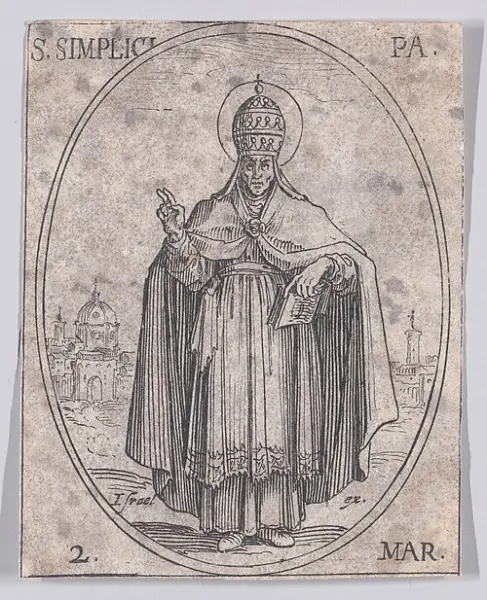
Overview
Simplicius, who died on 2 or 10 March 483, was bishop of Rome from 468 until his death, a pontificate that spanned the death of the Western Roman Empire itself. A native of Tivoli and the son of a citizen named Castinus, he was consecrated on 25 February 468 after a vacancy of only ten days following the death of Pope Hilarius. His fifteen years in office were spent chiefly in defense of the Council of Chalcedon against the Eutychian heresy: he protested repeatedly to the emperors of the East when Eutychian mobs installed Petrus Mongus in Antioch and Petrus Fullo usurped the patriarchate of Alexandria, and in 478 he held a Roman synod that anathematized the heretical eastern bishops Peter Fullo, John of Apamea, and Paul of Ephesus. In 476 he watched the Herulian mercenaries depose Romulus Augustulus, the last western emperor, and proclaim Odoacer king of Italy, an upheaval that left the administration of Rome largely in the hands of its bishop. He worked to maintain Roman authority in the West, appointing Zeno of Seville papal vicar in Spain, rebuked the archbishop of Ravenna for forcing a consecration, broke the custom of conferring holy orders only in December, and built or dedicated several Roman churches, among them Santa Bibiana and Santo Stefano Rotondo. He was buried in the Basilica of Saint Peter.
The Complete Life
Chosen in a Troubled Age
Simplicius was born at Tivoli, the ancient Tibur among the hills east of Rome, the son of a citizen named Castinus. Of his early life almost nothing is recorded, but his rise within the Roman church must have been considerable, for when Pope Hilarius died in 468 the succession passed to him after a vacancy of only ten days, and he was consecrated on 25 February of that year. He took up the government of the Roman church at one of the hinge moments of history. In the East, the settlement of Chalcedon of 451 was being torn apart by the Eutychian party, which denied the full humanity of Christ incarnate and had begun to seize the great patriarchal thrones of Antioch and Alexandria. In Italy, the western empire was a hollow shell governed by short-lived puppets, while barbarian armies commanded the real power. To be bishop of Rome in such an age meant to be, increasingly, the one figure of continuity amid collapse. Simplicius accepted that burden and carried it for fifteen years, combining theological firmness against heresy with practical care for a city whose imperial protectors were about to disappear forever, and exercising a watchful oversight over the churches of both East and West.
§ Election
Defender of Chalcedon
The great work of Simplicius's pontificate was the defense of the Council of Chalcedon against its eastern enemies. When the Eutychians rose in Antioch and installed Petrus Mongus in the episcopal throne, and when Petrus Fullo usurped the patriarchate of Alexandria, Simplicius made repeated complaints for action to the emperors of the East, first to Leo I and then to the usurper Basiliscus, demanding the restoration of the Catholic bishops; he also secured the rehabilitation of Patriarch Timotheos Solofaciolus. In 478 he summoned a synod in Rome that pronounced anathemas against the eastern heretical bishops Peter Fullo, John of Apamea, and Paul of Ephesus, giving the weight of the apostolic see to the embattled orthodox of the East. In the same spirit he guarded the authority of Rome in the West, naming Zeno, bishop of Seville, as papal vicar in Spain, and in 482 he did not hesitate to rebuke Joannes I, archbishop of Ravenna, for consecrating Gregory of Modena a bishop against his will. In that same year, 476, he had watched the Herulian mercenaries depose the last emperor, Romulus Augustulus, and proclaim Odoacer king of Italy; Odoacer made few changes in the city's administration, and Rome remained firmly in the hands of its bishop, a tacit acknowledgment of the authority Simplicius exercised.
§ Pontificate
Builder and Liturgist
Beyond controversy and governance, Simplicius left a physical and liturgical imprint on the city of Rome. He is credited with the construction of the church of Santa Bibiana, raised in memory of the virgin and martyr Saint Bibiana, and with the dedication of the church of Santo Stefano Rotondo on the Celian Hill, the church of Saint Andrew near Santa Maria Maggiore, and a church honoring Saint Lawrence in the Campo Verano, where the Christian dead of Rome had long been laid. These foundations stitched the memory of the martyrs into the urban fabric of a city that had recently endured siege and sack, and several of them remain landmarks of Christian Rome to this day. According to the Carolingian liturgist Amalarius of Metz, Simplicius was also the first pope to confer holy orders at seasons other than December before Christmas, beginning the practice of ordaining in February as well; the scholar Edmond Martène saw in this innovation the origin of the custom of the Ember days, the quarterly seasons of prayer and fasting that shaped the Western liturgical year for a millennium. A pope thus remembered simultaneously as a defender of doctrine, a builder of churches, and a shaper of the calendar of prayer stands among the chief architects of medieval Roman Christianity.
§ Pontificate
Death and Aftermath
Simplicius died at Rome on the second or tenth of March in the year 483, after a reign of fifteen years and seven days. His body was laid to rest in the Basilica of Saint Peter on 2 March, and the ancient records of the popes note that the episcopal throne of Rome stood empty for six days after his burial, a measure of the orderly transition his long pontificate had made routine. He had been, in effect, the last pope of the Roman Empire in the West: his consecration preceded the fall of Romulus Augustulus by eight years, and his death followed it by seven, so that his entire reign as bishop of Rome framed the extinction of the western imperial line. His successors inherited from him a church that had survived the catastrophe without losing either its property or its authority in the city. The memory of his sanctity was preserved in the calendar of the Roman church, where his feast was first observed on 2 March; since the liturgical reforms of 1971 it has been kept on 10 March in the General Roman Calendar, and he is venerated in both the Catholic and Orthodox communions as a confessor of the faith in its perilous age.
§ Death and aftermath
The Bishop Who Outlasted the Empire
The historical significance of Simplicius lies in what his pontificate demonstrated: that the bishop of Rome could absorb the collapse of imperial government without the collapse of Roman civic and ecclesiastical life. When Odoacer's mercenaries abolished the western empire, they changed almost nothing in the administration of the city, because the administration was already, in practice, in the hands of its bishop. The papacy thus emerged from the crisis of 476 as the functioning government of Rome, a position from which medieval popes would exercise authority over kings for the next thousand years. Simplicius's doctrinal campaign mattered equally: his protests, synods, and anathemas established the pattern by which the apostolic see claimed the right to judge the patriarchal thrones of the East, a claim that would define the theology and politics of Christendom for centuries. His liturgical reforms bore fruit in the Ember days; his churches sanctified the city's hills and cemeteries. Historians rank him among the popes who bridged antiquity and the Middle Ages, and the Orthodox and Catholic churches alike keep his memory as that of a man who, when the structures of the world were falling, held fast to the structure of the faith and handed it on intact.
§ Pontificate
Timeline
- 25 Feb 468
Consecrated bishop of Rome after a ten-day vacancy following the death of Pope Hilarius.
§ Election
- 476
Saw the Herulian mercenaries depose the emperor Romulus Augustulus and proclaim Odoacer king of Italy.
§ Pontificate
- 478
Held a synod in Rome pronouncing anathemas against the eastern bishops Peter Fullo, John of Apamea, and Paul of Ephesus.
§ Pontificate
- 482
Rebuked Archbishop Joannes I of Ravenna for consecrating Gregory of Modena a bishop against his will.
§ Pontificate
- 2 Mar 483
Buried in the Basilica of Saint Peter after his death, leaving Rome without a pope for six days.
§ Death and aftermath
- 1971
His feast in the General Roman Calendar was moved to 10 March, the date kept since.
§ Death and aftermath
The Record
- Major works
- Church of Santa Bibiana in Rome·Church of Santo Stefano Rotondo on the Celian Hill·Church of Saint Andrew near Santa Maria Maggiore·Church of Saint Lawrence in the Campo Verano
- Canonization
- Pre-congregation; venerated in both the Catholic and Orthodox churches
Prayer
Bibliography
Show 6 sources
- Kirsch, J. P. "Simplicius, Pope St." Catholic Encyclopedia, Vol. XIV. New York: Appleton, 1912, pp. 2–3.
- Duchesne, Louis (1886). Le Liber pontificalis, Tome premier. Paris: E. Thorin, pp. 249–251.
- Jaffé, Philippus, and S. Loewenfeld (1885). Regesta pontificum romanorum, Tomus primus, second edition. Leipzig: Veit, pp. 77–80.
- Loomis, Louise Ropes, ed. (1916). The Book of the Popes (Liber Pontificalis). New York: Columbia University Press, pp. 105–107.
- Thiel, Andreas (1868). Epistolae Romanorum pontificum genuinae, Vol. I. Brunsbergae: Peter, pp. 174–220.
- Pennacchio, Maria Cristina (2000). "Simplicio, santo". Enciclopedia dei Papi.
Profile text adapted from the Wikipedia article, licensed CC BY-SA 4.0.
Pray with this saint every day
Save St. Simplicius to your favorites, read the full profile, and get feast-day reminders in the Saints app.
Get the Saints AppFree on the App Store for iPhone and iPad