
c. 334 – 399·Feast 26 November
St. Siricius
Pope of the Oldest Preserved Papal Decretals
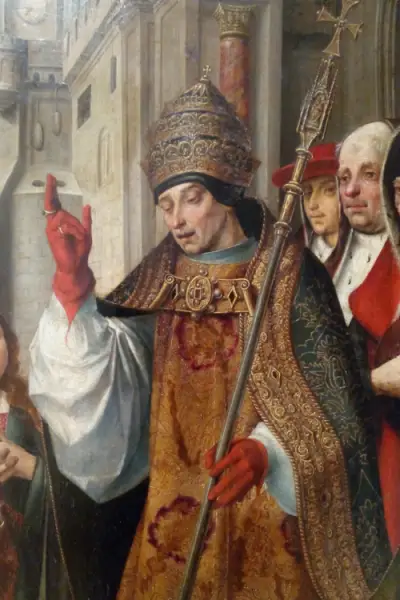
Overview
Siricius, born in Rome around 334 and died there on 26 November 399, was bishop of Rome from December 384 until his death, the thirty-eighth occupant of the apostolic see. He entered the service of the Roman church in his youth and served as lector and then deacon during the pontificate of Liberius, as the inscription on his tomb testified. Elected unanimously after the death of Damasus I despite the self-promotion of the antipope Ursinus, he received the confirmation of Emperor Valentinian II, which silenced objections to his succession. His pontificate is remembered above all for the Directa decretal, issued in answer to inquiries from Bishop Himerius of Tarragona, which settled fifteen questions touching baptism, penance, ecclesiastical discipline, and clerical continence; no earlier papal decretals survive in complete form, and some have called Siricius the first Roman bishop to assume the title pope. He worked to heal the Meletian schism in Antioch, receiving Bishop Flavian back into communion through an embassy led by Acacius of Beroea, and joined Ambrose of Milan and Martin of Tours in protesting to Emperor Magnus Maximus against the execution of the Spanish bishop Priscillian. He died after a reign of nearly fifteen years and was buried in the basilica of San Silvestro.
The Complete Life
A Roman from Youth
Siricius was a native of Rome, born around the year 334, the son of a citizen named Tiburtius. His life belonged entirely to the church of the city: he entered its service at an early age, and the inscription carved upon his grave records that during the pontificate of Liberius he served first as lector, the reader of the Scriptures in the assembly, and then as deacon of the Roman church. These were the ordinary steps of an ecclesiastical career in the fourth century, but they mattered in a city where the clergy were divided by the long aftershocks of the Arian controversy and the rivalries that Liberius's own troubled reign had left behind. The deacon Siricius thus grew up in the administration and the liturgy of the largest Christian community in the West, in the generation after the emperor Constantine had legalized the faith and the church of Rome had begun to build the great basilicas. When Pope Damasus I died in 384 after a long and glittering pontificate, the succession fell to this experienced Roman deacon. Despite the attempts of Ursinus, the rival of Damasus's later years, to promote himself once more, Siricius was elected unanimously, and the confirmation of his election by Emperor Valentinian II stilled every remaining objection.
§ Early life
The First Decretals
The event for which Siricius is chiefly remembered arose from a question asked in Spain. Bishop Himerius of Tarragona had sent inquiries to Rome about a range of pastoral and disciplinary problems in his church, and the pope's answer, known from its opening word as the Directa decretal, became a landmark in the history of canon law. In it Siricius gave fifteen separate rulings, covering baptism, penance, ecclesiastical discipline, and clerical continence, ruling with the authority of the apostolic see on matters that local bishops had previously settled on their own. These letters are the oldest completely preserved papal decretals, the first surviving examples of the formal rescript by which Roman pontiffs would govern the church for the next fifteen centuries. An active and administrative pope, Siricius involved himself closely in the government of the church and in the handling of its factions and differing viewpoints, and the practice begun with the Directa made the Roman see a court of appeal and a source of legislation in fact as well as in theory. It is also said of him, though authorities dispute it, that he was the first bishop of Rome to take the title of pope for his own office.
§ Pontificate
Reconciliation and Protest
Siricius exercised his office in the East as well as the West, and his interventions were marked by an instinct for reconciliation. He helped to mend the Meletian schism of Antioch, a wound left by the repeated exiles of Bishop Meletius at the hands of Arian emperors, a wound that reopened when Meletius died after presiding over the First Council of Constantinople in 381 and his followers refused his successor. At the urging of John Chrysostom and Theophilus of Alexandria, a delegation under Bishop Acacius of Beroea reached Rome and won Siricius over to recognizing Flavian and readmit him to communion with the church of Rome, a decisive step toward healing the division. In the West his courage showed itself in a different register. When the Spanish ascetic bishop Priscillian, accused of heresy by his fellow bishops, was executed by Emperor Magnus Maximus on a charge of magic, the first bishop to be put to death by a Christian state, Siricius joined Ambrose of Milan and Martin of Tours in protesting the verdict to the emperor. Some older sources also credit him with stern measures against the Manichaeans of Rome, though modern scholars generally regard this as a mistake, misattributed from the later pontificate of Leo I.
§ Relationship to heretics and heathens
Memory of a Lawgiver
Siricius died in Rome on 26 November 399, at about sixty-five years of age, and was succeeded by Anastasius I; he was buried in the basilica of San Silvestro, and his feast is kept on the day of his death. His memorial, however, is less a tomb than a method of governance. The decretal he sent to Himerius established the form in which the bishops of Rome would answer the church's questions: authoritative, pastoral, and binding, the seed from which the whole corpus of canon law grew. Because his letters are the oldest fully preserved, they mark the point at which the papal magisterium becomes visible to history in its own words rather than in the reports of others. The question of his titles has interested scholars almost as much: some name him the first Roman bishop to adopt the papal title, though others reply that the word was already an honorific for any bishop in the West, used in the East only for the patriarch of Alexandria, and became the peculiar property of the Roman see only gradually between the sixth and eleventh centuries. Whatever the truth of the title, the substance was his: under Siricius the successor of Peter first spoke to the whole church as its teacher and lawgiver.
§ Papal titles
Timeline
- 334
Born in Rome, the son of a man named Tiburtius.
§ Early life
- Dec 384
Elected bishop of Rome unanimously after the death of Damasus I, despite the rival claim of Ursinus.
§ Pontificate
- 26 Nov 399
Died in Rome after nearly fifteen years as pope and was buried in the basilica of San Silvestro.
§ Death and veneration
The Record
- Major works
- Directa decretal to Bishop Himerius of Tarragona
- Canonization
- Pre-congregation; feast kept on 26 November in the Catholic Church
Prayer
Bibliography
Show 6 sources
- Kirsch, Johann Peter (1912). "Pope St. Siricius". In Herbermann, Charles (ed.). Catholic Encyclopedia, Vol. 14. New York: Robert Appleton Company.
- Annuario Pontificio. Libreria Editrice Vaticana, 2012, p. 9. ISBN 978-88-209-8722-0.
- Leclercq, Henri (1911). "Meletius of Antioch". In Herbermann, Charles (ed.). Catholic Encyclopedia, Vol. 10. New York: Robert Appleton Company.
- Bettenson, Henry, and Chris Maunder (2011). Documents of the Christian Church. Oxford University Press, p. 88. ISBN 9780199568987.
- Oxford Dictionary of the Christian Church. Oxford University Press, 2005. ISBN 978-0-19-280290-3, articles "Pope" and "Pontifex Maximus".
- "The 38th Pope". Spirituality for Today, Diocese of Bridgeport.
Profile text adapted from the Wikipedia article, licensed CC BY-SA 4.0.
Pray with this saint every day
Save St. Siricius to your favorites, read the full profile, and get feast-day reminders in the Saints app.
Get the Saints AppFree on the App Store for iPhone and iPad