
42 – c. 125·Feast April 6
St. Sixtus I
Second-century Bishop of Rome who shaped early Roman liturgy
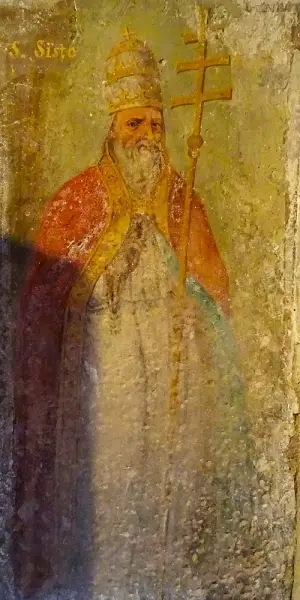
Overview
Sixtus I, also spelled Xystus, led the church of Rome at the close of the first quarter of the second century, succeeding Alexander I and handing the see on to Telesphorus. Ancient sources disagree on the exact span of his episcopate: the Liberian Catalogue places it from 117 to 126 under the emperor Hadrian, Eusebius gives 119 to 128, and the scholar Richard Adelbert Lipsius, weighing the conflicting testimony, concluded that he died around 125 after roughly ten years in office. A Roman of Greek descent, he gave the Roman church a succession of liturgical and administrative norms that the Liber Pontificalis records in his name: sacred vessels were reserved to sacred ministers, bishops summoned to Rome needed apostolic letters before being received home, and the Sanctus was sung by the people after the Preface of the Mass. Because he was the sixth bishop after Peter, some wondered whether his very name derived from the Latin for sixth. Honored as a martyr, he was buried near the grave of Peter on the Vatican Hill according to early belief, and his relics were later carried to Alife in Campania.
The Complete Life
A Roman of Greek Descent
Sixtus came from the city he would one day govern: tradition records him as a Roman of Greek descent, and his traditional biography sets his birth in the year 42, within living memory of the apostles. His very name became a small puzzle for later generations. Older writers spelled it Xystus, from a Greek word meaning polished, correct, or shaved, and this form was applied to the first three popes who bore the name. Yet because Sixtus stood sixth in the line of bishops after Peter himself, some asked whether the name instead arose from the Latin word for sixth. The ambiguity persisted for centuries, and churchmen had to clarify that the Xystus invoked in the Canon of the Mass was the second of the name, not this first Sixtus. Beyond these glimpses, the sources are nearly silent about his origins and early life, a silence common for bishops of the sub-apostolic age, whose stature grew in memory as the Roman see grew in importance. What the early records preserve is not anecdote but office: the man who followed Alexander I and preceded Telesphorus in a succession the church traced back to the apostles.
§ Name
Ordering the Worship of the Roman Church
The Liber Pontificalis preserves three ordinances in Sixtus's name, and together they sketch a bishop attentive to the dignity of worship and the order of the clergy. The first reserved the sacred vessels of the altar to sacred ministers alone, a rule that marked off the Eucharistic elements and their containers as set apart from ordinary use. The second concerned bishops who had been summoned to the Holy See: on returning home, they were not to be received back into their dioceses until they presented apostolic letters, an early mechanism for proving that a bishop's communion with Rome remained intact. The third bade the priest, once the Preface of the Mass was finished, to recite the Sanctus together with the people, giving the young Roman liturgy one of its most enduring features, since the Sanctus remains sung or said at that very point to this day. Whatever the exact date and authorship of these provisions, tradition judged them worthy of the earliest legislative memory of the Roman church, and they portray a pontificate concerned less with crisis than with the quiet consolidation of right practice: reverent hands for holy things, documented communion between churches, and a congregation joining the priest in the angelic hymn.
§ Liturgical codification
Death, Burial, and the Wanderings of His Relics
Sixtus died after a tenure that most authorities reckon at about ten years, and tradition crowned him with martyrdom, though the earliest records say little of the circumstances. Like nearly all of his predecessors, he was believed to lie buried near the grave of Peter on the Vatican Hill, yet differing traditions arose concerning where his remains actually rested. In the medieval period his relics surfaced far from Rome: a Romanesque crypt in the town of Alife, in Campania, came to house them, carried there by Rainulf III. Centuries later, Pope Clement X granted part of these remains to Cardinal de Retz, who deposited them at the Abbey of Saint Michael in Lorraine, and thus the bones of this second-century bishop came to be venerated in both southern and northern Europe. His feast is kept on April 6 in the Catholic Church and the Oriental Orthodox churches. Such scattered devotion is itself a kind of testimony: a pope about whom almost nothing certain can be narrated was nevertheless never forgotten, his name fixed in the ancient lists of the bishops of Rome and his cult carried across the Alps by those who treasured his relics.
§ Biography
Timeline
- 42
Born at Rome, according to the date given in his traditional biography
§ Pope Sixtus I
- 117
Began his tenure as bishop of Rome under Emperor Hadrian, as the Liberian Catalogue dates it
§ Biography
- 119
Year in which Eusebius places the start of his episcopate in his Ecclesiastical History
§ Biography
- 125
Died after roughly ten years in office, the date favored by Lipsius after weighing the sources
§ Biography
The Record
- Symbols
- papal tiara·palm branch·sacred vessels
- Canonization
- Pre-congregation canonization; venerated as a martyr from the earliest centuries of the Church
Prayer
Bibliography
Show 6 sources
- George L. Williams (2004). Papal Genealogy: The Families and Descendants of the Popes. McFarland. p. 9. ISBN 9780786420711.
- "Pope St. Sixtus I". The Catholic Encyclopedia. Vol. 14. New York: Robert Appleton Company. 1912.
- Eusebius, Ecclesiastical History, IV, 4-5.
- Jerome, Chronicon, 3rd year of Hadrian (AD 119) and AD 128.
- Lipsius, Richard Adelbert (1869). Chronologie der römischen Bischöfe bis zur Mitte des vierten Jahrhunderts. Schwers. pp. 183-192.
- Loomis, Louise Ropes. The Book of Popes (Liber Pontificalis). Evolution Publishing. ISBN 1-889758-86-8.
Profile text adapted from the Wikipedia article, licensed CC BY-SA 4.0.
Pray with this saint every day
Save St. Sixtus I to your favorites, read the full profile, and get feast-day reminders in the Saints app.
Get the Saints AppFree on the App Store for iPhone and iPad