
died 6 August 258·Feast August 7
St. Sixtus II
Pope and martyr beheaded in the Valerian persecution
Overview
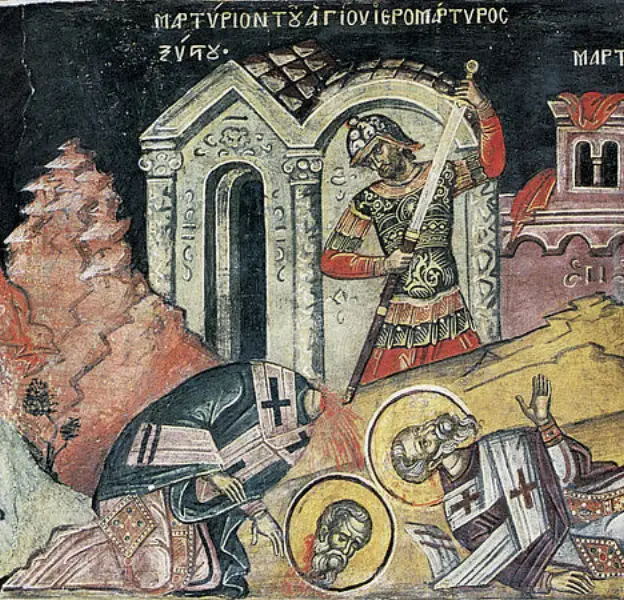
Sixtus II occupied the chair of Peter for barely a year, from 31 August 257 until 6 August 258, yet his brief pontificate held both reconciliation and a martyr's crown. A Greek by origin, according to the Liber Pontificalis, he was said in the same source to have been a philosopher before his elevation, though modern historians question whether its authors confused the pope with a Greek Pythagorean writer of the same name. His most consequential act came early: he healed the rupture his predecessor Stephen I had opened with the African and Eastern churches over the rebaptism of heretics, restoring communion across the Christian world at a moment when the emperor Valerian had begun to strike at the Church itself. In 258 imperial edicts targeted bishops, priests, and deacons, and Sixtus was among the first victims. Soldiers seized him while he preached in the cemetery, and he was beheaded on 6 August together with six deacons, offering himself first so that his flock might be spared. Four days later his best-known deacon, Lawrence of Rome, followed him to death. Pope Damasus I later marked his tomb in the catacomb of Callixtus with an inscription honoring the pastor who died for his people, and his name is still spoken in the Roman Canon.
The Complete Life
A Greek Philosopher on the Chair of Peter
The ancient biography preserved in the Liber Pontificalis describes Sixtus II as a Greek, born in Greece, and a philosopher before he entered the service of the Roman church. That portrait has not gone unchallenged. Modern Western historians have argued that the compilers of the Liber Pontificalis may have mistaken this pope for a contemporary: a Greek writer also named Xystus, a student of Pythagorean thought whose works circulated under a similar name. The confusion, if it was one, would be understandable, since the two men belonged to the same generation and the same name covered them both. What can be said with confidence is that the man elected bishop of Rome on 31 August 257 inherited a church under gathering storm, for the emperor Valerian's hostility to Christianity would soon break into open persecution. Nothing else survives of his formation, his family, or his path to the episcopate. The sources are silent where later hagiographers would have embroidered; what remains is a foreign-born scholar, perhaps, on the Roman throne, and within a year a martyr whose deacons died around him.
§ Life
Successor in a House Divided
Sixtus took office at the close of a bitter quarrel. His predecessor, Stephen I, had broken off relations with the churches of Africa and the East over the question of heretical baptism, a controversy raised in its sharpest form by the schism of Novatianism: whether converts baptized by heretics needed to be baptized again upon entering the Catholic Church. Stephen had answered no, and had defended that answer with an intransigence that alienated Cyprian of Carthage and the eastern bishops. Sixtus, elected in August 257, chose reconciliation. Under him the severed relations with the African and Eastern churches were restored, and the fever of the controversy subsided without surrender of principle on either side. The episode reveals a bishop more concerned with the communion of the Church than with victory in dispute, a temperament the more remarkable because the same years brought the first edicts of Valerian against Christian clergy. He also continued the Roman church's literary life: a treatise against Novatian written in these years, Ad Novatianum, is thought by some to be his, and a further Roman treatise from those same years, somewhere between 253 and 258, is likewise credited to him.
§ Life
The Pastor of the Cemeteries
In 258 the emperor Valerian made the clergy of the Church the special object of his persecution, and bishops, priests, and deacons began to be put to death across the empire. Sixtus II was among the first victims in Rome. The ancient inscription later set over his tomb preserves the scene: the bishop was teaching the Word of God in the cemetery when soldiers burst in and dragged him from his chair. The faithful around him offered their necks to the sword, but Sixtus, seeing that others were about to seize the palm of martyrdom, offered himself and his own head first, refusing to let the pagan fury harm his people. He was beheaded on 6 August, dying with six deacons who shared his fate: Januarius, Vincentius, Magnus, Stephanus, Felicissimus, and Agapitus. The image of a shepherd struck down while feeding his flock in the burial grounds of the martyrs fixed itself in the memory of the Roman church. His deacon Lawrence, the best known of his circle, was executed four days later, on 10 August, and his own cult became one of the most beloved of the Roman martyrs.
§ Life
A Name in the Roman Canon
Veneration of Sixtus II began where he fell. He was buried in the cemetery of Callixtus, and there Pope Damasus I, himself a fourth-century champion of the Roman martyrs, placed an inscription in verse that still speaks for the pope who died in 258: it tells of the pastor dragged from his chair, of the faithful who bared their necks, and of the bishop who offered his own head first so that Christ's flock would go unharmed. From the earliest liturgical books Sixtus has been honored among the great martyrs of Rome, and his name is pronounced in the Roman Canon of the Mass, the Eucharistic prayer of the city's church, alongside the first popes and martyrs. The Tridentine calendar kept his feast, together with the deacons Felicissimus and Agapitus, on 6 August, the day of his death, though that date was already given to the Transfiguration of the Lord. When the calendar reform of 1969 ended such commemorations, the memorial kept for Sixtus and his companions passed to 7 August, the day right after their martyrdom, where the Roman Rite still keeps it. The Eastern Orthodox and Oriental Orthodox churches likewise number him among the saints.
§ Legacy
Communion Restored, Blood Sealed
Sixtus II left behind no long list of decrees or buildings, yet two achievements gave him a permanent place in the memory of the Church. The first was diplomatic: in a single year he accomplished the reconciliation that his predecessor's rigidity had made impossible, drawing the African and Eastern churches back into full communion with Rome after the dispute over heretical baptism had sundered them. The second was his death, which taught the Roman church what its bishops were made of. The scene in the cemetery, the pastor offering his head before his people could be harmed, entered the poetic inscription of Damasus and through it the imagination of later centuries. His companions in death gave the Roman church a band of deacon-martyrs, chief among them Lawrence, whose own cult would rival his bishop's in renown. The ambiguity that clings to his biography, the uncertain philosophy and the disputed treatise, has never dimmed the clarity of his witness. A pope of one year, foreign-born and swiftly killed, he is remembered wherever the Eucharistic prayer is said, a testimony that the unity of the Church is worth healing and its faith worth dying for.
§ Legacy
Timeline
- 253
A treatise produced at Rome at some point in the years from this one to 258 is commonly credited to him
§ Life
- 31 Aug 257
Began his pontificate, succeeding Stephen I as bishop of Rome
§ Life
- 258
The emperor Valerian launched a persecution that put numerous bishops, priests, and deacons to death
§ Life
- 6 Aug 258
Put to death by the sword in Rome; six deacons fell beside him: Januarius, Vincentius, Magnus, Stephanus, Felicissimus, and Agapitus
§ Life
- 10 Aug 258
Lawrence of Rome, his best-known deacon, suffered martyrdom four days after his bishop
§ Life
- 1969
His memorial, formerly kept on 6 August with the Transfiguration, was moved to 7 August in the reformed Roman calendar
§ Legacy
In Their Own Words
At the time when the sword pierced the bowels of the Mother, I, buried here, taught as Pastor the Word of God; when suddenly the soldiers rushed in and dragged me from the chair. The faithful offered their necks to the sword, but as soon as the Pastor saw the ones who wished to rob him of the palm (of martyrdom) he was the first to offer himself and his own head, not tolerating that the (pagan) frenzy should harm the others. Christ, who gives recompense, made manifest the Pastor's merit, preserving unharmed the flock.
The Record
- Major works
- Ad Novatianum (authorship disputed)·A treatise written at Rome between 253 and 258, generally attributed to him
- Symbols
- papal tiara·palm branch·sword
- Canonization
- Pre-congregation canonization; venerated as a martyr from antiquity and named in the Roman Canon of the Mass
Prayer
Bibliography
Show 7 sources
- Herbermann, Charles, ed. (1913). "Pope St. Sixtus II". Catholic Encyclopedia. New York: Robert Appleton Company.
- Smith, William; Cheetham, Samuel (2005). Encyclopaedic Dictionary Of Christian Antiquities (in 9 Volumes). Concept Publishing Company. p. 936. ISBN 978-81-7268-111-1.
- The Book of Pontiffs (Liber Pontificalis), translated with introduction by Raymond Davies (Liverpool: University Press, 1989), p. 10.
- Miller, OFM, Don. "Saint Sixtus II and Companions", Franciscan Media.
- Calendarium Romanum (Libreria Editrice Vaticana 1969), p. 133.
- J. P. Migne, Patrologia Latina, XIII, 383–4.
- Erich Kettenhofen (1995). "Sixtus II". In Bautz, Traugott (ed.). Biographisch-Bibliographisches Kirchenlexikon (BBKL). Vol. 10. Herzberg: Bautz. cols. 578–582. ISBN 3-88309-062-X.
Profile text adapted from the Wikipedia article, licensed CC BY-SA 4.0.
Pray with this saint every day
Save St. Sixtus II to your favorites, read the full profile, and get feast-day reminders in the Saints app.
Get the Saints AppFree on the App Store for iPhone and iPad