
died 18 August 440·Feast March 28
St. Sixtus III
Pope builder of Santa Maria Maggiore after Ephesus
Overview
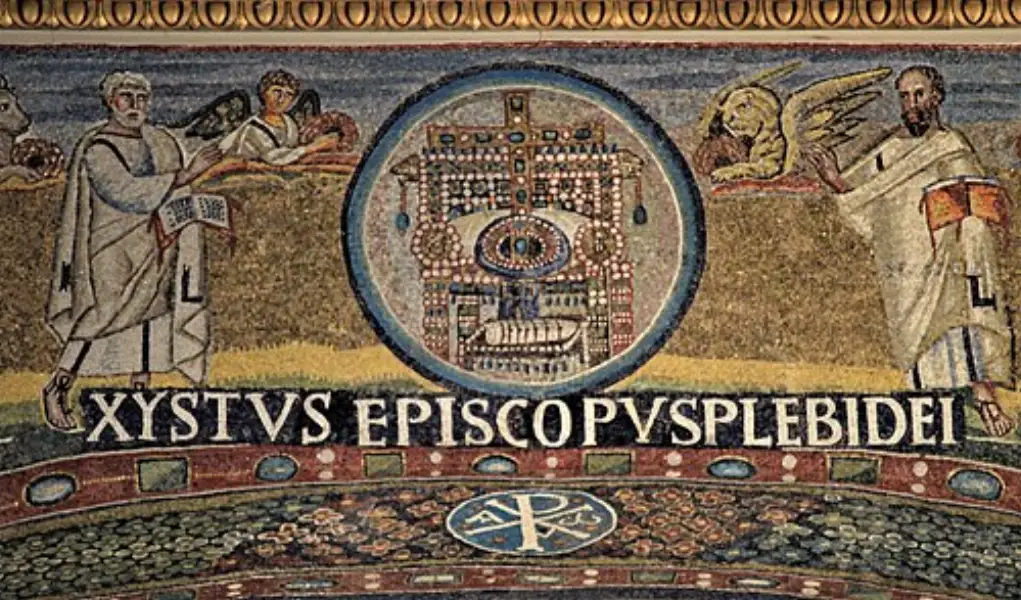
Sixtus III governed the church of Rome from 31 July 432 until his death on 18 August 440, an eight-year pontificate remembered above all for building. Born in Rome and prominent among the city's clergy before his elevation, he had corresponded frequently with Augustine of Hippo, and a dispute has long surrounded his early theology: Peter Brown judged him a former patron of the later-condemned Pelagius, while Alban Butler and Nicholas Weber rejected the charge, attributing it to his conciliatory temperament. As pope he turned from Roman quarrels to the peace of the wider Church, working to reconcile Cyril of Alexandria and John of Antioch after the Nestorian controversy, and defending Roman jurisdiction over Illyria and the rights of the archbishop of Thessalonica against the ambitions of Proclus of Constantinople. His name is linked with a great building boom in the city: Santa Sabina on the Aventine was dedicated under him, and he rebuilt the Liberian Basilica as Santa Maria Maggiore, its dedication to Mary the Mother of God proclaiming his acceptance of the Council of Ephesus and its grant of the title Theotokos. A mosaic of about 435 in that church still bears his name. He died in Gaul in 440, succeeded by Leo I.
The Complete Life
A Roman Cleric of Suspect Orthodoxy
Sixtus was a son of Rome, born in the city whose see he would eventually hold, and he rose to prominence among its clergy in the decades before his election. He was a man of letters as well as of church office, for he carried on a frequent correspondence with Augustine of Hippo, placing him among the learned Roman clerics who kept the Latin Church's greatest mind connected to the capital. Yet his reputation did not pass unchallenged. According to Peter Brown, Sixtus had been a patron of Pelagius, the ascetic teacher later condemned as a heretic, and the association cast a shadow over his early career. Alban Butler rejected the charge, tracing it instead to the liturgical scholar Garnier, and Nicholas Weber offered a different defense altogether: in his view the accusation arose precisely because Sixtus was conciliatory by disposition, and men of gentle temperament are easily accused of softness toward the errors they refuse to persecute. Whatever the truth, the controversy did not prevent his advancement. When the chair of Peter fell vacant in 432, the prominent Roman cleric, whatever his earlier associations, was chosen to fill it.
§ Early career
Peacemaker Among the Eastern Churches
Sixtus received the episcopal office on 31 July 432, taking charge of a Church still trembling from the Council of Ephesus, which had closed the year before. The council had settled the question of Christ's natures in favor of the title Theotokos for Mary, but it left the principal combatants unreconciled: Cyril of Alexandria and John of Antioch remained at odds, their communions on the edge of rupture. Sixtus devoted himself to restoring peace between them, extending Rome's good offices across the Greek-speaking East. In the Balkans he acted not as mediator but as defender of Roman rights: he upheld the pope's jurisdiction over Illyria and stood by the archbishop of Thessalonica in leading the Illyrian church locally, resisting the attempt of Proclus of Constantinople to stretch his own authority into the region. The two policies shared a single logic, that the order of the Church should rest on settled rights rather than on the expansionism of powerful sees. It was a quiet exercise of the Roman office, less spectacular than martyrdom or building, but it held together provinces of the Church that the controversies of the age might otherwise have pulled apart.
§ Pontificate
Stone and Mosaic for the Mother of God
Sixtus's name is woven into the greatest period of church building that Rome had yet seen. During his pontificate the basilica of Santa Sabina on the Aventine Hill received its dedication, and he rebuilt the ancient Liberian Basilica as the church now known as Santa Maria Maggiore, one of the great pilgrim churches of the city to this day. The dedication was a theological act. By titling the church for Mary the Mother of God, Sixtus made masonry speak the decision of Ephesus: where some had argued she should be called only Mother of Christ, the council had given her the Greek title Theotokos, God-bearer, and the great Roman basilica stood as Rome's public response to that ruling. Within it, a mosaic of about 435 carries his signature formula, Xystus Episcopus Plebi Dei, Sixtus, Bishop, to the People of God, a humility of style that has outlasted empire and antiquity alike. The Catholic Church and the Eastern Orthodox Church keep his feast on 28 March. He died on 18 August 440, away from Rome in Gaul, and the see passed to Leo I, whose own pontificate would carry the doctrine of Ephesus forward at Chalcedon.
§ Pontificate
Timeline
- 431
The Council of Ephesus closed, giving Mary the Greek title Theotokos, the doctrine his great Roman church would later honor
§ Pontificate
- 31 Jul 432
Consecrated bishop of Rome, succeeding Celestine I
§ Pontificate
- 435
The mosaic in Santa Maria Maggiore bearing his name was created, around this date
§ Pontificate
- 18 Aug 440
Died in Gaul, closing a pontificate of eight years
§ Pope Sixtus III
In Their Own Words
Xystus Episcopus Plebi Dei
The Record
- Major works
- Santa Maria Maggiore (rebuilt Liberian Basilica)·Santa Sabina on the Aventine Hill (dedicated under him)
- Symbols
- papal tiara·model of a church
- Canonization
- Pre-congregation canonization; venerated by the Catholic Church and the Eastern Orthodox Church from antiquity
Prayer
Bibliography
Show 6 sources
- "CATHOLIC ENCYCLOPEDIA: Pope St. Sixtus III". www.newadvent.org. Retrieved 13 August 2024.
- "The Holy Orthodox Popes of Rome". orthodoxengland.org.uk. Retrieved 2 May 2024.
- "St. Sixtus III, Pope", Catholic News Agency, March 28, 2017.
- Brown, Peter. "Pelagius and his Supporters." Journal of Theological Studies. 1968.XIX.1(93–114).
- Herbermann, Charles, ed. (1913). "Pope St. Sixtus III". Catholic Encyclopedia. New York: Robert Appleton Company.
- Helmut Feld (1995). "Sixtus III". In Bautz, Traugott (ed.). Biographisch-Bibliographisches Kirchenlexikon (BBKL). Vol. 10. Herzberg: Bautz. cols. 583–584. ISBN 3-88309-062-X.
Profile text adapted from the Wikipedia article, licensed CC BY-SA 4.0.
Pray with this saint every day
Save St. Sixtus III to your favorites, read the full profile, and get feast-day reminders in the Saints app.
Get the Saints AppFree on the App Store for iPhone and iPad