
c. 167 – c. 174·Feast April 22
St. Soter
Bishop of Rome who championed charity and Christian marriage
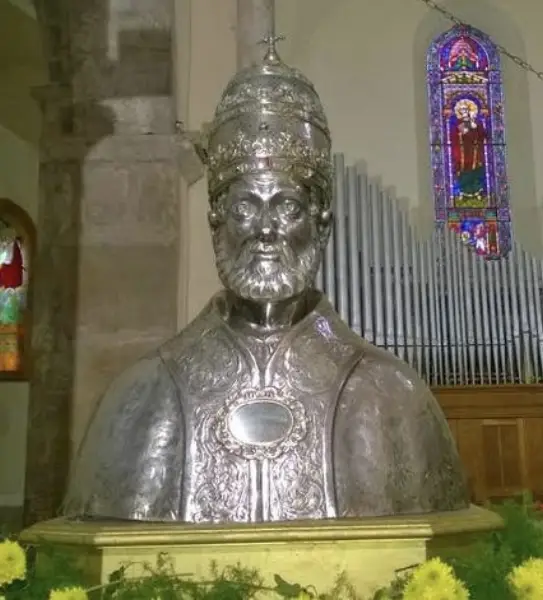
Overview
Soter, whose Greek name means saviour, was bishop of Rome from about 167 until his death around 174, though the Annuario Pontificio allows a range from 162–168 to 170–177. Born at Fundi, the modern Fondi in Lazio, into a Greek family, he carried his ancestral ties into his ministry, showing a particular concern for the Greek-speaking churches of the East. He is remembered for two rulings that shaped Roman practice: the validity of marriage, which he confined to unions a priest blessed as a sacrament, and the Easter feast, which he formally established at Rome as an annual celebration. His charity was famous far beyond Rome. Dionysius of Corinth praised his signal generosity in relieving exiled Christians in want and in remembering confessors condemned to the mines, and Soter sent a collection of funds to the church of Corinth for distribution to the poor. A late-antique source, the Praedestinatorum Haeresis, credits him with a book written against the Montanist movement. His name was his baptismal name, for his lifetime preceded the custom of popes taking new names upon election. The Catholic Church and Oriental Orthodoxy keep his feast on 22 April, shared with Saint Caius.
The Complete Life
A Greek Family in Roman Italy
Soter came from Fundi, the town now called Fondi, lying in the Lazio region of Italy, then reckoned part of Campania, and he was born into a Greek family settled far from their ancestral land. The circumstances of his childhood and his rise through the Roman church are not recorded; what survives is the mark his heritage left on his ministry. His Greek ancestry appears to have given him a particular interest in the problems of relations between the Roman see and the Greek Church, an interest that soon bore fruit in practical generosity. His very name belonged to this inheritance: Soter derives from the Greek word for saviour, and it was his baptismal name, given at the font and kept at his election, since the tradition by which popes adopt a new regnal name still lay centuries in the future. When he succeeded Anicetus as bishop of Rome, around 167, the Christian community in the capital was small, largely Greek-speaking at its roots, and scattered through the city's districts and burial grounds. A bishop who could bridge the Aegean in both directions was a natural choice for such a church.
§ Early life
Charity Across the Sea, and Two Enduring Decrees
The ancient testimony to Soter's pontificate concentrates on three things: his alms, his teaching on marriage, and his ordering of the Easter feast. Dionysius of Corinth, writing from Greece, bore witness to how generously the pope relieved Christians driven into exile and destitute, and how he remembered men sent to the mines, that savage punishment which swallowed up many confessors of the faith. Soter did not wait for the needy to reach Rome: he sent a collection of funds to the church of Corinth itself, to be distributed among the poor, an act of trans-Mediterranean solidarity that Dionysius evidently received with gratitude. Within his own city he left two institutional marks. Marriage, he declared, possessed validity only when a priest blessed it as a sacrament, a consequential and early Christian teaching on the married state, and Easter he formally established at Rome as a festival kept every year, fixing the observance of the Resurrection in the city's liturgical year. A source of late antiquity adds that he wrote a book against the Montanists, the enthusiast movement then spreading from Asia Minor, though the work itself has not survived.
§ Early life
Saint but Perhaps Not Martyr
It has often been supposed that every pope of the earliest centuries died for the faith, and Soter was long numbered among the martyr-bishops of Rome. The official record is more cautious. The Roman Martyrology, the Church's list of recognized saints, keeps his memory on 22 April, shared with Saint Caius, and honors him with a moving description drawn from Dionysius of Corinth, but it does not give him the title of martyr. When the General Roman Calendar was revised in 1969, the accompanying commentary declared plainly that nothing justifies counting Saint Soter and Saint Caius among the martyrs. His saintliness, in other words, rests not on the manner of his death, which the sources do not describe, but on the record of his life: the charity praised by a distant Greek bishop within living memory of his pontificate. Both the Catholic Church and the Oriental Orthodox churches venerate him on 22 April. The distinction matters little to his cult and much to the honesty of memory: Soter is honored as the pastor whose generosity was notorious, in the best sense, throughout the churches of East and West.
§ Roman Martyrology
Between Orthodoxy and the New Prophets
Soter's pontificate fell in the decades when the Montanist movement, born in Asia Minor, was making its way to Rome and Gaul, and the Roman church's response to it began in his day. The movement's nature at first diverged so little from contemporary orthodoxy that it was not immediately labeled heresy, and the events that forced a verdict came mostly after Soter's death, in the persecution at Lyon in 177 and the letters the confessors sent from their prison, carried to Pope Eleuterus by the presbyter Irenaeus. Yet a work once attributed to Augustine of Hippo, the Praedestinatorum Haeresis, records that Holy Soter, Pope of the City, wrote a book against the Montanists, alongside the treatise of Apollonius of Ephesus, while Tertullian answered both before his own regrettable defection to the new prophets. Meanwhile, within Rome itself, the Gnostics and Marcionites kept up their preaching against the Catholic Church, so that Soter's episcopate belonged to an age of contested teaching on every side. If the attribution of the lost book is correct, he met the new prophecy with pen as well as policy, and the Roman church's eventual, definite stand against Montanism had its roots in his reign.
§ Reaction to the Montanist movement
Timeline
- 162
Earliest possible beginning of his Roman episcopate, according to the dating range in the Annuario Pontificio
§ Pope Soter
- 167
Became bishop of Rome about this year, succeeding Anicetus
§ Pope Soter
- 174
Died in Rome after a pontificate of roughly seven years
§ Pope Soter
- 1969
The book revising the General Roman Calendar declared there are no grounds for numbering him among the martyrs
§ Roman Martyrology
In Their Own Words
At Rome, Saint Soter, Pope, whom Dionysius of Corinth praises for his outstanding charity towards needy exiled Christians who came to him, and towards those who had been condemned to the mines.
There are no grounds for including Saint Soter and Saint Caius among the martyrs.
The Record
- Major works
- A book written against the Montanists (recorded in the Praedestinatorum Haeresis)
- Symbols
- papal tiara·book
- Canonization
- Pre-congregation canonization; honored as a saint from antiquity, though the Roman Martyrology does not style him a martyr
Prayer
Bibliography
Show 7 sources
- Chapman, John (1908). "Caius and Soter, Saints and Popes" in The Catholic Encyclopedia. Vol. 3. New York: Robert Appleton Company.
- Annuario Pontificio 2012 (Libreria Editrice Vaticana, ISBN 978-88-209-8722-0), p. 8*.
- Rendina, Claudio (2002). The Popes: Histories and Secrets. Seven Locks Press. p. 18. ISBN 978-1-931643-13-9.
- Martyrologium Romanum (Libreria Editrice Vaticana 2001, ISBN 88-209-7210-7).
- Calendarium Romanum (Editrice Vaticana 1969), p. 120.
- Eusebius, Historia Ecclesiastica, 5.3.4; translated by G.A. Williamson, Eusebius: The History of the Church (Harmondsworth: Penguin, 1965), p. 206.
- "The Holy Orthodox Popes of Rome". St John's Orthodox Church, England. Retrieved 2025-05-22.
Profile text adapted from the Wikipedia article, licensed CC BY-SA 4.0.
Pray with this saint every day
Save St. Soter to your favorites, read the full profile, and get feast-day reminders in the Saints app.
Get the Saints AppFree on the App Store for iPhone and iPad