
before 284 – 31 December 335·Feast December 31
St. Sylvester I
Pope of the Peace of the Church and Nicaea
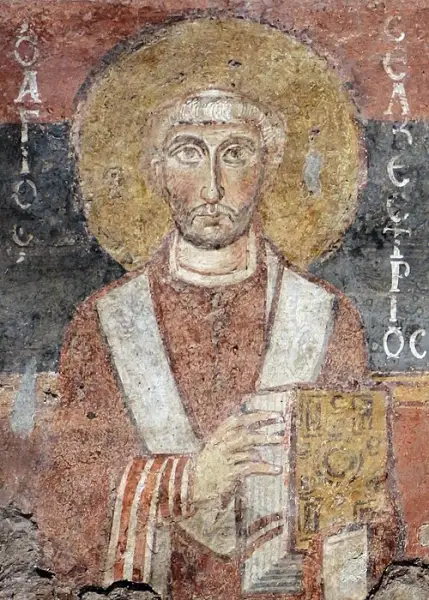
Overview
Sylvester I held the bishopric of Rome from 31 January 314 until 31 December 335, the day he died, a pontificate of twenty-one years spanning the transformation of the Church from persecuted sect to the religion of the emperors. Born before 284, according to his traditional chronology, and the son of a Roman named Rufinus, he occupied the Roman see at a decisive hour, though of his life very little can be known. Under him the Council of Arles met in 314 and condemned the Donatist sect in its separatism, and in 325 the First Council of Nicaea assembled to settle the Arian controversy over the divinity of Christ. The age of Constantine also changed the face of Rome: the Basilica of Saint John Lateran, Old Saint Peter's Basilica, the Basilica of the Holy Cross in Jerusalem, and several churches over the graves of martyrs all arose in these years. Later ages embroidered his memory with the legend of Constantine's baptism and the forged Donation of Constantine, fictions that made the pope the emperor's benefactor and master. He was buried in the Catacomb of Priscilla on the last day of December, the date the West still keeps as Saint Sylvester's Day.
The Complete Life
A Roman Son Before the Peace
Sylvester was born before 284 by the reckoning of his traditional chronology, and the Liber Pontificalis, the great book of the popes, preserves the one certain fact of his family: Rufinus, a Roman, was his father. His traditional biography places his birth at Asculam, in Italy. Beyond this the sources fall silent, for Sylvester belonged to a generation of Roman Christians whose lives were lived under the shadow of the last and fiercest persecutions, and the Church that survived those years recorded little of the biographies of its clergy. The account of his pontificate in the Liber Pontificalis, compiled in the seventh or eighth century, offers little beyond an inventory of the gifts that Constantine I was said to have bestowed on the Roman church, a treasure list where a life should be. Such silence is itself eloquent: the man who would preside over the Church's emergence into daylight came of age in its night, formed by a community that met in the burial grounds of its martyrs and elected its bishops knowing the office might cost them everything. When he succeeded Miltiades on the last day of January 314, the age of danger was ending and the age of marble was beginning.
§ Personal biography
The See of Rome in the Constantinian Turning
Sylvester took up the bishopric of Rome on 31 January 314, inheriting the see at the precise moment when the emperor Constantine's favor remade the condition of Christians throughout the empire. His election cannot have been predictable in its consequences, for no bishop of Rome had yet governed a church free to build, assemble, and deliberate in public. The sources themselves admit that he occupied the See of Rome in an important era of the Western Church's story, even while conceding how little of his life can be recovered. The first test came quickly: the quarrel over the Donatists, the rigorist sect of North Africa that denied the validity of sacraments administered by traditores, reached the new pope's tribunal almost at once, and Sylvester responded by convening a council. The pattern of his reign emerges from these years: a bishop of Rome exercising, for the first time on an imperial stage, the office of convoker and judge for the churches of the West, while the emperor supplied the means by which the Church's decisions could be gathered and published. The persecuted community had become a institution with councils, basilicas, and public doctrine, and Sylvester was its first full steward in Rome.
§ Pontificate
Councils, Basilicas, and the Defense of the Faith
Two councils anchor the record of Sylvester's pontificate. The first was the Council of Arles in 314, which he convened and which condemned the separatist Donatist sect, settling, at least for the moment, the African schism that had split the Church of Carthage. The second was the First Council of Nicaea in 325, convened to resolve the Arian controversy, the teaching that denied the full divinity of the Son; the council's confession that the Son is of one substance with the Father became the cornerstone of Christian doctrine, and its promulgation fell within the Roman pontificate that had called for it. The peace of the Church transformed the physical city of Rome as well. During Sylvester's episcopate the large basilicas of the new age were founded and built: the Archbasilica of Saint John Lateran, the cathedral of the bishops of Rome; the Basilica of the Holy Cross in Jerusalem; Old Saint Peter's Basilica, rising over the apostle's grave; and several churches erected over the graves of the martyrs, turning the cemeteries of the persecuted into sanctuaries of pilgrimage. The bishop who had perhaps been born under Diocletian presided over a Rome whose skyline now proclaimed the faith his predecessors had died for.
§ Pope Sylvester I
The Legend of Constantine's Baptism
Long after his death, Sylvester became the hero of one of the most consequential fictions of the Middle Ages. An early version appeared in the Symmachian forgeries of the early sixth century, produced in the curia of Pope Symmachus, and it flowered in the Donation of Constantine, a forgery of the late eighth century that claimed to give the emperor's own account of his conversion and the privileges he had conferred on Sylvester, his clergy, and their successors. In the legend, Constantine, in the story, was cleansed of leprosy through the power of the baptismal water the pope administered; abjectly grateful, the emperor acknowledged the bishop of Rome as primate over every other bishop, laid aside his imperial insignia, and walked ahead of Sylvester's horse carrying its bridle like a papal groom, while Constantine abandoned Rome to the pope and removed himself to Constantinople. In the Donation's telling, Sylvester was even offered the imperial crown and refused it. Norman Cantor judged the teaching smuggled in by this charming tale to be a radical one: every ruler, even the Roman emperor, stands beneath the pope, holding his crown as the pontiff's gift and removable by papal decree. That legend spread widely, and Gregory of Tours cited it in his history of the Franks in the 580s, and it seemed to support the Gelasian doctrine of papal authority guiding imperial power. Folk imagination added marvels of its own: a Sicilian tale in which Sylvester baptizes a sickly Constantine and his Jewish retinue from a woodland cave, and the widespread legend that the pope slew a dragon, the dying beast that often accompanies him in art.
§ Legacy
Saint Sylvester's Day at the Year's End
Sylvester was buried in the Catacomb of Priscilla on 31 December 335, and the West keeps his feast on that day, the last of the year, so that the calendar closes upon the memory of the pope who buried the age of persecution. The Eastern churches keep him on 2 January in the revised calendar, or 15 January in the traditional reckoning, and the Armenian Apostolic Church honors him on 22 December. In German-speaking countries, and in some lands near them, New Year's Eve is called simply Silvester, the saint's name given to the night itself; elsewhere the day is known as Saint Sylvester's Day or the Feast of Saint Sylvester. In São Paulo, Brazil, a long-distance running event held every 31 December carries his name as the Saint Silvester Road Race, a curious afterlife of a fourth-century bishop in the streets of a modern metropolis. His relics are venerated in the Abbey of Saint Sylvester at Nonantola, and he is counted the patron of Feroleto Antico, of the Sylvestrine Benedictines, and of Nonantola itself. He is venerated across the Catholic Church, the Anglican Communion, the Eastern and Oriental Orthodox churches, and the Lutheran Church, and his later namesake, Pope Sylvester II, chose the name expressly in imitation of him.
§ Legacy
Timeline
- 31 Jan 314
Became bishop of Rome, succeeding Miltiades at the dawn of the Constantinian age
§ Pope Sylvester I
- 314
Convened the Council of Arles, which condemned the separatist Donatist sect
§ Pontificate
- 325
Convened the First Council of Nicaea, called to resolve the Arian controversy
§ Pope Sylvester I
- 31 Dec 335
Died in Rome after twenty-one years as bishop, and was buried that day in the Catacomb of Priscilla
§ Legacy
- 514
By the death of Pope Symmachus this year, his curia had circulated the Symmachian forgeries spreading the legend of Constantine's cure and baptism
§ Legacy
In Their Own Words
The doctrine behind this charming story is a radical one: The pope is supreme over all rulers, even the Roman emperor, who owes his crown to the pope and therefore may be deposed by papal decree.
The Record
- Major works
- Archbasilica of Saint John Lateran·Old St. Peter's Basilica·Basilica of the Holy Cross in Jerusalem (Santa Croce in Gerusalemme)
- Patron of
- Feroleto Antico·Sylvestrine Benedictines·Nonantola
- Symbols
- papal vestments·papal tiara·bull·dragon
- Canonization
- Pre-congregation canonization; venerated from antiquity across the Catholic, Orthodox, Anglican, and Lutheran traditions
Prayer
Bibliography
Show 8 sources
- Annuario Pontificio per L'anno 2008. Libreria Editrice Vaticana, 2008. p. 8*. ISBN 978-88-209-8021-4.
- Lieu, Samuel N.C. (2006). "Constantine in Legendary Literature". In Lenski, Noel (ed.). The Cambridge Companion to the Age of Constantine. Cambridge University Press. pp. 298–323. ISBN 978-0-521-52157-4.
- Cross, F. L.; Livingstone, E. A., eds. (2005). "Sylvester I, St.". The Oxford Dictionary of the Christian Church (3rd rev. ed.). Oxford University Press. ISBN 978-0-19-280290-3.
- Butler, Alban (1981). Butler's Lives of the Saints, Volume 4. Christian Classics. p. 644. ISBN 978-0-87061-046-2.
- Kirsch, J.P. (1912). "Pope St. Sylvester I". In Herbermann, Charles (ed.). Catholic Encyclopedia. Vol. 14. New York: Robert Appleton Company.
- Cantor, Norman F. (1993). The Civilization of the Middle Ages (Revised ed.). New York: HarperCollins. p. 177. ISBN 978-0060170332.
- Pitrè, Giuseppe, Fiabe, novelle e racconti popolari siciliani, Volume terzo, Palermo 1875. pp. 39–42.
- Pohlsander, Hans A. (2002). The Emperor Constantine. Taylor & Francis. p. 25. ISBN 978-0-203-13721-5.
Profile text adapted from the Wikipedia article, licensed CC BY-SA 4.0.
Pray with this saint every day
Save St. Sylvester I to your favorites, read the full profile, and get feast-day reminders in the Saints app.
Get the Saints AppFree on the App Store for iPhone and iPad