
died 19 July 514·Feast July 19
St. Symmachus
Pope who survived the Laurentian schism unjudged
Overview
Symmachus was bishop of Rome from 22 November 498 until his death on 19 July 514, a fifteen-year pontificate dominated by the most serious schism the Roman church had yet endured. A pagan by birth, on the island of Sardinia while it lay under Vandal rule, and a son of Fortunatus, he received baptism in Rome and rose to become archdeacon under Pope Anastasius II, an outsider among the aristocratic clergy of the city. His election in the Constantinian basilica was contested the same day by the archpriest Laurentius, elected by a Byzantine-sympathizing faction, and King Theodoric the Great had to arbitrate before Symmachus prevailed. Accused in 501 of keeping Easter wrongly, unchastity, and misuse of church property, the pope fled his judges at Ariminum, an act counted against him, and Laurentius returned to Rome as a rival. Four synods later, the bishops assembled at Palma in 502 ruled that the successor of Peter could not be judged by men, leaving his cause to God, and in 506 Theodoric finally withdrew his support from Laurentius. Symmachus aided the exiled Catholic bishops of Africa and Sardinia, ransomed prisoners, granted Caesarius of Arles his pallium, and died with a reign of fifteen years, seven months, twenty-seven days behind him.
The Complete Life
A Pagan from Sardinia in the Roman Church
Symmachus entered the world far from the city whose church he would one day govern: his birth took place on the Mediterranean island of Sardinia, which then obeyed the Vandal kingdom, and his father was a man named Fortunatus. More striking still, Jeffrey Richards, noting his pagan birth, pronounces him possibly the rankest outsider among the Ostrogothic popes, who for the most part sprang from Italy's aristocratic families. Somewhere in his early manhood he made his way to Rome, received baptism there, and climbed the ordinary ladder of the Roman clergy until, under Pope Anastasius II, he stood as archdeacon of the Roman Church, the senior deacon responsible for much of the church's administration and alms. The conversion of an adult pagan was no small matter in the late fifth century, and it may explain both the fervor of his advancement and the suspicion he later met in Rome's clubbable clerical elite. When Anastasius died in 498 after a brief and conciliatory pontificate, the elective machinery of the Roman church split in two. The archdeacon from Sardinia had his party; so did the archpriest Laurentius, favored by those who looked toward Constantinople. Rome went to the polls twice on the same day.
§ Early life
Two Popes in One Day
On 22 November 498 the clergy of Rome fractured. Symmachus was elected in the Constantinian basilica of Saint John Lateran, while the archpriest Laurentius, candidate of a faction with Byzantine sympathies backed by the Eastern emperor Anastasius, was elected at the Basilica of Saint Mary, presumably Saint Mary Major. The city held two claimants to the chair of Peter, and neither party would yield. Both factions agreed to let the Gothic King Theodoric the Great arbitrate, and the king decided in favor of whichever candidate had been elected first and could show the greater number of supporters, a judgment that was political in essence, and an investigation found for Symmachus. Shadows lingered: the Laurentian Fragment, an early document, alleges that papal bribery bought the judgment, and the deacon Magnus Felix Ennodius of Milan later wrote that four hundred solidi had found their way into the hands of influential personages whose names it would be indiscreet to give. The new pope moved quickly to heal the breach. He summoned a synod to Rome for 1 March 499, attended by seventy-two bishops and the entire Roman clergy, and Laurentius came. The assembly assigned Laurentius the diocese of Nuceria in Campania, whether, as the Liber Pontificalis says, guided by sympathy, or, as the Laurentian Fragment insists, under threat, and decreed that any cleric who canvassed for a future papal succession during a pope's lifetime should be deposed and excommunicated.
§ Papacy
Accusation, Flight, and Four Synods
In 501 the truce collapsed. Accusations from the senator Rufius Postumius Festus, who favored Laurentius, rained down on Symmachus, crimes of many kinds, opening with the claim that he kept Easter on the wrong date. Theodoric summoned the pope to Ariminum to answer, but on arrival Symmachus discovered that further charges awaited him as well: unchastity, and squandering of the church's goods. He panicked, fleeing the city in the middle of the night with a single companion, and his flight was counted an admission of guilt. Laurentius returned to Rome, though most of the senior clergy withdrew from his communion, and Theodoric appointed the visiting bishop Peter of Altinum to celebrate Easter 502 and administer the see pending judgment. The synod that met in Santa Maria Maggiore, presided over by the metropolitans of Ravenna, Milan, and Aquileia, deadlocked over the apostolic visitor, for his presence implied the see was vacant, and the see could be vacant only if the pope were already guilty. Rioting emptied the synod; Theodoric ordered it to reconvene on 1 September. Then came blood: a mob attacked Symmachus' party as he set out for the session, wounding many and killing the priests Gordianus and Dignissimus, after which the pope retreated to Saint Peter's and refused to emerge. Finally, on 23 October 502 at Palma, seventy-six bishops resolved that the successor of Peter the Apostle could not be judged by men, left the matter to God, and ordered all who had abandoned his communion to be reconciled.
§ Ariminum Synod II
Alms for the Exiles, Ransom for Captives
Amid the recriminations of the schism, the record preserves a quieter portrait of Symmachus as a bishop of works. Money and clothing flowed from him to Catholic bishops of Africa and Sardinia whom their Arian Vandal rulers had driven into exile, men who had lost their sees, their churches, and often their liberty for refusing the confession of their barbarian masters, many of them exiles from the very island of his birth. Prisoners from upper Italy he likewise ransomed, sending them away with gifts of aid, buying back captives from the borderlands where the wars of Goths and empire had filled the roads with the enslaved. These acts bound the distant churches to Rome: the charity of the apostolic see flowed north to captive Italians and across the sea to persecuted Africans, and the bishops who received it knew to whom they owed their survival. In the same spirit of building communion, his meeting in 513 with Caesarius of Arles, detained in Italy, led to the bishop's receiving the pallium, and Caesarius later wrote back asking Symmachus' help in establishing his authority at home, help the pope was eager to supply, seeking in Klingshirn's judgment outside support for his primacy. Charity and jurisdiction traveled together in the practice of this troubled pope, each strengthening the other.
§ End of papacy
The End of the Schism and a Quiet Death
Though the synod of Palma had settled the principle, the schism itself ground on. Laurentius came back to Rome, where, the Laurentian Fragment relates, he occupied the Roman churches and reigned as pope through the four years that followed with the backing of Senator Festus. The struggle between the factions was waged on two fronts: mob violence between the religious camps, vividly described in the Liber Pontificalis, and a war of documents, which produced the so-called Symmachian forgeries, a sheaf of fabricated judgments in ecclesiastical law supporting the claim that a pope could not be called to account. Diplomacy proved more effective than either. Two supporters from outside Rome, Ennodius the Milanese deacon and Dioscorus the exiled deacon, pressed Theodoric until finally, in 506, the king withdrew his support from Laurentius and instructed Festus to hand the Roman churches over to Symmachus. The pope had held his see through eight years of contest, and his remaining eight years were comparatively untroubled, marked by the grant of the pallium to Caesarius of Arles and his quiet works of alms. He died on 19 July 514, and was buried in Saint Peter's Basilica, having governed, as the sources record with Roman exactness, fifteen years, seven months, twenty-seven days.
§ End of papacy
Immunity Forged in Controversy
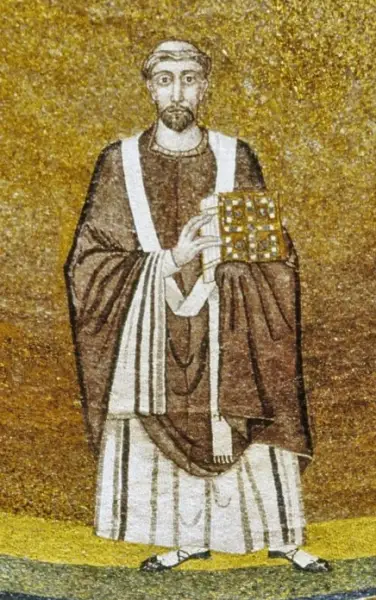
The Laurentian schism left the papacy stronger in principle than it had ever been. The synod of Palma's doctrine, that the successor of Peter cannot be judged by any human tribunal, became a foundation stone of medieval papal claims, and the fabricated legal opinions of the Symmachian forgeries, composed in all likelihood during the third Roman synod to supply the conclusion reached at Palma, circulated for centuries afterward as authentic law. The principle was born of a pope's need, forged in partisan documents and mob violence, and later ages inherited it without its context. Symmachus himself entered the calendar of the saints of the Catholic Church, with his feast on 19 July, the day of his death. Yet the memory of the contest kept its irony: though Laurentius ranks as an antipope, the portrait hanging in the papal gallery of the Church of Saint Paul's is his, while Symmachus' own image has been lost to the accidents of art and time. Historians remain divided over his character, reading the same events through partisan sources, the hostile Laurentian Fragment on one side, the adulatory Life of Symmachus on the other. The outsider from Sardinia, pagan-born and baptized in Rome, thus remains what Richards called him, an enigma at the origin of one of the papacy's greatest constitutional claims.
§ End of papacy
Timeline
- 22 Nov 498
Elected bishop of Rome in the Constantinian basilica, while the archpriest Laurentius was elected the same day by a rival faction
§ Papacy
- 1 Mar 499
Opened a synod at Rome attended by 72 bishops and the whole Roman clergy, which reconciled Laurentius and barred canvassing for the papacy
§ Roman Synod I
- 501
Accused by Senator Festus of various crimes, he fled the summons to Ariminum in the night, an act his enemies read as an admission of guilt
§ Ariminum Synod II
- 23 Oct 502
The synod assembled at Palma declared that the successor of Peter could not be judged and left his cause to God
§ Palmaris Synod IV
- 506
King Theodoric withdrew his support from Laurentius and instructed Senator Festus to hand the Roman churches over to Symmachus
§ End of papacy
- 513
Received the visiting bishop Caesarius of Arles and granted him the pallium, beginning a correspondence that bolstered the papal primacy
§ End of papacy
- 19 Jul 514
Died in Rome, closing a rule of fifteen years, seven months, twenty-seven days, and was laid to rest in St. Peter's Basilica
§ Death
In Their Own Words
perhaps the rankest outsider
to gather outside support for his primacy
The Record
- Symbols
- papal tiara·mosaic portrait
- Canonization
- Pre-congregation canonization; venerated as a saint in the Catholic Church from antiquity
Prayer
Bibliography
Show 7 sources
- Davis, Raymond (2000), The Book of Pontiffs (Liber Pontificalis): The Ancient Biographies of the First Ninety Roman Bishops to AD 715, Liverpool University Press, ISBN 978-0-85323-545-3.
- Richards, Jeffrey (1979), The Popes and the Papacy in the Early Middle Ages, 476–752, London: Routledge & Kegan Paul, ISBN 978-0-7100-0098-9.
- Klingshirn, William E. (1994), Caesarius of Arles: Life, Testament, Letters, Glasgow: Liverpool University Press, ISBN 978-0-85323-368-8.
- Moorhead, John (1978), "The Laurentian Schism: East and West in the Roman Church", Church History, 47 (2): 125–136.
- Kirsch, Johann Peter (1913). "Pope St. Symmachus". In Herbermann, Charles (ed.). Catholic Encyclopedia. New York: Robert Appleton Company.
- Townsend, W. T. (1933), "The so-called Symmachan forgeries", Journal of Religion, 13 (2): 165–174.
- Demacopoulos, George E. (2013), The Invention of Peter: Apostolic Discourse and Papal Authority in Late Antiquity, Philadelphia: University of Pennsylvania Press, ISBN 978-0-8122-4517-2.
Profile text adapted from the Wikipedia article, licensed CC BY-SA 4.0.
Pray with this saint every day
Save St. Symmachus to your favorites, read the full profile, and get feast-day reminders in the Saints app.
Get the Saints AppFree on the App Store for iPhone and iPad