
died c. 137·Feast January 5
St. Telesphorus
Second-century pope, martyr, and Carmelite patron
Overview
Telesphorus led the church of Rome from about 126 until his death around 137, serving across the reigns of the emperors Hadrian and Antoninus Pius and standing eighth in the traditional succession after Peter. A man of Greek stock, he came from Thurii in Calabria, and the Liber Pontificalis records that he had lived as a hermit before taking up the bishopric — a detail that would later make him a beloved patron of the Carmelite order. His pontificate unfolded in a capital that attracted every kind of teacher, including the Gnostic preachers he combated, chief among them the philosopher Valentinus, who had recently arrived from Egypt and gathered a large following in the city. A letter of Irenaeus preserved by Eusebius shows that Telesphorus kept Easter always on a Sunday, while unlike his successor Victor he stayed in communion with communities that kept another custom. Later tradition credits his reign with the beginnings of Christmas Midnight Mass, a seven-week Lent, and the singing of the Gloria, though the historian Johann Peter Kirsch judges these attributions unreliable. What is certain, on Irenaeus's testimony written around 180, is that Telesphorus died a martyr — the first pope after Peter whose martyrdom is so early attested. He was buried beside his predecessors in the Vatican Necropolis.
The Complete Life
A Greek of Calabria
Telesphorus came from Thurii, the ancient town on Italy's southern coast that today bears the name Terranova da Sibari, in Calabria, and his family roots were Greek rather than Latin — a reminder of how thoroughly Hellenic speech and thought shaped the Christian communities of the western Mediterranean in the second century. His birth year is unknown; the sources that preserve his memory care nothing for chronology before his election. What the Liber Pontificalis does preserve is the shape of his life before Rome: he had been an anchorite, a monk-like solitary given over to prayer and ascetic discipline. That makes him a rare figure among the early bishops of the imperial capital, most of whom surface in the record only as names in a list. A man formed in the desert silence of solitary prayer arrived to govern a church pressed from without and divided from within, and the church never forgot it. Centuries later, when the Carmelites searched the earliest generations of Christian history for forerunners of their eremitical vocation, they found him: a pope who had first been a hermit, and they took him as one of their own.
§ Biography
Bishop of Rome in the Age of Hadrian
Telesphorus assumed the bishopric of Rome around the year 126 and held it until about 137, spanning the closing years of Hadrian and the accession of Antoninus Pius. Eusebius, working from older records in his Church History, dates the beginning of the pontificate to the twelfth year of Hadrian's reign and the death to the first year of Antoninus Pius, a slightly different reckoning that modern tables usually harmonize to the years 126 to 137. He stands eighth in the traditional roll of bishops after Peter, succeeding Sixtus I and yielding the see to Hyginus. The Rome he governed was the administrative hub of an empire that let ideas travel freely along its roads and among its peoples, and the city drew orthodox teachers and innovators alike. Governing that mixed population fell to a bishop whose own formation was ascetic rather than administrative, and whose decade in office would prove to be the most precisely attested martyr-episcopate of the subapostolic church.
§ Biography
Guarding the Flock Against Gnosis
The defining struggle of Telesphorus's pontificate was with Gnosticism, the wave of speculative teaching that promised salvation through secret knowledge. Because Rome was the crossroads of the empire, every doctrine found its way there, and during these years the most influential of the Gnostic teachers was the philosopher Valentinus, who had relocated from Egypt to the capital and maintained a substantial following there for more than two decades. Telesphorus opposed these teachers vigorously, convinced that their mysticism detached religion from the concrete reality of incarnation, sacrament, and history. His second great concern, known from a fragment of a letter Irenaeus wrote to Pope Victor during the Easter controversy of the late second century, was the date of the resurrection feast. Telesphorus belonged to those bishops of Rome who always celebrated Easter on a Sunday rather than on the weekday fixed by the Jewish Passover calculation. Yet where Victor would later threaten to break with the churches of Asia Minor over this very question, Telesphorus took a softer path: he kept his own practice while remaining in full communion with communities that observed the older reckoning, a precedent of firm belief joined to patient breadth.
§ Biography
Liturgy Attributed to His Reign
Later ages attached to Telesphorus's name a remarkable cluster of liturgical firsts: the tradition of Mass at midnight on Christmas, Easter kept always on a Sunday, a Lenten fast of seven weeks leading up to Easter, and the Gloria sung in the Christian assembly. Whether he actually decreed any of them is doubtful. The historian Johann Peter Kirsch, weighing the sources, states plainly that none of the claims in the Liber Pontificalis and other late authorities about this pope's liturgical decisions can be treated as genuine, since they come from writers far removed from his own century. Still, the attributions are not meaningless. They show how the Roman church remembered him — as a father of its worship, the man in whose time the great annual cycle of feasts and fasts began to take the shape later Christians would recognize. And the devotion to a hermit-pope suggests something deeper: a memory of the second-century church as austere, watchful, and unseduced by the fashionable mysticism of the age, qualities the tradition found summarized in the figure of the anchorite from Calabria who shepherded Rome.
§ Biography
Martyrdom and Burial
Telesphorus died around the year 137, and Irenaeus, writing his Against Heresies around 180, says that he suffered martyrdom — not merely that he was called a martyr by pious convention. The distinction matters enormously. Many of the earliest bishops of Rome are labeled martyrs by sources like the Liber Pontificalis, which in its oldest form dates no earlier than the third century; Telesphorus is the only one of them for whom a witness stands so close to the events, and his is therefore the earliest pope's martyrdom attested after that of Peter himself. The circumstances of his death are not recorded: whether he fell in a general persecution or was singled out, the sources are silent. What is known is where he was laid. He was buried in the Vatican Necropolis, beside the tombs of the bishops who had ruled the Roman church before him, in the ground hallowed by the grave of the apostle. There the pilgrims of the ancient city could honor him, and there his remains rest still beneath the great basilica that later centuries would raise above the apostle's tomb.
§ Biography
Honored from the Beginning
Telesphorus belongs to the company of saints canonized not by decree but by the unanimous devotion of the church, a pre-congregation saint whose cult arose because his blood had been shed for Christ and his tomb had drawn pilgrims from the first generations. The Roman Martyrology keeps his feast on 2 January, and the Catholic and Eastern Orthodox churches both observe 5 January in common, while other Eastern churches remember him on 22 February. Few early bishops of Rome can claim so firm a place on the calendars of East and West alike, and fewer still can claim so early and so weighty a witness to their crown. His name appears among the saints of the Catholic Church in every catalog of the pontiffs, and his martyrdom, guaranteed by Irenaeus's testimony, gives him a peculiar dignity in the long line of Roman bishops: he is the first of Peter's successors whose confession unto death stands attested within living memory of the apostolic age, a link between the church of the martyrs and the see that Peter had watered with his own blood.
§ Patronage
The Hermit-Pope of the Carmelites
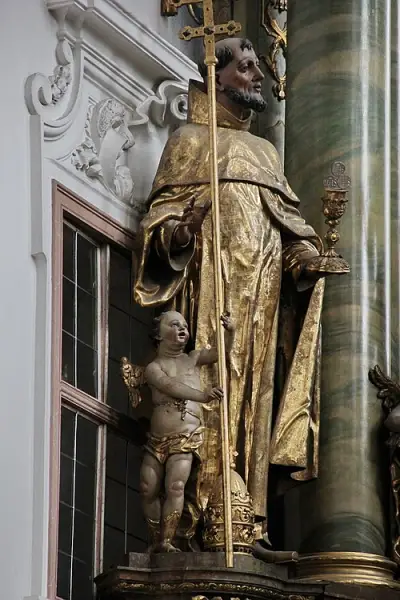
Telesphorus's afterlife has been surprisingly vivid for a man of the second century. Until the seventeenth century the Carmelite order venerated him as a patron, reasoning that a pope who had lived as a hermit belonged to the spiritual ancestry of the sons of Mount Carmel; a stained glass window in the Carmelite monastery of Boxmeer, in the Netherlands, bears his image and keeps his memory before the friars who prayed beneath it. Geography keeps his name too: the municipality of Saint-Télesphore, in the southwest of the Canadian province of Quebec, is named for him, a title entered in the official bank of Quebec place names. In art he wears the papal vestments of a much later age, a fourteenth-century depiction in the Carmelite Monastery of Straubing in Bavaria showing him in the regalia of a medieval pontiff. For historians he remains something more precise: the eighth bishop of Rome, the first whose martyrdom early testimony guarantees, and the pope whose era saw the Roman church define itself against Gnostic speculation while holding communion generously with those who worshipped on a different calendar.
§ Patronage
Timeline
- 126
Became bishop of Rome, succeeding Sixtus I, during the reign of Emperor Hadrian
§ Pope Telesphorus
- 128
Eusebius dates the pontificate's opening to the twelfth regnal year of Hadrian
§ Biography
- 137
Suffered martyrdom at Rome and was laid to rest in the Vatican Necropolis alongside the bishops who preceded him
§ Biography
- 138
Eusebius gives his death in the first year of Antoninus Pius, the year after the usual date
§ Biography
The Record
- Major works
- Traditionally associated with the institution of Christmas Midnight Masses, Easter celebrated on Sundays, a seven-week Lent, and the singing of the Gloria
- Patron of
- Carmelites
- Symbols
- Papal vestments
- Canonization
- Pre-congregation; his martyrdom is the earliest one a contemporary witness attests for any pope after Peter
Prayer
Bibliography
Show 6 sources
- Kirsch, Johann Peter. "Pope St. Telesphorus." The Catholic Encyclopedia. Vol. 14. New York: Robert Appleton Company, 1912.
- Chisholm, Hugh, ed. (1911). "Telesphorus". Encyclopædia Britannica (11th ed.). Cambridge University Press.
- "St. Telesphorus Window", Boxmeer, The Netherlands.
- "Reference number 57684". Banque de noms de lieux du Québec. Commission de toponymie du Québec.
- Attwater, Donald and Catherine Rachel John. The Penguin Dictionary of Saints. 3rd edition. New York: Penguin Books, 1993. ISBN 0-14-051312-4.
- Kelly, J.N.D. Oxford Dictionary of Popes. (1986). Oxford, England: Oxford University Press.
Profile text adapted from the Wikipedia article, licensed CC BY-SA 4.0.
Pray with this saint every day
Save St. Telesphorus to your favorites, read the full profile, and get feast-day reminders in the Saints app.
Get the Saints AppFree on the App Store for iPhone and iPad