
c. 175 – 230·Feast May 25
St. Urban I
Bishop of Rome in the peaceful reign of Severus
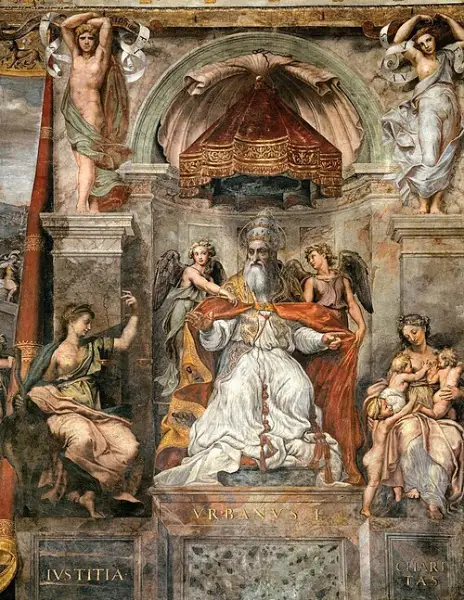
Overview
Urban I, a Roman born around 175, was bishop of Rome from 222 until his death on 23 May 230, succeeding the martyred Callixtus I and preceding Pontian. Though much of his life is wrapped in obscurity and later legend, he holds a distinction no earlier pope can claim: his is the first reign whose dates can be established with certainty, thanks to Eusebius's history and an inscription in the Coemeterium Callisti that bears his name. He took office in the year Emperor Elagabalus was assassinated and served throughout the reign of Alexander Severus, a time when the imperial government no longer promoted persecution and the Roman church enjoyed relative freedom — freedoms under which it grew so markedly that Urban came to be remembered as a gifted converter of souls. Within the city, however, the schismatic Hippolytus still led a rival congregation, and Urban is said to have kept his predecessor's firm line against that party. A decree governing the offerings the faithful brought to Mass bears his name, directing that such gifts serve the church's needs, the common good, and the poor. For centuries Urban was believed martyred, but recent scholarship concludes he died a natural death. His tomb, long sought between the Praetextatus cemetery and the Catacomb of Callixtus, remains a matter of scholarly debate.
The Complete Life
A Roman Born Around 175
Urban came from the city he would one day govern, born in Rome around the year 175, when the church there was still a generation removed from the age of the apostles' immediate successors. Of his family, his education, and his path to the ministry, history preserves nothing; he enters the record only when he emerges as bishop of Rome. The silence is characteristic of the third-century papacy, where even the reigning pontiffs of the imperial capital are known chiefly by their names and the length of their reigns. What can be said is that he grew to manhood and church office in the decades before the great theological controversies and persecutions of the mid-third century, in a Roman community still marked by the tensions between its mainstream and the rigorist circles that would produce the schism of Hippolytus. When Callixtus I died a martyr's death and the leadership of the Roman church fell vacant, Urban, by then a man of mature years, was chosen to succeed him, taking up the burden of the see in troubled and in hopeful circumstances alike.
§ Pontificate
The First Datable Pontificate
Urban's reign has a distinction unique among the earliest popes: although sources for his life are scarce and much about him is shrouded in mystery, he is the first bishop of Rome whose term of office can be definitely dated. Two witnesses make this possible — Eusebius's early-church history, together with an inscription in the Coemeterium Callisti that names him as pope. Reading the two together, Urban took up the papacy in 222 — the very year the emperor Elagabalus met assassination — and died on 23 May 230. The whole of his pontificate therefore fell within the reign of Alexander Severus, whose government took a different attitude toward Christianity than many before it: Severus did not promote the persecution of the church. This accident of politics shaped Urban's episcopate profoundly. Where his predecessors had often led a community under threat, Urban shepherded a church permitted to organize, build, and recruit openly, and the sources suggest that the Roman Christian community used that breathing space well. His election followed the martyred Callixtus I, so the transition from a persecuted to a tolerated ministry took place under a single, steady hand.
§ Pontificate
Growth, Schism, and the Gifts of the Faithful
The relative freedom the church enjoyed under Severus bore fruit in numbers: the Christian community of Rome grew during Urban's pontificate, so markedly that later writers judged him a skilled converter. But the growth of the mainstream congregation did not end the internal quarrel it had inherited. It is believed that the schismatic Hippolytus still led a rival Christian congregation in the city during these years, and that it was he who published the Philosophumena, a polemic aimed at Urban's predecessor Callixtus. Faced with this continuing division, Urban reportedly carried forward Callixtus's hard line against the schismatic party, refusing concessions to a rival communion that had attacked his predecessor so bitterly. Alongside this firmness, tradition preserves a more pastoral monument: a papal decree attributed to Urban on the donations believers made at Mass, which stipulated that such gifts serve only ecclesiastical ends, the general welfare of the Christian community, and the poor — they being the consecrated offerings of the faithful, the sinners' atonement offering, and the patrimony belonging to the needy. In that one sentence the pastoral economics of the early Roman church survive: worship, welfare, and the forgiveness of sins bound together in a single fund of charity.
§ Pontificate
Death and the Question of His Tomb
For centuries it was believed that Urban, like so many of the early popes, had died a martyr. Modern historical discoveries have overturned that assumption, and scholars now hold that he died of natural causes, closing his pontificate at Rome on 23 May 230. Where his body lay, however, has proved a genuinely stubborn puzzle. For a long time scholars assumed that Urban lay buried in the Coemetarium Praetextati, where a tomb bearing his inscription could be seen. Then the Italian archaeologist Giovanni de Rossi, excavating in the Catacomb of Callixtus, uncovered the lid of a sarcophagus suggesting that the pope had in fact been interred there, and found also a list of martyrs and confessors buried at Saint Callistus's that contained Urban's name. De Rossi concluded that the Urban of the Praetextatus cemetery was another bishop, and that the pope rested in the Catacomb of Saint Callistus. Many historians accept this, but doubt persists: a list drawn up under Pope Sixtus III of the saints buried at Saint Callistus places Urban not among the succession of popes but in a list of foreign bishops. The pope's grave therefore remains an open question between the two cemeteries.
§ Tomb
Saint of East and West
Whatever the uncertainty of his death, the church's veneration of Urban never wavered, and he is honored as a saint both by the Catholic Church and by the Eastern Orthodox Church, his feast being kept on 25 May. His cult attached itself early to the legends of the Roman martyrs: in the story told of Saint Cecilia, it was Urban who received her husband Valerianus and her brother-in-law Tiburtius among his converts, binding his name to one of the most beloved martyr families of the Roman tradition. Devotion to him has left physical traces across Europe. A relic from his body is preserved in the Monok Roman Catholic Church in Hungary, placed there through the generosity of Pope Clement XIV, who in 1773 donated it to the Andrássy family. In Poland he is invoked as a patron of Cieszowa, and among the faithful he has also been taken as a protector of family doctors — an unexpected patronage for a third-century pope, but a reminder of how widely his intercession was trusted. As a pre-congregation saint he needs no decree for his honors; the unanimous memory of the churches of East and West has been his canonization.
§ Tomb
Legends, Poets, and Painters
Because no contemporary account of Urban's pontificate survives, the imagination of later centuries filled the silence, and many legends and acts attached to his name are fictitious or impossible to verify. The legendary Acts of Saint Cecilia and the Liber Pontificalis both carry material about him whose reliability is doubtful. A tale once printed in the Catholic Church's Breviary relates that among his many converts were Tiburtius and Valerianus, the husband of Cecilia, and credits him with the wonder-working feat of felling an idol by prayer — a marvel said to have brought on his beating, torture, and beheading, an account that reflects the older belief in his martyrdom. Another story, now recognized as a sixth-century invention, had Urban ordering silver liturgical vessels and patens for the twenty-five titular churches of Rome. Geoffrey Chaucer made him a character in The Second Nun's Tale of The Canterbury Tales, carrying the third-century pope into English poetry. Art remembers him in two principal guises: seated in the papal tiara and robes with a sword pointed toward the ground, or in papal garb and mitre holding a Bible and a bunch of grapes, with rarer scenes showing his supposed beheading, the falling idols, or the young Valerian kneeling before him, as in the twelfth-century fresco at Chalivoy-Milon.
§ Legends and myths
Timeline
- 222
Became bishop of Rome in the year of Emperor Elagabalus's assassination, succeeding the martyred Callixtus I
§ Pontificate
- 230
Died in Rome on 23 May, probably of natural causes, after eight years as pope
§ Pope Urban I
- 1773
Pope Clement XIV donated a relic of Urban's body to the Andrássy family, now kept in the Monok Roman Catholic Church in Hungary
§ Tomb
In Their Own Words
The gifts of the faithful that are offered to the Lord can only be used for ecclesiastical purposes, for the common good of the Christian community, and for the poor; for they are the consecrated gifts of the faithful, the atonement offering of sinners, and the patrimony of the needy.
The Record
- Major works
- A papal decree on the use of the faithful's offerings at Mass, attributed to him
- Patron of
- Family doctors·Cieszowa
- Symbols
- Papal tiara and a sword pointed toward the ground·Bishop's mitre with a Bible and a bunch of grapes
- Canonization
- Pre-congregation; a saint of the Catholic Church and the Eastern Orthodox Church from antiquity
Prayer
Bibliography
Show 6 sources
- Kirsch, Johann Peter (1912). "Pope Urban I" in The Catholic Encyclopedia. Vol. 15. New York: Robert Appleton Company.
- "Pope Urban I". newadvent.org. New Advent, LLC. Retrieved 9 October 2022.
- Kung, Hans. The Catholic Church: A Short History. New York; The Modern Library, 2003, p. 41.
- Herbermann, Charles, ed. (1913). "Pope Urban I". Catholic Encyclopedia. New York: Robert Appleton Company.
- Roman Breviary.
- Calendarium Romanum (Libreria Editrice Vaticana, 1969), p. 124.
Profile text adapted from the Wikipedia article, licensed CC BY-SA 4.0.
Pray with this saint every day
Save St. Urban I to your favorites, read the full profile, and get feast-day reminders in the Saints app.
Get the Saints AppFree on the App Store for iPhone and iPad