
died 199·Feast July 28
St. Victor I
African-born pope of the Easter controversy
Overview
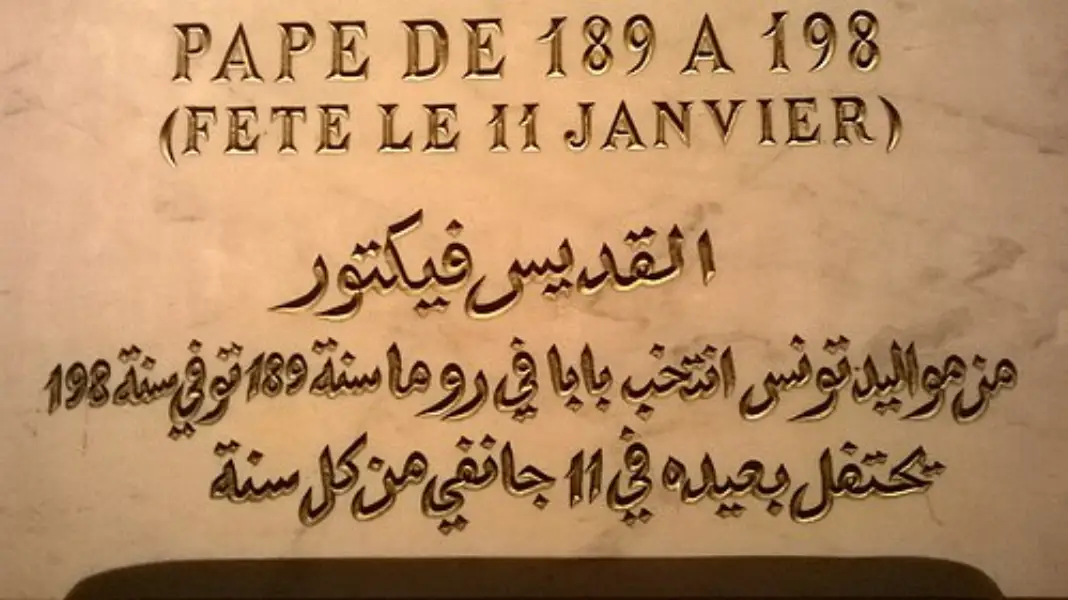
Victor I, who died in 199, was a Roman African prelate of Berber origin who governed the church of Rome in the last decade of the second century, the first pope known to have come from the African provinces of the empire. The ancient sources do not agree on the exact years of his episcopate: Eusebius sets his accession in 189, the tenth year of the emperor Commodus, while Jerome's Chronicle prefers 193 and other witnesses 186; the most commonly accepted reconstruction gives him a reign of nine or ten years, from about 189 to 198 or 199, after which Zephyrinus succeeded him. Two episodes define his pontificate. On the testimony of a writer whom Eusebius quotes, Victor cast out Theodotus of Byzantium for claiming that Christ was no more than a man — an early defense of the Savior's full divinity. He is better remembered, however, for the Quartodeciman controversy. The churches of Asia Minor kept Easter on the fourteenth of Nisan whatever the weekday, and when synods across the Christian world disapproved of the custom, Victor alone moved to sever communion with those ancient churches, whose bishops included Polycrates of Ephesus — an act of severity for which Irenaeus and others rebuked him. He was later honored as a saint and martyr, and a bilingual plaque in the Cathedral of Saint Vincent de Paul in Tunis commemorates the African-born pope.
The Complete Life
A Son of Roman Africa
Victor was born in the Roman Province of Africa, in the city of Leptis Magna on the North African coast, and he was of Berber origin — a fact that makes him the first bishop of Rome known to have come from the African provinces of the empire. Nothing survives of his family, his education, or the road that carried him from a provincial town of Roman Libya to the capital of the empire and its Christian community; the sources that preserve his pontificate are silent about everything before his accession. His African birth is nonetheless more than a curiosity. The church of the late second century was thoroughly Mediterranean, its leaders drawn from Syria, Greece, Italy, and now Libya, and Victor's election shows a Roman community in which Christians of African origin could rise to its highest office. His name in Latin and his African tongue would have stood alongside Greek, the working language of the Roman church in that age. Modern Tunisia, where he is remembered by a commemorative plaque in Tunis, and modern Libya, where he was born, both count him among their gifts to the papacy.
§ Biography
An Uncertain Chronology, Firmly Remembered
The dates of Victor's episcopate are among the most disputed of the early papacy, because the ancient witnesses disagree. Eusebius places his accession in the tenth year of the emperor Commodus, the year 189, a dating that the scholar Lipsius accepted as correct. Jerome's version of the Chronicle instead places the accession under Pertinax, or in the first year of Septimius Severus — that is, 193 — while the Armenian version of Eusebius assigns it to Commodus's seventh year, 186; the Liber Pontificalis connects it with the consulate of Commodus and Glabrio, again 186, and the Liberian Catalogue, on which the Liber Pontificalis drew for its chronology, is damaged precisely where his reign would be recorded. Nor do the sources agree on its length: the Armenian Chronicle allows him twelve years, the Liberian Catalogue nine years, two months, and ten days, the Liber Pontificalis ten years and the same months and days, and Eusebius has Zephyrinus succeeding about the ninth year of Severus. Weighing the evidence, Lipsius concluded that Victor held office between nine and ten years, giving the dates 189 to 198 or 199 that most modern accounts follow.
§ Biography
Guarding the Faith, Dividing the Churches
Two actions of Victor's pontificate stand out in the record. The first is doctrinal: an anonymous writer whom Eusebius quotes relates that Victor cast out Theodotus of Byzantium, a teacher who held Christ to be no more than a man. In casting out this early adoptionist error, the bishop of Rome gave one of the first recorded exercises of his office in defense of what the great councils would later define as the full divinity of the incarnate Lord. The second is the affair that made his name: the Quartodeciman controversy. The churches of Asia Minor celebrated Easter on the fourteenth day of the Jewish month of Nisan, whatever day of the week it fell, honoring the date of the Crucifixion as they said the apostles had taught them; the Latins, who kept the feast on the Sunday following, called them Quartodecimans. Synods met throughout the Christian world — under Theophilus of Caesarea and Narcissus of Jerusalem in Judea, under Palmas in Pontus, under Irenaeus in Gaul, under Bishop Bachillus in Corinth, and in Mesopotamia's Osrhoene — all disapproved of the Asian practice and wrote letters declaring that the mystery of the resurrection was accomplished on the Lord's Day alone. Yet the general feeling was that such a venerable difference was no ground for excommunication. Victor alone proved intolerant of it: he severed ties with those ancient churches, whose bishops included Polycrates of Ephesus, and for that severity Irenaeus and others rebuked him, according to Eusebius.
§ Biography
Martyr's Title and African Memory
Victor died in 199, whether by violence or in peace the record does not say, and he was succeeded by Zephyrinus. The church that remembered him gave him the title of martyr: his feast was celebrated on 28 July as that of Saint Victor I, Pope and Martyr, a name still found in the General Roman Calendar of 1954, while another tradition keeps his memory on 11 January. The calendar of 1969 removed the feast, but his cult belongs to the earliest stratum of papal veneration, and as a pre-congregation saint he stands among the pontiffs the church has honored from antiquity. His African origins have not been forgotten in his homeland: a bilingual plaque in the Cathedral of Saint Vincent de Paul in Tunis commemorates him, marking the memory of the Berber-born bishop in the land nearest his birth. Among historians he remains a figure of first importance, both for the chronology of the second-century papacy, in which his reign anchors the succession from Eleutherius to Zephyrinus, and for the Quartodeciman controversy, in which his severity provoked one of the earliest recorded rebukes of a Roman bishop by the wider church, even as it showed how far the see of Rome would press its judgment in matters of the universal calendar.
§ Biography
Timeline
- 189
Acceded as bishop of Rome in the tenth year of Emperor Commodus, according to Eusebius, succeeding Eleutherius
§ Biography
- 199
Died in Rome, closing an episcopate of about nine or ten years, and was succeeded by Zephyrinus
§ Biography
The Record
- Canonization
- Pre-congregation; honored as "St Victor I, Pope and Martyr" with a feast on 28 July
Prayer
Bibliography
Show 6 sources
- Kirsch, Johann Peter (1912). "Pope St. Victor I" in The Catholic Encyclopedia. Vol. 15. New York: Robert Appleton Company.
- Avis, Paul (2018). The Oxford Handbook of Ecclesiology. Oxford University Press. pp. 627–628. ISBN 9780191081378.
- Raymond D. Davis, The book of Pontiffs (Liber Pontificalis) (Liverpool: University Press, 1989), pp. 6, 94.
- "Philip Schaff: NPNF2-01. Eusebius Pamphilius: Church History, Life of Constantine, Oration in Praise of Constantine". Christian Classics Ethereal Library. www.ccel.org. Retrieved 2022-01-20.
- Josef Rist. "VICTOR I.". Biographisch-Bibliographisches Kirchenlexikon (BBKL).
- Handl A. (2016). Viktor I. (189?-199?) von Rom und die Etablierung des "monarchischen" Episkopats in Rom. Sacris Erudiri: a Journal on the Inheritance of Early and Medieval Christianity, 55, 7-56.
Profile text adapted from the Wikipedia article, licensed CC BY-SA 4.0.
Pray with this saint every day
Save St. Victor I to your favorites, read the full profile, and get feast-day reminders in the Saints app.
Get the Saints AppFree on the App Store for iPhone and iPad