
600 – 672·Feast January 27
St. Vitalian
Pope who reconciled Rome with Constantinople
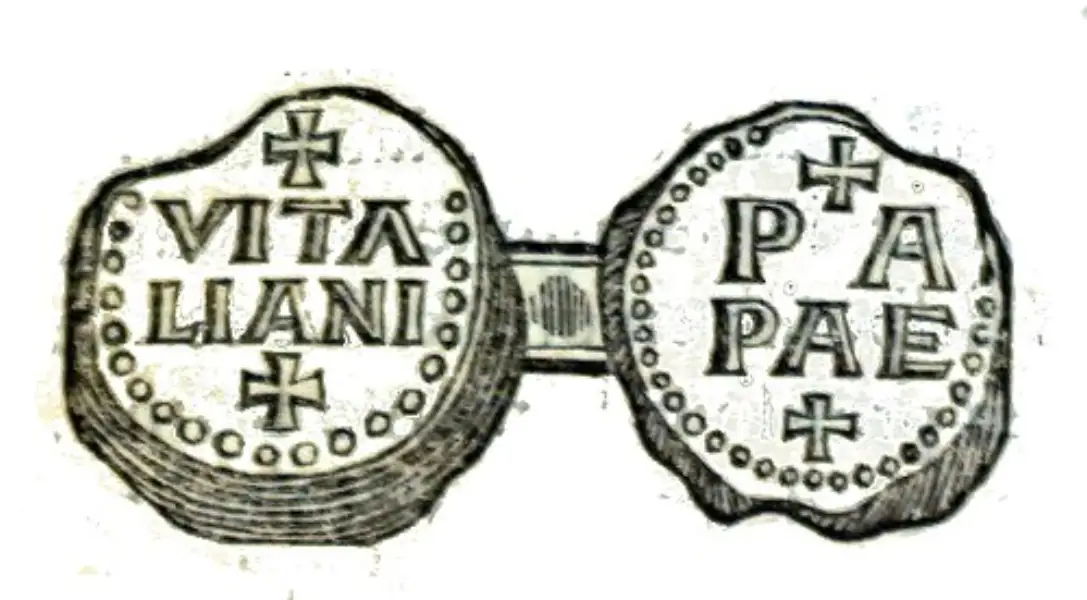
Overview
Vitalian, born at Segni in Lazio on 21 September 600, the son of Anastasius, was bishop of Rome from his consecration on 30 July 657 until his death on 27 January 672. His pontificate was dominated by the long quarrel between the papacy and the imperial government at Constantinople over Monothelitism, the teaching of a single will in Christ that Rome condemned. Against that background Vitalian proved a patient diplomat: he announced his elevation to Emperor Constans II and to Patriarch Peter of Constantinople, received in reply a confirmation of the Holy See's privileges and a magnificently bound codex of the Gospels, and saw his name entered on the diptychs of the Byzantine churches — the only pope so honored between Honorius I and the Sixth Ecumenical Council. When Constans visited Rome in 663, Vitalian received him with full ceremony at Saint Peter's. Yet the same years saw darker episodes: a joint order with the emperor and Patriarch Peter that helped bring Maximus the Confessor to condemnation and exile, and the schism of the Archbishopric of Ravenna, whose archbishop Maurus declared himself independent of Rome. In the West Vitalian's record shines more brightly: after the Synod of Whitby he sent Theodore of Tarsus as archbishop of Canterbury, shaping English Christianity for centuries. He died in 672 and was succeeded by Adeodatus II.
The Complete Life
A Son of Segni
Vitalian was born on 21 September 600 at Segni, a hill town of Lazio that then belonged to the Eastern Roman Empire, and his father bore the Greek name Anastasius — a small witness to how thoroughly the Byzantine world and the Latin West were interwoven in seventh-century Italy. Of his childhood and formation the record says nothing; he surfaces in history as a candidate for the papal throne in the summer of 657. His hometown, nevertheless, was no obscure corner of the Christian world: Segni lay in the Roman duchy, within easy reach of the Eternal City, in an age when Greek-speaking administrators, eastern monks fleeing Monothelete persecution, and Latin clergy moved constantly along the roads between Campania and Rome. A man born at the turn of the seventh century would have reached priestly maturity during the last great persecuting phase of the Monothelite dispute, when Pope Martin I was seized by imperial officers and ended his life in exile, and Pope Eugene I reigned in the uneasy aftermath. When Eugene died on 2 or 3 June 657, the choice of the Roman church fell on Vitalian, son of Anastasius of Segni.
§ Election
Election and First Overtures
Pope Eugene I died in early June 657; Vitalian was chosen to succeed him and received consecration on 30 July of that year, keeping his baptismal name as his reign's first mark of continuity. He inherited a papacy estranged from Constantinople, where the imperial court and patriarch defended Monothelitism, the doctrine of one will in Christ that Rome had refused to accept. Vitalian moved at once to reopen the conversation without abandoning the Roman position. He sent letters — the customary synodica — announcing his elevation both to Emperor Constans II and to Patriarch Peter of Constantinople, a prelate inclined to the Monothelete cause. The emperor's reply was favorable: he affirmed the Holy See's prerogatives as the Church's head in the West, and dispatched to Rome a Gospel codex whose gold cover was richly set with precious stones, a gesture of goodwill. Patriarch Peter also replied, cautiously and somewhat noncommittally on the disputed doctrine, yet giving the impression of accord with the pope. On these careful exchanges, ecclesiastical intercourse between the sees of Rome and Constantinople was renewed, and the diptychs of the Byzantine churches received Vitalian's name — the only pope's name so entered between the death of Honorius I in 638 and the Sixth Ecumenical Council of 680–81.
§ Monothelitism
The Emperor at Saint Peter's
The high point of Vitalian's diplomacy came in 663, when Emperor Constans II came to Rome on his way to campaign against the Lombards and spent twelve days in the city. On 5 July the pope and his clergy went out to the sixth milestone to meet the emperor and brought him in procession to Saint Peter's Basilica, where Constans offered gifts. On the following Sunday the emperor went in state to the basilica, presented a pallium wrought with gold, and assisted at the Mass the pope celebrated; he dined with Vitalian on the Saturday, attended Mass again on the Sunday, and then took his leave. The visit's darker sequel came swiftly: on departing Italy Constans stripped Rome of a host of bronze artworks, including the bronze tiles of the Pantheon's roof, a building long dedicated to Christian worship. Vitalian's conciliatory course carried a heavy price elsewhere. Together with Constans and Patriarch Peter he took part in issuing a joint order requiring all to be in communion with the Church of Constantinople, a measure bound up with the condemnation and exile of Maximus the Confessor, the great defender of Christ's two wills. After Constans was assassinated at Syracuse in 668, Vitalian backed his son Constantine IV against the usurper Mezezius and helped him gain the throne, hoping thereby to win the new emperor for orthodoxy — an effort that ultimately failed, though Rome's ties with the palace endured.
§ Monothelitism
Schism at Ravenna and a Name Struck from the Diptychs
The closing years of the pontificate were shadowed by rebellion closer to home. The Archbishopric of Ravenna, which reported directly to Rome, chafed under that dependence: Archbishop Maurus, who held the see from 644 to 671, sought to make it autocephalous. When Vitalian called him to account for his theological position, Maurus would not obey and proclaimed himself independent of Rome, inaugurating a schism. The pope excommunicated him; Maurus responded by excommunicating Vitalian in return. Emperor Constans II threw his weight behind the archbishop, issuing an edict that removed Ravenna from Rome's patriarchal jurisdiction and ordered that its archbishop receive the pallium from the emperor instead. Maurus's successor Reparatus was consecrated in 671 with the schism still standing, and its suppression would wait for the pontificate of Leo II in 682–83. Meanwhile the hoped-for conversion of Constantine IV came to nothing. The Monothelete Patriarch Theodore I of Constantinople struck Vitalian's name from the diptychs, undoing the reconciliation so carefully built; only with the Sixth Ecumenical Council, after Vitalian's death, was Monothelitism suppressed and the pope's name restored to the Byzantine churches. Vitalian died in Rome on 27 January 672, aged seventy-one, and Adeodatus II succeeded him.
§ Western Church relations
A Saint of the Undivided Tradition
Vitalian is honored as a saint by the Roman Catholic Church, and the Eastern Orthodox Church likewise numbers him among the holy pontiffs, a remembrance reaching back to the era before the two communions drew apart. His feast is kept on 27 January, the day of his death, though some accounts record his celebration on 23 July. He belongs to the company of pre-congregation saints, honored not by formal process but by the continuous devotion of the churches. His cult reflects, in part, the memory of a pope who held communion with East and West at once: his name stood on the diptychs of Byzantium when no other pope's did, and his letters opened a dialogue that the Sixth Ecumenical Council would complete. To that same reconciling memory belongs the tradition that the introduction of church organ music into Western worship dates from the time of his papacy — an artistic legacy as enduring as any doctrinal settlement, and one that has filled the churches of his flock with music ever since.
§ Death and legacy
England, Crete, and the Sound of Organs
Vitalian's most fruitful work lay in the far northwest of Christendom. The church in England was divided between Anglo-Saxon and British clergy over various ecclesiastical customs, and at the Synod of Whitby King Oswy of Northumbria accepted Roman practice in the keeping of Easter and the form of the tonsure, aligning his kingdom with Rome. Vitalian answered this turn toward Rome with a gift of his own: he dispatched a highly educated monk, Theodore of Tarsus, a man who commanded both Latin and Greek, to serve as archbishop of Canterbury. Theodore's long tenure organized the English church and left a mark on its learning and structure that endured for centuries — perhaps the most consequential appointment any seventh-century pope made. In the Mediterranean, too, Vitalian exercised pastoral oversight: when Bishop John of Lappa in Crete, a diocese under Roman jurisdiction, was deposed by a synod under Metropolitan Paul and imprisoned for appealing to Rome, he escaped and made his way to the pope. Vitalian convened a synod in December 667, pronounced John guiltless, wrote demanding his restoration to his diocese and the return of monasteries unjustly taken from him, and ordered the metropolitan to depose two deacons who had taken wives after consecration. And from his reign, tradition says, came a new sound in Western worship: the introduction of organ music into the church's solemn praise.
§ Western Church relations
Timeline
- 21 Sep 600
Born at Segni in Lazio, son of Anastasius
§ Election
- 30 Jul 657
Was elected and consecrated pope after the death of Eugene I, keeping his baptismal name
§ Election
- 5 Jul 663
Met Emperor Constans II at the sixth milestone from Rome and accompanied him to St. Peter's Basilica at the start of a twelve-day imperial visit
§ Monothelitism
- Dec 667
Held a Roman synod that pronounced Bishop John of Lappa of Crete guiltless after his unjust deposition by Metropolitan Paul
§ Authority over Bishops in Crete
- 668
Supported Constans II's son Constantine IV against the usurper Mezezius after the emperor's assassination at Syracuse
§ Monothelitism
- 671
Saw Reparatus, the successor of the schismatic Archbishop Maurus of Ravenna, consecrated amid the continuing Ravenna schism
§ Western Church relations
- 27 Jan 672
Died in Rome aged seventy-one and was succeeded by Adeodatus II
§ Death and legacy
The Record
- Major works
- Synodica letters announcing his elevation to Emperor Constans II and Patriarch Peter of Constantinople
- Canonization
- Pre-congregation; venerated as a saint in the Roman Catholic Church and the Eastern Orthodox Church
Prayer
Bibliography
Show 9 sources
- The Editors of Encyclopædia Britannica. "Saint Vitalian". Encyclopædia Britannica. Retrieved 15 August 2016.
- Miranda, Salvatore. "The Cardinals of the Holy Roman Church", Florida International University.
- Ekonomou, Andrew J. (2007). Byzantine Rome and the Greek Popes. Lexington Books. p. 162. ISBN 9780739119778.
- Richards, Jeffrey (2014). The Popes and the Papacy in the Early Middle Ages (Routledge Revivals) 476-752. Taylor and Francis. p. 194. ISBN 9781317678175.
- Allen, Pauline; Neil, Bronwen (2003). Maximus the Confessor and his Companions: Documents from Exile. Oxford University Press. p. 24. ISBN 9780198299912.
- Kirsch, Johann Peter (1912). "Pope St. Vitalian" in The Catholic Encyclopedia. Vol. 15. New York: Robert Appleton Company.
- Stenton, Sir Frank. Anglo-Saxon England, third edition (Oxford: Clarendon Press, 1971), pp. 123, 130.
- Brusher, Joseph S.J. (1959). "St. Vitalian". Popes Through the Ages. Christ's Faithful People.
- James-Griffiths, Paul (2016-08-20). "The earliest church organ". Christian Heritage Edinburgh. Retrieved 2024-01-14.
Profile text adapted from the Wikipedia article, licensed CC BY-SA 4.0.
Pray with this saint every day
Save St. Vitalian to your favorites, read the full profile, and get feast-day reminders in the Saints app.
Get the Saints AppFree on the App Store for iPhone and iPad