
died 26 December 418·Feast December 27
St. Zosimus
Bishop of Rome amid the Pelagian controversy
Overview
Zosimus served as bishop of Rome from 18 March 417 until his death on 26 December 418, a brief but stormy pontificate at the heart of late Roman church politics. The Liber Pontificalis records that he was a Greek whose father was named Abramius, though scholars have disputed what this origin implies. His time in office was dominated by two tangled disputes. In Gaul he threw his support behind the newly elevated see of Arles, granting Bishop Patroclus metropolitan rights over the provinces of Viennensis and Narbonensis and making him a kind of papal vicar, a decision that provoked the protests of Vienne, Narbonne and Marseille and remained unresolved for decades. In the Pelagian controversy he first appeared to favor Caelestius and Pelagius, whose confessions of faith he examined before the Roman clergy, drawing a sharp rebuke from the African bishops under Archbishop Aurelius of Carthage. After an African council and imperial action by Honorius, however, he issued the Tractoria, which finally condemned Pelagianism and its authors. He also clashed with the African bishops over the right of condemned clerics to appeal to Rome in the case of the priest Apiarius, mistakenly citing a canon of Sardica as Nicene. He died in Rome and was buried in the Basilica of Saint Lawrence outside the Walls.
The Complete Life
A Greek in the Roman Church
The earliest notice of Zosimus comes from the Liber Pontificalis, the book of the popes, which records that he was a Greek and that his father bore the name Abramius. Beyond these spare lines, almost nothing survives about his upbringing, his education, or the path that carried him from the Greek world into the church of Rome. The detail has provoked centuries of scholarly debate. The great German historian Adolf von Harnack reasoned that a father named Abramius suggested a family of Jewish origin, an inference that caught the imagination of later writers. The French historian Louis Duchesne, however, rejected this deduction, and the question remains open. What can be said with confidence is that Zosimus belonged to the cosmopolitan Christian world of the late fourth and early fifth centuries, when the city of Rome drew clergy from every province of the empire. By the time he emerged into history he was a senior figure of the Roman church, chosen to succeed Innocent I at a moment when the western empire was reeling from barbarian invasion and the church was fighting doctrinal battles over grace, free will, and the reach of papal authority. The Greek cleric who mounted the chair of Peter in March 417 inherited a church under pressure from every direction.
§ Family background
Raised to the See of Peter
Zosimus received consecration as bishop of Rome on 18 March 417, taking the place of Innocent I. Among those present at the festival stood Bishop Patroclus of Arles, whose own seat rested on remarkable circumstances: Constantius III had deposed Bishop Heros of Arles and installed Patroclus in his stead. Patroclus wasted no time courting the new pontiff. On 22 March, only four days after the ceremony, a papal letter reached him granting metropolitan authority across the Gallic provinces of Viennensis and both Narbonensis, together with the role of papal vicar throughout Gaul. Its most striking clause required every Gallic churchman traveling to Rome to carry papers of identity issued by Patroclus. Political calculation stood behind the arrangement: since the year 400 the praetorian prefect who administered the civil diocese of Gaul had resided at Arles rather than Trier, and Patroclus, backed by the commander Constantine, hoped to convert the city's civil pre-eminence into ecclesiastical primacy. From Vienne, Narbonne, and Marseille came indignant protests against the aggrandizement of Arles, and the exchanges of letters these provoked occupied Zosimus without ever producing a settlement.
§ Pontificate
The Pelagian Storm
Pelagianism furnished the defining battle of the pontificate. Caelestius, an exponent of the doctrine already anathematized under Innocent I, arrived in Rome to lodge an appeal after his expulsion from Constantinople. During the summer of 418 the pope gathered his clergy in the Basilica of St. Clement, where Caelestius faced the propositions on which Carthage had condemned him in 411. He declined to anathematize them, yet offered a general confession of faith that won the assembly's approval. Zosimus declared himself satisfied, informed the African bishops that their proceedings had been precipitate, and commanded his accusers to appear at Rome within two months. Pelagius then sent his own confession together with a fresh treatise on free will; a second Roman synod read both and pronounced them sound doctrine, and the pope again took Pelagius's part while censuring his prosecutors, who included the Gallic bishops Hero and Lazarus. Aurelius of Carthage convened a synod whose blunt answer accused the pontiff of being deceived by heretics. Zosimus responded that no definitive judgment had been reached and none would be without African consultation. Only after the council of 1 May 418 dispatched another synodal letter, and Emperor Honorius moved against the Pelagians, did the pope publish his Tractoria, which condemned the heresy and its authors at last.
§ Confrontation with Pelagianism
The Case of Apiarius and a Divided Rome
A dispute that outlived him engulfed the closing months of his reign. Apiarius, a priest of Sicca, had been excommunicated by his own bishop for criminal conduct, yet instead of following the African church's carefully prescribed appellate procedure he carried his case straight to Rome. Zosimus admitted the appeal immediately and dispatched credentialed legates to investigate in Africa. Prudence might have suggested referring the matter first through the ordinary African channels; instead the pope rested his intervention on a canon he attributed to Nicaea but which in fact belonged to the Council of Sardica. Manuscript transmission explained the blunder: Roman copies appended the Sardican canons to the Nicene ones without a separate heading, whereas African manuscripts preserved only the genuine Nicene text, so the canon Rome invoked appeared nowhere in the African copies. A grave and lasting jurisdictional quarrel over appeals was the consequence. Zosimus died on 26 December 418 with the Roman clergy badly divided, his quarrelsome disposition having soured controversies in Gaul, Africa, and Italy alike. His remains were laid in the sepulchral Basilica of Saint Lawrence outside the Walls, and Boniface I succeeded him, inheriting both the Pelagian settlement and the smoldering African dispute.
§ Pontificate
Veneration from Antiquity
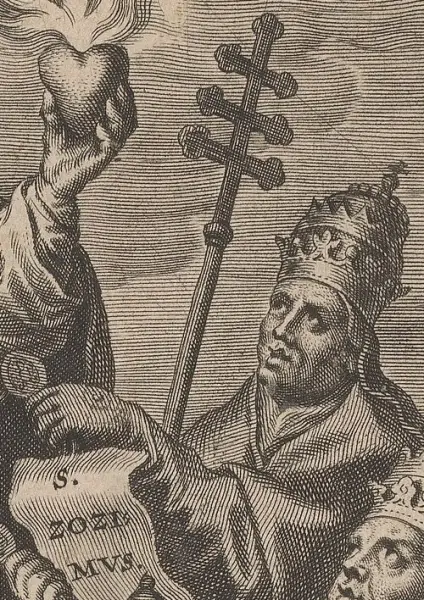
Zosimus belongs to the long line of early bishops of Rome whom the Church honors as saints without any formal process of canonization, a status later described as pre-congregation. His feast is kept on 27 December, the day after the Church commemorates his death on 26 December 418. His name entered the ancient lists of Roman pontiffs alongside the martyrs and confessors of the imperial city, and medieval catalogues of the popes transmitted his memory to later generations. An engraving by Cornelis Galle the Elder from around 1640 shows how his image continued to circulate among the cultivated Catholic public of the early modern period. The men and women of the early Roman church did not measure sanctity by the smoothness of a pontificate; they honored those who had borne the burden of office in perilous times and had died in communion with the faith they confessed. By that measure Zosimus, whatever the turbulence of his reign, took his place among the blessed succession of Peter. Pilgrims to Rome can still stand near his resting place at the Basilica of Saint Lawrence outside the Walls, one of the great sepulchral churches where the bishops of the ancient city were laid to rest.
§ Pontificate
Letters, Decrees, and an Unsettled Inheritance
Apart from the Tractoria, a substantial correspondence survives: letters sent to African bishops of the Byzantine province concerning a deposed prelate, and others dispatched to Gaul and Spain treating Priscillianism and promotion through the grades of clerical office. The Liber Pontificalis credits him with a decree regulating the maniple worn by deacons and another prescribing the dedication of Easter candles in country parishes, together with a prohibition barring clerics from taverns. These provisions offer a rare window onto a pope ordering both liturgy and the daily discipline of his clergy. His greater bequest, however, was a catalogue of unfinished conflicts. The privileges lavished on Arles kept the churches of Vienne, Narbonne, and Marseille at odds until Leo I finally composed the Gallic dispute. The Apiarius affair, resting on a Sardican canon mistaken for a Nicene one, fed the jurisdictional controversy with Africa over condemned clerics appealing to Rome. Historians have read his reign as a case study in how papal authority was constructed: Mar Marcos has analyzed the ways this pope pressed Roman claims against local autonomy and imperial control across the western churches.
§ Legacy
Timeline
- 400
Arles replaced Trier as the seat of the praetorian prefect of the Gallic diocese, strengthening the city's claim to ecclesiastical precedence.
§ Pontificate
- 411
Caelestius was condemned at Carthage on propositions drawn up by the deacon Paulinus of Milan.
§ Confrontation with Pelagianism
- 18 Mar 417
Zosimus was consecrated bishop of Rome, with Bishop Patroclus of Arles attending the festival.
§ Pontificate
- 22 Mar 417
He sent Patroclus of Arles a letter granting metropolitan rights over Viennensis and Narbonensis I and II.
§ Pontificate
- 29 Sep 417
He wrote a letter dealing with the metropolitan claims of Bishop Patroclus of Marseille.
§ Pontificate
- 1 May 418
The African council sent a new synodal letter to Rome pressing its case against Pelagianism.
§ Confrontation with Pelagianism
- 26 Dec 418
Zosimus died in Rome after issuing the Tractoria condemning Pelagianism; the Roman clergy were deeply divided at his death.
§ Pontificate
The Record
- Major works
- Tractoria condemning Pelagianism·Letters to the African bishops defending Pelagius and Caelestius·Letters concerning appeals of condemned clerics to the Roman See·Letters to the bishops of Gaul and Spain on Priscillianism and clerical ordination·Decrees on the maniple, Easter candles, and clerics visiting taverns attributed by the Liber Pontificalis
- Canonization
- Pre-congregation canonization; venerated as a saint from antiquity, with his feast kept on 27 December.
Prayer
Bibliography
Show 7 sources
- Herbermann, Charles, ed. (1913). "Pope St. Zosimus". Catholic Encyclopedia. New York: Robert Appleton Company.
- Chisholm, Hugh, ed. (1911). "Zosimus". Encyclopædia Britannica. Vol. 28 (11th ed.). Cambridge University Press. p. 1044.
- Adolf von Harnack, Sitzungsberichte der Berliner Akademie, 1904, 1050
- Louis Duchesne, Histoire ancienne de l'église, Tome III, deuxième édition (Paris: Fontemoing 1910), p. 228, note.
- Dalmon, L. (2009), "Le Pape Zosime et la tradition juridique romaine," Eruditio Antiqua 1 (2009) 141–154.
- Marcos, Mar (2013). "Papal Authority, Local Autonomy, and Imperial Control: Pope Zosimus and the Western Churches," in The Role of the Bishop in Late Antiquity: Conflict and Compromise. London: A&C Black/Bloomsbury Group. pp. 145–166. ISBN 978-1-78093-217-0.
- Loomis, Louise Ropes (tr.), ed. (1916). The Book of the Popes (Liber Pontificalis). Vol. I. New York: Columbia University Press. pp. 88–89.
Profile text adapted from the Wikipedia article, licensed CC BY-SA 4.0.
Pray with this saint every day
Save St. Zosimus to your favorites, read the full profile, and get feast-day reminders in the Saints app.
Get the Saints AppFree on the App Store for iPhone and iPad