
977 – 1048·Feast January 25
St. Poppo of Stavelot
Flemish knight turned monastic reformer
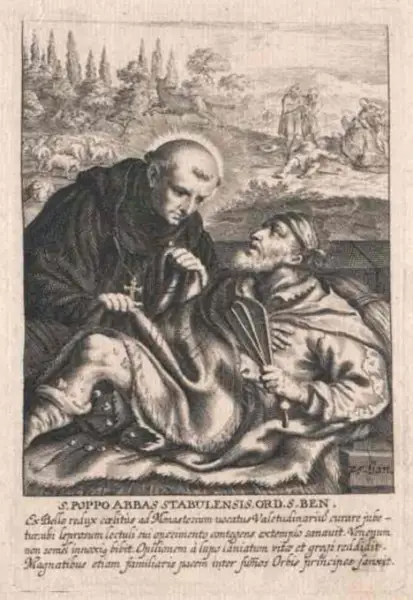
Overview
Poppo of Stavelot was born at Deinze in Flanders in 977 to a noble family, his parents being Tizekinus and Adalwif. Raised as a knight, he experienced a dramatic conversion while preparing for marriage, when a flame burst from the night sky and set his lance radiating, an event he took for an illumination of the Holy Spirit. He entered the monastery of Saint Thierry at Rheims in 1005 and three years later joined the reforming circle of Abbot Richard of Saint Vannes at Verdun. As prior of St. Vaast at Arras and later of Beaulieu in the Diocese of Verdun, he recovered monastic lands from vassals and secured the monasteries' possessions by deed. In 1020 Emperor Henry II appointed him abbot of Stavelot and Malmedy, and in 1023 he also received the Abbey of St. Maximin at Trier. Under Conrad II he became one of the most influential abbots of the German empire, entrusted with the supervision of imperial monasteries including Limburg, Echternach, St. Gall, and Hersfeld, through which the Cluniac reform reached German houses. He practiced severe asceticism and took no interest in literary or political affairs. Losing influence under Henry III, he died at the Abbey of Marchiennes on 25 January 1048 and was buried at Stavelot.
The Complete Life
A Knight of Flanders
Poppo first saw the light at Deinze in Flanders in 977, in the household of the nobleman Tizekinus and his wife Adalwif. Flemish aristocrats of that generation formed a warrior caste, and the boy was bred to arms, destined for an advantageous marriage like any young man of his station. Yet his life as a soldier was interrupted by journeys that enlarged it. Around the year 1000 he and two companions undertook the long, perilous road to the Holy Land, and he stands among the earliest Flemish pilgrims whose journey was set down in writing. Rome followed soon afterward, where he prayed at the apostles' tombs. The Vita Popponis, compiled soon after his death by the monk Onulf together with Everhelm, abbot of Hautmont, preserves these particulars and depicts a young noble already restless for something beyond his class's ambitions. The pilgrimage years sowed the seed of conversion, though he came home to Flanders and to the claims of his family, which included the marriage already arranged with a lady of good birth.
§ Biography
The Flame from the Sky
The turning point came late one night while Poppo was on the brink of marriage to a lady of noble family. A flame abruptly burst from the night sky and made his lance glow with radiance, an event Poppo took for an illumination of the Holy Spirit. Whatever natural explanation later chroniclers might have offered, the young knight read in the blazing spear a summons to abandon his former life. He soon renounced the marriage and entered the monastery of Saint Thierry at Rheims in 1005, exchanging the equipment of a soldier for the habit of a monk. Two influences now shaped the rest of his career. The first was monastic reform, the movement to restore strict observance, discipline, and economic security to the great houses of Lotharingia and the empire. Around 1008 Abbot Richard of Saint Vannes at Verdun, the foremost reformer of monasteries in those lands, took Poppo to his own monastery and formed him in the reformed life. The second influence was the trust of rulers, for the German emperors were looking for reliable abbots to carry their reform forward. Poppo would spend the rest of his life joining these two things: personal asceticism and the institutional renewal of monasteries entrusted to him by bishops and emperors.
§ Biography
Abbot and Reformer of the Empire
Richard first employed his disciple as a prior, sending him around 1013 to St. Vaast at Arras in the Diocese of Cambrai, where his task was to win back the monastery's estates from vassals and to guarantee its holdings by deed; before 1016 he held the same office at Vasloges, called also Beaulieu, in the Diocese of Verdun. In 1020 Emperor Henry II named him abbot of the twin houses of Stavelot and Malmedy in Lower Lorraine, and three years later the Abbey of St. Maximin at Trier was added to his charge. Under Conrad II his standing rose higher still. From St. Maximin the Cluniac reform now penetrated the German monasteries, and the emperor committed a series of imperial houses to Poppo's direction or oversight: Limburg an der Hardt, Echternach, Weissenburg, St. Gislen, Hersfeld, St. Gall, Hastières, Hautmont, and Waulsort. Once he had installed his pupils and kinsmen in these posts, the bishops and lay founders of yet other monasteries followed suit, giving him Hohorst, Brauweiler, Marchiennes, St. Vaast, St. Eucharius at Trier, St. Vincent at Metz, and St. Laurence at Liège. Seldom has one abbot carried so heavy a portfolio, held together by nothing but personal confidence.
§ Biography
Severe Asceticism, Hidden Holiness
Contemporaries knew Poppo above all for the severity of his asceticism, which his biographers presented as the engine of everything he accomplished. He had no interest in literary affairs, and unlike many great abbots of his age he left no writings; he lacked what later observers called management capacities in the ordinary sense, and he was not prominent in politics. His power rested instead on personal holiness, on the credibility of a man who lived more strictly than those he governed. The reform movement he served believed that the renewal of monastic life began with prayer, fasting, and the faithful observance of the rule, and that property and privileges were worth recovering only so that communities could keep that observance secure. In this spirit Poppo spent his decades as prior and abbot traveling between the houses entrusted to him, installing his pupils and kinsmen as heads of communities, and binding the monasteries of Lotharingia and the empire into a network of shared observance. His career shows how the spiritual authority of an ascetic could become an instrument of institutional reform, and how the Cluniac ideal traveled north and east through the personal influence of a single Flemish monk rather than through any formal legislation.
§ Biography
Last Years and Death
The accession of Henry III brought a cooling of the favor Poppo had enjoyed under Henry II and Conrad II, and the aged abbot lost influence at court. The great reform movement of Richard of Saint-Vanne, which Poppo had carried into the German empire, achieved no permanent success there, and the network of houses under his care could not outlast the personal bonds on which it was built. Poppo withdrew into the quieter work of governing his own abbeys, Stavelot and Malmedy, and the community at St. Maximin. He died while staying at the Abbey of Marchiennes, one of the houses that had been placed under his care in the north, on 25 January 1048. His body was carried back to the Abbey of Stavelot, the principal seat of his long abbacy, and buried there, where his tomb became the focal point of his cult. He had spent roughly forty years in monastic life, first as a converted knight, then as a prior recovering lost estates, and finally as the most widely entrusted abbot of his generation. The memory of that career was preserved for later ages in the Vita Popponis, written soon after his death by men of the reformed milieus he had served.
§ Biography
Saint of Stavelot
No formal process ever canonized Poppo, for he belongs to the eras when the Church acknowledged saints on the common voice of the communities that honored them. His grave at the Abbey of Stavelot became his chief shrine, and the abbey cherished him as the glory of its line of superiors over the double monastery of Stavelot-Malmedy. His feast was fixed on 25 January, the anniversary of his death in 1048, following the old custom of celebrating a saint on the day he entered heaven. Both the Roman Catholic Church and the Orthodox Church keep his commemoration, and medieval devotional compilations, the tradition behind the Patron Saints Index and the annual calendars, carried his name beyond the abbey walls that sheltered his remains. The Vita Popponis, that biography set down soon after his death by Onulf the monk and Everhelm of Hautmont, secured his cult for later ages by preserving the tale of the flaming lance and the pilgrim knight. In the Low Countries he endures as one of the memorable figures of the great age of monastic reform, the nobleman who exchanged worldly honor for cloister rigor.
§ Biography
Pilgrim, Reformer, Founder of Reform
Poppo left three distinct legacies. As a pilgrim he ranks among the earliest Flemish Christians on record to reach the Holy Land, a forerunner of the pilgrim and crusading movements soon to sweep his homeland, and his journey on to Rome modeled devotional travel as an aristocratic calling. As a monastic reformer he served as the chief conduit through which the Cluniac reform, passed down by his master Richard of Saint Vannes, entered the German monasteries from his Trier base at St. Maximin; the roster of houses emperors and founders committed to him stretches from Echternach and St. Gall to Hersfeld, Brauweiler, and Marchiennes, one of the longest ever entrusted to a single abbot. As a historical figure he exemplifies how reform worked in the eleventh-century empire: abbots were chosen and commissioned by rulers and founders, and success depended on the credibility and connections of individual men. Modern biographers concede frankly that the reform of Richard of Saint-Vanne never took permanent root in the German Empire, and that Poppo wrote nothing; his lasting monument is the memory of a converted knight whose severe asceticism won the trust of emperors.
§ Biography
Timeline
- 977
Born at Deinze in Flanders to the noble couple Tizekinus and Adalwif.
§ Biography
- 1000
Traveled with two companions on pilgrimage to the Holy Land, among the earliest Flemish pilgrims of record.
§ Biography
- 1005
Entered the monastery of Saint Thierry at Rheims after the heavenly flame over his lance convinced him of his calling.
§ Biography
- 1008
Was taken by Abbot Richard of Saint Vannes to his reforming monastery at Verdun.
§ Biography
- 1013
Was made prior of St. Vaast in Arras, in the Diocese of Cambrai, charged with reclaiming the monastery's lands.
§ Biography
- 1020
Emperor Henry II appointed him Abbot of the Abbeys of Stavelot and Malmedy in Lower Lorraine.
§ Biography
- 1023
Received in addition the Abbey of St. Maximin at Trier, his base for the reform of German monasteries.
§ Biography
- 25 Jan 1048
Died during a stay at the Abbey of Marchiennes; his body was carried back for burial at Stavelot.
§ Biography
The Record
- Major works
- Reform of the Abbeys of Stavelot and Malmedy·Reform of the Abbey of St. Maximin at Trier·Supervision of imperial monasteries: Limburg, Echternach, Weissenburg, St. Gislen, St. Gall, Hersfeld, Waulsort, Hautmont, Hastières·Care of houses including St. Laurence at Liège, St. Vincent at Metz, St. Eucharius at Trier, Hohorst, Brauweiler, St. Vaast and Marchiennes
- Canonization
- Pre-congregation canonization; venerated from the Middle Ages by the Roman Catholic and Orthodox Churches, feast kept on 25 January.
Prayer
Bibliography
Show 3 sources
- Uta-Renate Blumenthal (1991), The Investiture Controversy, ISBN 978-0-8122-1386-7, pages 42–3
- Timothy Reuter et al (2000), The New Cambridge Medieval History, ISBN 978-0-521-36447-8, page 182
- Onulf and Everhelm of the Abbey of Hautmont, Vita Popponis
Profile text adapted from the Wikipedia article, licensed CC BY-SA 4.0.
Pray with this saint every day
Save St. Poppo of Stavelot to your favorites, read the full profile, and get feast-day reminders in the Saints app.
Get the Saints AppFree on the App Store for iPhone and iPad