
c. 347 – 420·Feast February 26
St. Porphyrius of Gaza
Bishop who ended paganism in Gaza
Overview
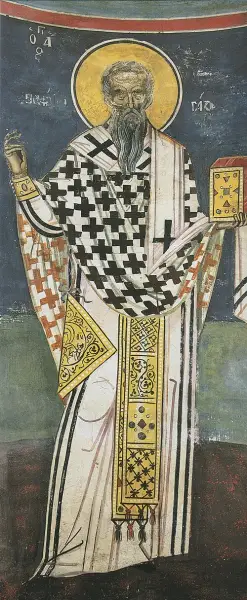
Porphyrius of Gaza, born at Thessalonica around the year 347, served as bishop of Gaza from 395 until his death in 420 and is remembered for bringing the stubbornly pagan city of Gaza to the Christian faith. Gaza had long been dangerous ground for believers: martyrs had died there under Diocletian, and under Julian its basilica had been burned, its Christians killed, and its church pushed outside the walls. When Porphyrius arrived at the age of forty-five, the Christian community numbered scarcely 280 souls. A drought in his first year was laid at his door by the worshippers of the god Marnas, and harassment of the faithful continued with official support. Undeterred, the bishop appealed over the heads of the local authorities, sending his deacon to Constantinople in 398 for an order closing the temples, and journeying to the capital himself in the winter of 401 and 402, where the empress Eudoxia won from Arcadius a decree for the destruction of the temples of Gaza. In May 402 eight sanctuaries, including the great Marneion, were burned or razed, and on their ruins rose the Eudoxiana, dedicated on 14 April 407. He died at Gaza on 26 February 420, and his tomb lies beneath the church that bears his name.
The Complete Life
From Thessalonica to the Desert
Porphyrius came into the world around 347 at Thessalonica, the great city of Macedonia, at a time when the empire had only lately emerged from its last great assault upon the Christian faith. Everything that is known of him is drawn from the vivid biography written by Mark the Deacon, the Vita Porphyrii, a work whose historical core modern scholars have debated but which preserves the memory of the end of paganism in Gaza in unmatched detail. The account presents a man who renounced a life of ease: his passage from wealth to extreme asceticism, so striking that modern students of his character have read it as a complete remaking of the self, set the pattern for everything that followed. He embraced poverty and the disciplines of the desert in the classic manner of the Palestinian ascetics of his age, and the reputation formed in that school of self-denial is what the church of a suffering city would one day call upon. Gaza, meanwhile, remained one of the strongholds of the old religion: its martyrs of the Diocletian era were recent memory, Julian's revival had seen its basilica burned and its believers killed, and its Christian congregation, hemmed outside the walls, counted fewer than three hundred members when he was called to lead them.
§ Account in Vita Porphyrii
A Bishop in a Hostile City
In 395, at the age of forty-five, Porphyrius was raised to the episcopal see of Gaza. He entered the city without incident, but the welcome that awaited him was soon made plain. Drought struck the region that same year, and the pagans ascribed the calamity to his arrival, declaring that the oracle of their god Marnas had warned that the feet of the new bishop brought misfortune upon the city. Harassment of the Christians followed, encouraged and protected by the local officials, and the position of the church remained what it had been: believers might not hold civil office, were treated with contempt, and worshiped in a building kept deliberately outside the walls. To the fourth-century bishops of the region had been given the telling title of bishops of the churches about Gaza, a phrase that measured the city's refusal. Porphyrius answered this hostility not by withdrawal but by petition and persistence, taking as his weapon the machinery of an empire now officially Christian. His first move came in 398, when he dispatched Marcus, his deacon and the future chronicler of his life, to Constantinople to secure an order closing the temples — an order that arrived, though its execution was soon corrupted by bribery.
§ Account in Vita Porphyrii
The Fall of the Marneion
The closing of the temples ordered in 398 proved hollow, for the commissioner Hilarius, bought with a great sum, left the Marneion — the sanctuary of Zeus Marnas, the city's chief god, an ancient deity of the Levant — standing untouched. Porphyrius therefore resolved to carry his cause to the summit of the empire. In the winter of 401 and 402, accompanied by the bishop of Caesarea Palaestina, he traveled to Constantinople and gained the ear of the empress Eudoxia. Though the emperor Arcadius hesitated, the petition was presented during the baptismal ceremony of the imperial infant Theodosius, and the empress secured the decree for the destruction of the temples of Gaza. In May 402 the envoy Cynegius put it into effect: the temples of Aphrodite, Hecate, the Sun, Apollo, Kore, Tyche, a hero's shrine, and at last the Marneion itself were pulled down or burned, the great temple fed with pitch and sulfur until it blazed for days, its stones carted off to pave the streets. Soldiers quartered in the emptied houses searched each dwelling in turn, consigning images and book collections alike to the flames under the charge of sorcery. On the leveled ground of the Marneion, at the empress's expense, there rose a vast basilica, the Eudoxiana, named in her honor.
§ Account in Vita Porphyrii
Ascetic and Intercessor
The power that Porphyrius exercised in Gaza flowed, in the account of his companion Marcus, from a life of extreme ascetic discipline. The man who confronted governors and empresses had first learned to conquer himself in the desert fashion of fourth-century Palestine, having abandoned substantial wealth for poverty, and his identity as an ascetic gave his words an authority that office alone could not supply. His method as a bishop combined this personal austerity with tireless advocacy: he prayed for the city that cursed him, endured the harassment of its crowds and the negligence of its officials, and meanwhile worked every channel available to him — deacon, fellow bishop, empress, emperor — until justice was done for his flock. Modern students of his career have described his episcopate as the deployment of charismatic authority in a resistant society, but his contemporaries described it more simply as holiness joined to perseverance. The confidence of his intercession was matched by a builder's hope: the Eudoxiana that rose from the ashes of the Marneion was his monument and his answer, a church in which the despised community of 280 souls would one day worship in the grandest building of their city, singing the faith for which their earlier brethren had died in the arena.
§ Account in Vita Porphyrii
The Bishop Beneath the Church
Porphyrius died at Gaza on 26 February 420, after a quarter of a century of episcopate that had transformed the city, and the date became his feast throughout the churches of East and West, which venerate him alike. His body is said to lie beneath the ruins of the Church of Saint Porphyrius in Gaza City, the shrine that still bears his name, and that ancient church has remained a living center of the Christian remnant of Gaza into the present day. The story of his life reached posterity through the pen of his own deacon: the Vita Porphyrii, circulating in Greek and Georgian recensions, is prized as a contemporary chronicle of how one city passed from paganism to Christianity, even as scholars debate how much of its color belongs to history and how much to the conventions of hagiography. A sixteenth-century fresco in a monastery of Mount Athos keeps his image among the great hierarchs, and far from Gaza a street in the Maltese town of Zejtun carries his name. In the Coptic Church he is honored among the Church Fathers, one of the ascetic bishops whose era decisively turned the Roman world to Christ.
§ Account in Vita Porphyrii
Timeline
- 347
Born at Thessalonica in the Roman Empire, according to the traditional date.
§ Account in Vita Porphyrii
- 395
Appointed bishop of Gaza at the age of forty-five, arriving in a city whose Christians were barred from office and worshiped under constant threat.
§ Account in Vita Porphyrii
- 398
Sent his deacon Marcus to Constantinople, obtaining an imperial order to close the pagan temples; the official Hilarius closed the others but took a bribe to leave the Marneion open.
§ Account in Vita Porphyrii
- 401
Traveled to Constantinople for the winter with the bishop of Caesarea Palaestina, winning the support of Empress Eudoxia for the destruction of Gaza's temples.
§ Account in Vita Porphyrii
- May 402
The imperial envoy Cynegius carried out the decree of Arcadius: eight temples of Gaza, among them the Marneion, were torn down or set alight.
§ Account in Vita Porphyrii
- 14 Apr 407
Dedicated the Eudoxiana, the great church raised on the ruins of the Marneion at the empress's expense.
§ Account in Vita Porphyrii
- 26 Feb 420
Died at Gaza after twenty-five years as its bishop; his body is said to rest beneath the ruins of the Church of Saint Porphyrius.
§ Account in Vita Porphyrii
The Record
- Major works
- The Eudoxiana, the great church of Gaza built upon the ruins of the Marneion
- Symbols
- bishop's vestments with omophorion·Gospel Book·right hand raised in blessing
- Canonization
- Pre-congregation; venerated by the Catholic, Eastern Orthodox, and Oriental Orthodox Churches.
Prayer
Bibliography
Show 6 sources
- Head, Thomas F. (2001). Medieval Hagiography: an anthology. Routledge.
- MacMullen, Ramsay (1984). Christianizing the Roman Empire. New Haven: Yale University Press.
- Uthemann, Karl-Heinz (1994). "Saint Porphyrius". Biographisch-Bibliographisches Kirchenlexikon (BBKL). Vol. 7. Herzberg: Bautz. cols. 848–854. ISBN 3-88309-048-4.
- Grégoire, H. and Kugener, M.-A. (1930). Marc le Diacre, Vie de Porphyre. Paris.
- Peeters, Paul (1941). "La vie géorgienne de Porphyre de Gaza". Analecta Bollandiana. 59: 65–216.
- "Saint Porphyrius, Bishop of Gaza". www.oca.org. Retrieved 2022-11-29.
Profile text adapted from the Wikipedia article, licensed CC BY-SA 4.0.
Pray with this saint every day
Save St. Porphyrius of Gaza to your favorites, read the full profile, and get feast-day reminders in the Saints app.
Get the Saints AppFree on the App Store for iPhone and iPad