
died c. 160·Feast January 14
St. Potitus
Teenage martyr of Roman Thrace
Overview
Potitus, an early Christian martyr, met his death around 160, still in his teenage years, under the emperor Antoninus Pius. His birthplace was Sardica — today Sofia, the Bulgarian capital — within the Roman province of Thracia, created in 107 after the Second Dacian War and was later renamed Dacia Inferior. According to his hagiography, set down in the ninth-century Passio Sancti Potiti, he belonged to a very rich pagan family yet turned to Christianity, and his brief life was marked by many attributed miracles, above all the curing of the madness of Agnes, the daughter of Antoninus Pius. Brought before the authorities, he refused to renounce his faith. He was thrown to the lions, which refused to attack him; he was then cast into boiling oil, from which he emerged unharmed; and he was finally put to death by the sword. Venerated on 14 January by the Roman Catholic and Eastern Orthodox Churches, Tricarico in southern Italy, with its diocese, adopted him as chief patron; there his chief relics repose in the cathedral. Ascoli Satriano and its diocese likewise honor him as principal patron. His cult spread widely in the Middle Ages, reaching Capua, Naples, and Benevento, where a Benedictine church of San Potito received a special office from Pope Clement XII.
The Complete Life
A Rich Pagan House in Sardica
Potitus was born at Sardica, the city that stands today as Sofia, capital of Bulgaria, within the Roman province of Thracia. Rome's Danubian expansion had created the province, established in 107 following the Second Dacian War and later renamed Dacia Inferior, and Sardica ranked among its leading towns. His hagiography relates that he came of a very rich pagan family, reared amid the comfort of a provincial elite faithful to the empire's ancestral gods. Nothing further survives about his parents, schooling, or boyhood, but the account insists that while barely more than a child he converted to Christianity, joining a persecuted minority against the expectations of household and society alike. The ninth-century Passio Sancti Potiti, the chief source for his life, depicts his youth as already crowded with wonders, crediting him with many miracles and pre-eminently the curing of the madness afflicting Agnes, daughter of the emperor Antoninus Pius. Whether the tale preserves the memory of a genuine boy from Thracia or legend accreted around an early tomb, East and West alike have honored him since antiquity as a martyr of the Antonine age.
§ Life
Conversion and Conflict
The conversion of a wealthy pagan youth to Christianity placed Potitus on a collision course with his family, his city, and ultimately the empire itself. His legend emphasizes that he had everything the world could offer: wealth, position, and the favor of a leading household, and that he surrendered the prospect of all of it for the name of Christ. The climactic wonder of his story, the deliverance of Agnes, the emperor's daughter, from madness, made his reputation impossible to ignore and, in the logic of the narrative, drew the attention of the imperial court to the young Christian in its midst. When he was required to renounce his faith, he refused. The hagiographical tradition surrounds his trial with marvels: thrown to the lions, the beasts refused to attack him; thrown into boiling oil, he emerged unharmed. Each failed execution became in the telling a public testimony to the power that accompanied his confession, until the authorities at last resorted to the sword, the one instrument that did not fail. The sequence of lions, oil, and sword gave his passion the shape that early Christian communities loved to retell, and it fixed his memory as a teenage martyr who conquered the wild beasts and the flames before submitting to a swift blade.
§ Life
A Martyr of the Ancient Church
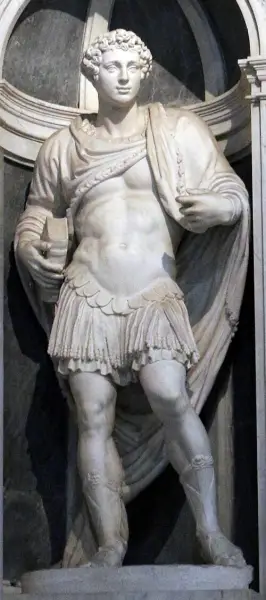
Potitus was never canonized by a formal process, for he died some thirteen centuries before such machinery existed; like the other martyrs of the early Roman persecutions he was raised to the altars by the immediate veneration of the churches that kept his memory. He is honored as a saint by both the Roman Catholic Church and the Eastern Orthodox Church, and his feast is kept on 14 January; before the revision of 2003, the Roman Martyrology assigned him 13 January. His cult is among the venerable martyr cults of the Catholic calendar, listed alongside the martyrs of the first three centuries, and his image entered the artistic tradition of the Church, as in the statue of Saint Potitus carved by Paolo Guidotti for the San Ranieri altar of Pisa Cathedral. His iconographic attribute is the martyr's palm branch, the sign of victory through death. The durability of his veneration rests on the network of southern Italian towns and dioceses that adopted him as their patron, above all Tricarico and Ascoli Satriano with their respective dioceses, and on the medieval diffusion of his relics, which made his name a fixture of local liturgies from Capua to Benevento.
§ Veneration
Relics, Processions, and the Ciuccio
Tricarico Cathedral holds his chief relics, and he stands as that city's principal patron together with its diocese; during the Middle Ages his cult traveled widely, arriving at Capua, Naples, and Benevento. Ascoli Satriano, his other great cult center, keeps a church in his name and a bust-reliquary enclosing a piece of the saint's ulna in its former cathedral; annually, between 18 and 20 August, the reliquary makes its way through the streets in procession, and when the festival ends the crowd burns the ciuccio, the traditional festival construction. At Naples the Benedictines staffed the church of San Potito bearing his name, and Pope Clement XII conferred on that church a special office in the saint's honor, its hymns edited by the Bollandists, the Jesuit hagiographers whose critical scholarship reshaped such cults. His legend kept circulating through the ninth-century Passio Sancti Potiti and the devotional writing that drew on it, while the loyalty of Campanian and Lucanian towns to their patron kept him alive in popular religion. From Sardica in Thrace to the cathedrals and processions of the Italian south, the teenage martyr remains a living patron of the communities that treasure his relics.
§ Veneration
The Record
- Patron of
- Main patron saint of Tricarico and its diocese·Main patron saint of Ascoli Satriano and its diocese·Patron of San Potito Sannitico and San Potito Ultra·Patron of the Diocese of Cerignola-Ascoli Satriano and the Diocese of Tricarico
- Symbols
- martyr's palm branch
- Canonization
- Pre-congregation canonization; venerated as a martyr from the earliest centuries by the Roman Catholic and Eastern Orthodox Churches.
Prayer
Bibliography
Show 4 sources
- Borrelli, Antonio. "San Potito", Santi e beati, December 13, 2003.
- Passio Sancti Potiti (9th century)
- Catholic.net (Spanish)
- Roman Martyrology (pre-2003 revision)
Profile text adapted from the Wikipedia article, licensed CC BY-SA 4.0.
Pray with this saint every day
Save St. Potitus to your favorites, read the full profile, and get feast-day reminders in the Saints app.
Get the Saints AppFree on the App Store for iPhone and iPad