
625 – 676·Feast January 25
St. Praejectus
Bishop of Clermont and martyr of the Auvergne
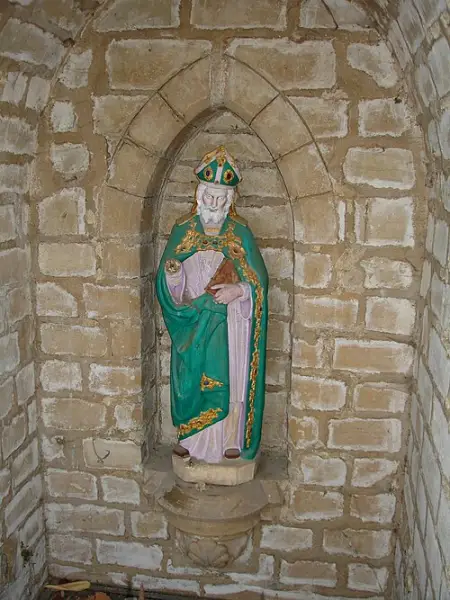
Overview
Praejectus, remembered in French tradition as Saint Prix or Saint Priest, served as bishop of Clermont in the troubled decades of late Merovingian Gaul. Born in the Auvergne around 625 to Gundolenus, a man of the lesser nobility, he was formed under Bishop Genesius of Clermont, ordained a priest, and entrusted with the church at Issoire before being named to lead the monastery of Chantoin. Raised to the episcopal see of Clermont in 666 with the approval of King Childeric II, he drew on the generosity of Count Genesius to establish monasteries, hospitals, and churches across his diocese. His episcopate became entangled in the factional struggles of the Frankish court. A lawsuit heard before the royal court at Autun in 675 tied him to Hector, lord of Marseille, whose execution the bishop was afterwards blamed for. In retaliation an assassin named Agritius fell upon him at Volvic on 25 January 676, and the bishop died together with the abbot Amarinus, whose own monastery stood in that district. He was honored as a martyr almost at once, a life of him was written within a generation, and his relics were later enshrined at Flavigny Abbey, where most of them remain.
The Complete Life
Early Life
Praejectus was born in the Auvergne, the son of Gundolenus, who belonged to the lesser nobility of that upland region of central Gaul. His family's standing gave him access to schooling within the church, and he pursued his studies under Bishop Genesius of Clermont, one of the notable prelates of the province. Under this bishop's direction he was prepared for holy orders and in time ordained a priest. His first recorded responsibility was the pastoral charge of the church at Issoire, a town of the Auvergne where he served the people committed to him. From there his advancement continued within the circle of his former teacher. Bishop Felix, who then occupied the see of Clermont, named him to lead the monastery at Chantoin, a house that Genesius himself had established. The appointment placed Praejectus at the head of a monastic community bound closely to the episcopal household, and it marked him out as a figure of consequence in the church of the Auvergne. When Bishop Felix died, the question of who should govern the diocese drew Praejectus out of monastic administration and into the contested politics of the Merovingian church, with consequences that would shape the rest of his life.
§ Life
Vocation and Election
Upon the death of Bishop Felix, the see of Clermont fell vacant, and Praejectus put himself forward for it, contesting the succession with the archdeacon Garivaldus. His bid did not succeed at first: Garivaldus was chosen instead, yet his tenure proved brief, for he died a short time after becoming bishop. The court of King Childeric then intervened in the affairs of the Auvergne, sending edicts that directed the election of Genesius, Count of Clermont, who was probably a relative of the late bishop under whom Praejectus had studied. The count, however, stepped aside, troubled by the fear that installing him would run against the canons. With the question thus reopened, and with the approval of Childeric II, Praejectus at last received the episcopate and became bishop of Clermont in 666. The course of his election revealed both the factional character of Merovingian episcopal appointments and the esteem in which he was held at court. Once consecrated, he joined the pastoral office to the networks of family and nobility that had formed him, relationships that would sustain his works of building and charity and, in the end, draw him into the deadly rivalries of the Frankish kingdom.
§ Life
Episcopal Mission
As bishop of Clermont, Praejectus turned the resources of his office and the liberality of Count Genesius toward the building up of his diocese. The record of his life credits him with the foundation of monasteries, hospitals, and churches, works of religion and mercy that extended the institutional church across the Auvergne. Among the communities associated with his efforts was the monastery of Chamalières, a house of women whose abbess was likely one of his own kin. His episcopate, however, was conducted amid the violent politics of the Frankish courts, and his standing brought him into disputes far beyond his diocese. In 675 a quarrel over certain bequests brought him before the royal court at Autun, where his opponent was Hector, lord of Marseille, the son-in-law of Count Genesius. The lawsuit entangled the bishop with a man caught up in the struggles surrounding Wulfoald, mayor of the palace of Austrasia, and King Childeric II himself. What began as a contest over property would turn lethal within a year, as the shifting allegiances of the court transformed a land dispute into a charge that the bishop bore personal responsibility for a nobleman's death.
§ Life
Martyrdom at Volvic
Hector had quarreled with Wulfoald, who held the palace mayorship in Austrasia. Charges of various crimes were brought against him, and King Childeric II ordered his arrest and execution. Among those who held the bishop answerable for Hector's fate was a man named Agritius, who came to believe that Praejectus had brought about the nobleman's ruin. At Volvic, Agritius fell upon the bishop with a blade, and Amarinus, whose abbey stood nearby, perished with him. The murder occurred on 25 January 676. Contemporaries linked the death of Praejectus with that of Leger, the steadfast opponent of Ebroin. Ebroin, who twice held the palace mayorship of Neustria, waged a violent and despotic campaign to bend Burgundy and Austrasia to Neustrian authority. A council of bishops had sat in judgment on Leger at Marly, near Paris, and its members included Praejectus, Reol of Rheims, Agilbert of Paris, and Ouen of Rouen, all supporters of Ebroin. It was therefore supposed that the bishop's killer acted in sympathy with Leger's cause; Leger himself was murdered on 2 October 679. Praejectus thus died amid the political violence that consumed the Frankish church, and for this his own generation reckoned him a martyr.
§ Life
Veneration as a Martyr
Praejectus was venerated as a martyr immediately after his death, without the formal processes that the later church would come to require. An account of his life was written a short time after the killing at Volvic, perhaps by 690, for the work was composed during the lifetime of St. Avitus II of Clermont. Its authorship has been the subject of careful conjecture. The writer may have been a nun of the monastery of Chamalières, the community founded through Praejectus' own efforts and governed by an abbess who was probably a kinswoman of his house. Alternatively, the hagiographer may have been a monk of Volvic, the place where the bishop died, or of Saint-Amarin, the house associated with the abbot Amarinus who perished beside him. Whichever of these was the case, the early composition of the life secured the memory of the bishop's witness within a generation of the event. Both the Eastern Orthodox Church and the Roman Catholic Church have continued to number him among the martyrs, keeping his commemoration each year on the anniversary of his death, and he stands in the long catalogue of martyrs honored by the church of the first Christian centuries and after.
§ Veneration
Legacy
The memory of Praejectus took durable root in the places associated with his life and death. During the time of Charlemagne, Abbot Manasses of Flavigny Abbey transferred the relics from Volvic to Flavigny, where most of them remain to this day; other relics are preserved elsewhere. His cultus spread beyond the lands of his birth and found a place on English monastic calendars, evidence of the regard in which the martyr was held across the monasteries of the early medieval West. At Volvic itself, the church where he was killed is dedicated to St Priest, the French form of his name, and the town keeps his memory among its landmarks. In 1278 a relic of the saint, a finger, was translated to the town of Saint-Prix in the Val-d'Oise, where a commemorative plaque and the fountain of Saint Pry recall him still. The valley of Saint-Amarin preserves the name of Amarinus, the abbot who died with him. In France the saint is known under many forms of his name — Pry, Prie, Prix, Priest, Prest, and Preils — a sign of how widely his cult was celebrated, and how deeply it entered the religious geography of the country.
§ Veneration
Timeline
- 625
Born in the Auvergne to Gundolenus, who belonged to the lesser nobility of the region.
§ Life
- 666
Became bishop of Clermont with the approval of King Childeric II.
§ Life
- 675
A dispute with Hector, lord of Marseille, concerning certain bequests came before the royal court at Autun.
§ Life
- 25 Jan 676
Murdered at Volvic; the abbot Amarinus of a neighboring monastery perished alongside him.
§ Life
- 690
An account of his life had been composed by about this year, during the lifetime of St. Avitus II of Clermont.
§ Veneration
- 760
Abbot Manasses of Flavigny Abbey transferred his relics from Volvic to Flavigny.
§ Veneration
- 1278
One of his relics, a finger, was translated to the town of Saint-Prix in the Val-d'Oise.
§ Veneration
The Record
- Major works
- Monastery of Chamalières, founded through his efforts·Monasteries, hospitals, and churches in the diocese of Clermont
- Canonization
- Pre-congregation; venerated as a martyr immediately after his death at Volvic in 676
Prayer
Bibliography
Show 7 sources
- Damiano Pomi (2004), "San Proietto", Santi, beati e testimoni
- Butler, Alban. "Saint Genesius, Bishop and Confessor". Lives of the Fathers, Martyrs, and Principal Saints 1866. CatholicSaints.Info. 1 June 2013
- "Martyrdom of Praeiectus", The Cult of the Saints, University of Oxford
- Fouracre, Paul et al. Late Merovingian France: History and Hagiography, 640-720, Manchester University Press, 1996, ISBN 9780719047916
- Henry Hart Milman, History of Latin Christianity (T.Y. Crowell, 1881), 398
- Barbara H. Rosenwein, Emotional Communities in the Early Middle Ages (New York: Cornell University Press, 2006), 170
- Bienvenue sur le site de la commune de Volvic
Profile text adapted from the Wikipedia article, licensed CC BY-SA 4.0.
Pray with this saint every day
Save St. Praejectus to your favorites, read the full profile, and get feast-day reminders in the Saints app.
Get the Saints AppFree on the App Store for iPhone and iPad