
died 165·Feast July 21
St. Praxedes
Roman virgin who sheltered persecuted Christians
Overview
Praxedes was a Christian virgin of second-century Rome, remembered as a Roman maiden of a distinguished senatorial household. Her father, Pudens, was a convert of the Apostle Peter whom Paul greets in the Second Letter to Timothy, and her sister was Pudentiana; tradition also names her brothers as Novatus and Timothy. When the family inherited its fortune, the two sisters devoted it to the relief of the poor. In an age when professing Christians risked ruin and death, the sisters buried the bodies of the martyrs, carried aid to believers in prison, hid fugitives in Praxedes's house, and saw to it that those held in captivity or forced into labor wanted for nothing. Both sisters died in 165, Praxedes being sixteen years old. The Catholic Encyclopedia describes them as martyrs of an obscure period, honored in Rome as martyrs from at least the fourth century. They were laid to rest in the Catacomb of Priscilla near the Via Salaria, and seventh-century itineraries of the Roman martyrs' graves still record their tombs. A basilica stands on the site of Praxedes's home; rebuilt by Pope Paschal I, it preserves their relics beneath a marked stone in the nave and shows the sisters offering their crowns to Christ in its apse mosaic.
The Complete Life
A Daughter of a Christian House
Praxedes belonged to one of the notable Christian families of early Rome. Her father was Pudens, a Roman senator whose conversion is traced to the preaching of the Apostle Peter and whose name Paul includes among those he greets in his final letter, the Second Epistle to Timothy. In the company of her sister Pudentiana, and with brothers named in tradition as Novatus and Timothy, she grew up in a household where faith in Christ had cost the family standing but had won them a deeper inheritance. When the fortune of the house passed to the two sisters, they resolved not to keep it for themselves. The wealth that might have secured them a comfortable place in Roman society was instead placed, steadily and deliberately, at the service of the poor. In the Rome of the second century, such a choice carried real danger: the church was small, watched, and periodically savaged by persecution. The sisters' home became more than a residence; it was a refuge, a storehouse of aid, and a gathering point for a threatened community. From this sheltered aristocratic upbringing came one of the most consequential lay ministries of the early Roman church, carried out by two young women who understood their patrimony as a trust held for Christ.
§ Biography
Mercy in a Time of Persecution
The work for which Praxedes is remembered was carried out in the shadow of the persecutions that struck the early Roman church. Together with Pudentiana, she took upon herself the duties that others feared to perform. She buried the bodies of Christians who had died for the faith, ensuring that the martyrs received honorable interment when the state denied them graves. She visited believers held in prison, bringing them comfort, encouragement, and material support, and she ministered to them in their chains. Those forced into servitude or laboring in slavery were supplied by her care so that they lacked nothing. Most perilously of all, she opened her own house as a hiding place, sheltering fugitive Christians beneath her roof while the search for them continued in the streets. Contemporary remembrance pairs her constantly with her sister, the two acting as one in a ministry of works of mercy: almsgiving to the destitute, consolation to the afflicted, and devotion to the dead. In an era when a single act of open charity could draw the attention of the authorities, the constancy of these Roman sisters made their home a lifeline for the persecuted church, and their quiet bravery a living argument for the faith they served.
§ Biography
Death and Burial
Praxedes did not live long by any measure. Both she and Pudentiana died in the year 165, and Praxedes was only sixteen years old at her death. The brevity of her life contrasts with the reach of her reputation: the Catholic Encyclopedia, writing in the early twentieth century, classes the two sisters among the martyrs of an unknown era, a reminder of how much of the earliest Roman record has been lost while veneration endured. From the fourth century onward the church at Rome honored them as martyrs, and their cult took firm root. The sisters were buried alongside their father in the Catacomb of Priscilla, the ancient burial ground near the Via Salaria that served the Christian community from the late second century through the fourth. So established was their memory that the seventh-century itineraries, the pilgrim guides listing the tombs of the Roman martyrs, record their graves in that catacomb. Pilgrims who descended into the galleries to pray at the martyrs' resting places found the sisters' names already fixed in the sacred geography of the city, less than a stone's throw from the great roads along which their fellow Christians had once been led to death.
§ Biography
Churches, Relics, and Images
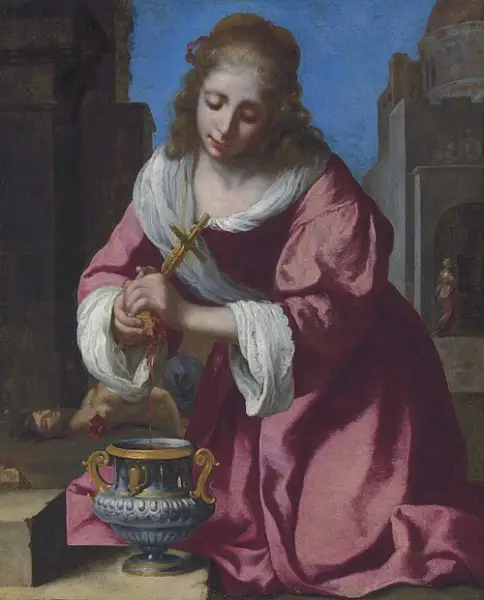
The memory of Praxedes took durable form in stone. The most celebrated of the churches bearing her name, the Basilica of Santa Prassede in Rome, rises on the site of her own home; first built in the fourth century, it was rebuilt by Pope Paschal I in the early ninth century, and it was Paschal who translated the relics of Praxedes and Pudentiana into the new basilica. There the sisters are believed to appear in the apse mosaic as the two female figures who present their crowns to Christ, and a marked portion of the nave floor indicates the place where their relics rest. Images of Praxedes in the basilica show her wringing into a vessel the blood of the martyrs, which she had gathered with a sponge — an image that condenses her whole story of mercy toward the slain into a single gesture, and one that gave rise to her traditional emblems of the crown, the sponge, and the vessel. Art historians have ranked the churches of the two sisters among the most famous and remarkable in Rome. Beyond the city, her name spread to foundations and places as distant as Todi, the Philippine municipality of Santa Praxedes in Cagayan, and Sainte-Praxède in Quebec, and Johannes Vermeer's early painting Saint Praxedis, painted about 1655, keeps her before the eyes of the art-loving world.
§ Biography
Timeline
- 165
Praxedes and her sister Pudentiana died; Praxedes was sixteen years old.
§ Biography
- 817
Pope Paschal I rebuilt the basilica over Praxedes's house and translated the sisters' relics there.
§ Biography
In Their Own Words
allowed those who were in prison or toiling in slavery to lack nothing
squeezing the blood of the martyrs which she has collected from a sponge into a vessel
The Record
- Symbols
- crown·vessel·sponge
- Canonization
- Pre-congregation; venerated as a martyr in Rome from the 4th century
Prayer
Bibliography
Show 8 sources
- de Voragine, Jacobus (1995). William Granger Ryan (ed.). The Golden Legend Vol. 1. Princeton UP. p. 374. ISBN 978-0-691-00153-1.
- "21.07: Memoria di Santa Prassede di Roma asceta e martire, sorella della Santa Martire Pudenziana e figlia di San Pudente senatore romano (tra il 151 e il 159)". www.ortodossia.it. Retrieved 2021-08-12.
- Dipippo, Gregory (21 July 2014). "The Feast of Saint Praxedes". New Liturgical Movement. Retrieved 20 September 2023.
- Kirsch, Johann Peter (1911). "Praxedes and Pudentia". The Catholic Encyclopedia (12th ed.). New York: Robert Appleton Company. Retrieved 19 September 2023.
- "St. Praxedes at Rome". Antiochian Orthodox Christian Archdiocese of North America. Englewood, New Jersey. Retrieved 19 September 2023.
- Baring-Gould, Sabine (2009). The Lives of the Saints. BiblioBazaar. pp. 269–70. ISBN 978-1-113-80661-1.
- Tabor, Margaret E. (1913). The Saints in Art (2nd ed.). New York: E. P. Dutton and Company.
- "The Basilica of Saint Praxedes". Turismo Roma. Rome. 4 March 2016. Retrieved 20 September 2023.
Profile text adapted from the Wikipedia article, licensed CC BY-SA 4.0.
Pray with this saint every day
Save St. Praxedes to your favorites, read the full profile, and get feast-day reminders in the Saints app.
Get the Saints AppFree on the App Store for iPhone and iPad