
died c. 297·Feast June 9
St. Primus and Felician
Brother martyrs of the Diocletian persecution at Nomentum
Overview
Primus and Felician were brothers born at Nomentum, a town about twelve miles from Rome, in the early third century. They belonged to a patrician family and converted to Christianity as adults, afterward devoting themselves to works of mercy among the poor and the imprisoned of the Roman Church. When the persecution ordered by the Emperor Diocletian reached their district around the year 297, both men were seized and brought before the judge Promotus. Each refused on separate occasions to offer sacrifice to the pagan gods, and each was scourged and imprisoned. The judge tried to break their resolve by telling one brother that the other had already given way, but neither deception succeeded. Both were condemned and beheaded at Nomentum, Primus being about eighty years of age at the time. They were buried beside the fourteenth milestone of the Via Nomentana, where a church later rose over their tombs. Their names were entered in early Roman martyrologies under June 9, and in 648 Pope Theodore I moved their remains into the city, placing them beneath the altar of the Church of Santo Stefano Rotondo, where they are still venerated.
The Complete Life
Brothers of Nomentum
Primus and Felician were born in the early years of the third century at Nomentum, a small town in the Roman campagna some twelve miles from the city itself. The sources describe them as brothers, and as members of a patrician family, which placed them among the landed and respected households of the district. Their upbringing would have been formed by the religion of the Roman state, with its temples, its festivals, and its expectation of sacrifice to the traditional gods. At some point in their adult lives both brothers embraced Christianity, a decision that set them apart from their class and exposed them to danger whenever the imperial authorities turned against the Church. Nothing is recorded of their parents, their occupations, or the precise circumstances of their conversion. What the tradition preserves is the fact that they remained at Nomentum rather than withdrawing from the world, and that their new faith expressed itself from the beginning in practical charity toward the Christians of their own neighborhood. Their story belongs to that generation of Roman believers who lived quietly until the great persecution of Diocletian arrived at the end of the century and demanded from every Christian a public choice between the old gods and Christ.
§ Acts
Servants of the Poor and Prisoners
The account of their martyrdom records that after their conversion the two brothers devoted themselves to the care of the poor and to visiting those held in prison. In the Christian community of the Rome region this was a recognized and demanding ministry. Prisons held not only criminals but believers arrested for their faith, and prisoners depended entirely on relatives and friends for food, clothing, and comfort, since the state provided almost nothing. Visiting them was itself risky, for anyone known to aid a condemned Christian could attract the suspicion of the authorities. The brothers' patrician standing gave them means and standing to help, and the tradition presents their charity not as an occasional alms but as a sustained commitment of their lives. Alongside the corporal works they must also have sustained the local church at Nomentum by their presence and their example, since their names were remembered there for centuries afterward. This double service to the needy and the captive is what the Acts of the martyrs single out as the distinguishing mark of their Christianity. It was this same public identification with the forbidden faith that made them conspicuous when the Diocletian edicts began to be enforced in the Italian towns, and that brought them, in the course of time, to the attention of the judge who would put their confession to the test.
§ Acts
Trial and Martyrdom
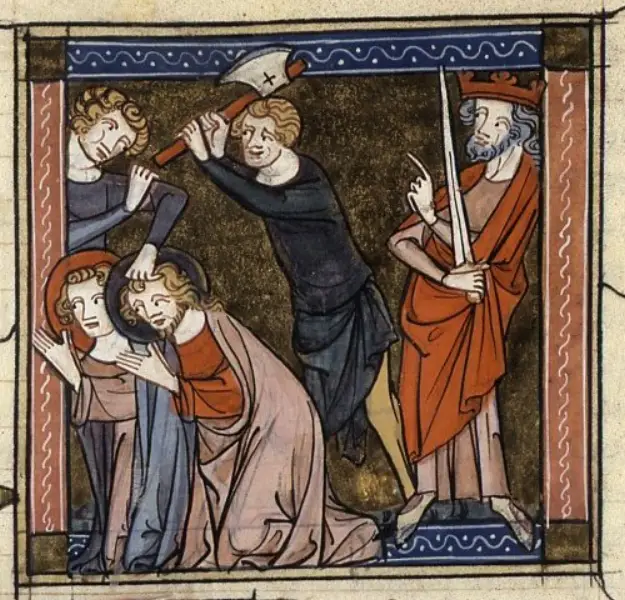
Around the year 297, in the course of the persecution of Diocletian, both brothers were arrested at Nomentum. Brought before the judge Promotus, they were commanded to sacrifice to the public gods as proof of their loyalty to the empire. Each refused. They were scourged and thrown into prison, and then examined separately, so that the faith of each could be broken in isolation. The judge resorted to a stratagem familiar in the acts of the martyrs: he told each brother that the other had already apostatized and offered sacrifice, hoping that shame or loneliness would move the remaining one to follow. The deception failed on both counts. Neither brother weakened, and neither rebuked the other, for each understood that the reported fall was a lie and that his own confession would hold whatever his brother did. Condemned to death, the two were beheaded at Nomentum under the authority of the emperor. The tradition notes that Primus was eighty years old when he died, an old man whose long life ended in a single act of fidelity beside his younger brother. The faithful of the district buried them beside the road outside the town, at the fourteenth milestone of the Via Nomentana, and in time a church was raised over the place of their burial.
§ Acts
Ancient Witness of the Church
Primus and Felician were never formally canonized, for they belong to the earliest generation of saints whose holiness was recognized by the Church's own practice rather than by papal decree. Their names are found in the Martyrologium Hieronymianum under the ninth of June, with the note that both were laid to rest where the Via Nomentana passed its fourteenth milestone outside Nomentum; this notice descends from the catalogue of Roman martyrs compiled in the fourth century, only a few generations after their deaths. Their feast was kept on June 9, and in the later Middle Ages they entered the General Roman Calendar of the universal Church. Their cult was strong enough to spread far beyond Latium, reaching Bavaria in the south of Germany and Provence in Gaul, where their memory became entwined with that of Saint Faith of Agen and Caprasius. In 1969 the reform of the Roman liturgical calendar removed their observance from the universal calendar, not as a judgment against their antiquity but because of the limited devotion to them outside Italy, and left it to individual dioceses to decide whether to keep their feast locally. They remain counted among the canonized saints of the Catholic Church, venerated on the same June date as in the fourth-century lists.
§ Veneration
Relics, Images, and Far Lands
The brothers seem to have been the earliest martyrs whose remains are known to have been carried back inside the city's defenses. In 648 the pope of that day, Theodore I, had their bones moved, along with the body of his own father, to the Church of Santo Stefano Rotondo and set beneath an altar raised in their honor, where they rest to this day. The chapel of Ss. Primo e Feliciano there, built by the same pope, preserves seventh-century mosaics in which the two martyrs flank a jeweled cross, one of the oldest surviving images of them. Their figures appear again in the thirteenth-century mosaics of St Mark's Basilica in Venice and in the twelfth-century Cappella Palatina at Palermo. Away from Rome, a Bavarian tradition remembered them as Roman soldiers who preached in the Chiemgau, where Primus discovered a spring of curative water; the fountain of Saint Primus can still be seen at Adelholzen, beside a chapel built in 1615. At Agen in France their names were joined in legend to those of Caprasius and Saint Faith, whom they were said to accompany in martyrdom. A statue of Primus overlooks a district of Milan from the cathedral, a quiet sign of how widely the brothers of Nomentum traveled in the memory of the Church.
§ Burial
Timeline
- 297
Beheaded at Nomentum under Diocletian after refusing to sacrifice to the Roman gods.
§ Acts
- 648
Pope Theodore I translated their relics to the Church of Santo Stefano Rotondo in Rome.
§ Burial
- 1615
A chapel dedicated to the two brothers was constructed at the hot springs of Adelholzen in Bavaria.
§ Veneration in Bavaria
- 1969
Their observance was removed from the General Roman Calendar and left to individual dioceses.
§ Veneration
The Record
- Patron of
- venerated at Adelholzen, Bavaria, for the curative fountain of Saint Primus
- Symbols
- Felician nailed to a tree·Primus forced to swallow molten lead·palm of martyrdom
- Canonization
- Pre-congregation martyrs, venerated since antiquity; their names appear in the fourth-century Roman martyr catalogues
Prayer
Bibliography
Show 5 sources
- Kirsch, Johann Peter. "Sts. Primus and Felician." The Catholic Encyclopedia Vol. 12. New York: Robert Appleton Company, 1911.
- Delehaye, H., Étude sur le légendier romain (1936), pp. 14–31.
- "Lives of the Saints, For Every Day of the Year," edited by Hugo Hoever, New York: Catholic Book Publishing Co., 1955, p. 220.
- Calendarium Romanum (Libreria Editrice Vaticana 1969), p. 125.
- Alban Butler, David Hugh Farmer, Paul Burns, Butler's Lives of the Saints (Liturgical Press, 2000), 139.
Profile text adapted from the Wikipedia article, licensed CC BY-SA 4.0.
Pray with this saint every day
Save St. Primus and Felician to your favorites, read the full profile, and get feast-day reminders in the Saints app.
Get the Saints AppFree on the App Store for iPhone and iPad