
1864 – 1918·Feast July 18
St. Elisabeth of Hesse and by Rhine
Grand Duchess, nun, and new martyr of Russia
Overview
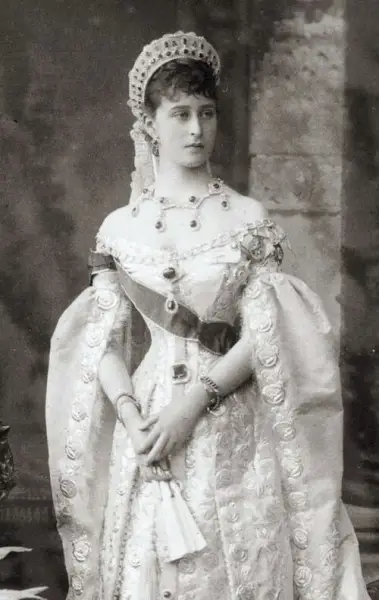
Princess Elisabeth of Hesse and by Rhine, known in Russia as Grand Duchess Elizabeth Feodorovna, sprang from the German dynasty of Hesse-Darmstadt, counted Queen Victoria among her grandparents, and was the elder sister of Alexandra, the last Russian empress. Born at Bessungen on 1 November 1864, she was celebrated for her dignified beauty and her generosity to the poor. In 1884 she married Grand Duke Sergei Alexandrovich, fifth son of Emperor Alexander II, and after his appointment as Governor-General of Moscow she ranked among the leading figures of imperial society. She embraced Orthodoxy of her own accord in 1891. When revolutionaries assassinated her husband with a bomb in February 1905, she publicly forgave his murderer, visited him in his cell to plead for his repentance, and petitioned for his life to be spared. She then withdrew from court life, sold her jewels — even her wedding ring — and founded the Marfo-Mariinsky Convent in Moscow, serving as its abbess while its sisters built a hospital, pharmacy, chapel, and orphanage for the city's destitute. Arrested by the Bolsheviks in 1918, she was exiled to Perm and Yekaterinburg and then taken to Alapayevsk, where on the night of 17 July she and her fellow prisoners were thrown alive into an abandoned mine shaft at Siniachikha and killed with grenades. She was canonized by the Russian Church in 1981 and 1992, and her relics rest in the Church of Mary Magdalene in Jerusalem.
The Complete Life
A Hessian Childhood
On 1 November 1864, at Bessungen, Elisabeth became the second-born child of Grand Duke Ludwig IV of Hesse and by Rhine and of Princess Alice, herself a daughter of Queen Victoria. Her name paid homage to St. Elizabeth of Hungary, ancestress of the House of Hesse, and for her paternal grandmother Princess Elisabeth of Prussia, she was known in the family simply as Ella. Her christening on 28 November gathered sponsors from across the royal houses of Europe, including her great-uncle Tsar Alexander II of Russia. Alice raised her daughters with deliberate simplicity: an English nanny governed the nursery, the children ate plain food, wore plain dresses, and learned to bake, make their beds, lay fires, and clean their own rooms. Their mother took them to hospitals and charities and impressed on them the duty of giving to the poor — a lesson that would shape the whole of Elisabeth's life. Grief came early and often. In 1873 her hemophiliac brother Friedrich fell through an open window and died of a brain haemorrhage, and his mother's mourning shadowed the household. In November 1878 diphtheria swept through the family: Ella alone escaped the illness, but her sister Marie died on 16 November and her mother Alice on 14 December. Sent away to keep her safe, she returned to a silenced house, describing the reunion as terribly sad, with no one daring to speak of what filled their thoughts.
§ Early life
Marriage and Conversion
Beautiful and accomplished, Elisabeth numbered suitors among the princes and notables of Europe; her cousin Wilhelm of Prussia loved her in vain, as did the soldier Henry Wilson and the future Grand Duke Frederick II of Baden. Her heart turned instead to Russia. She had known Grand Duke Sergei Alexandrovich, fifth son of Tsar Alexander II, all her life, and after the couple spent time together at Schloss Wolfsgarten in the autumn of 1883 she accepted the proposal she had at first declined. Their engagement was announced in Darmstadt on 26 February 1884, and they were married on 15 June of that year in the Chapel of the Winter Palace in Saint Petersburg — the wedding at which the young Tsarevich Nicholas first met Elisabeth's youngest sister Alix, the future empress. The couple settled in St. Petersburg and, after Sergei became Governor-General of Moscow in 1892, in a Kremlin palace, spending summers at the Ilyinskoye estate. Childless themselves, they filled Ilyinskoye with parties for children and raised Sergei's niece and nephew, Dmitry and Maria Pavlovna, as their own. In 1891 Elisabeth made the decision that marked her inward turn: though Lutherans were not required to convert, she embraced Russian Orthodoxy voluntarily, taking the name Elizaveta Feodorovna — a step that scandalized her Lutheran relations but testified to a faith deeper than court convention. She also used her standing to further the marriage of Nicholas and Alix, gently persuading her reluctant sister to accept Orthodoxy.
§ Engagement and marriage
Forgiveness in the Bloodstained Snow
On 17 February 1905 a terrorist of the Socialist Revolutionary Party's combat detachment, Ivan Kalyayev, hurled a nitroglycerin bomb into Grand Duke Sergei's carriage inside the Kremlin, killing him instantly. Summoned to the scene, Elisabeth stood stunned but composed, gave instructions, and knelt in the snow to gather up her husband's remains with her own hands. What followed made her famous far beyond Russia. She spent the days before the burial in unceasing prayer and set upon the tombstone Christ's own plea from the cross, begging that his killers be spared, for they understood not what they did; and the day before the burial she insisted on being driven to the jail that held Kalyayev. Inside the assassin's cell, she asked why he had killed her husband, heard his defense of tyrannicide, and answered with a plea for repentance, promising to beg the emperor for his life, because she had already forgiven him. He refused to repent and was hanged two months later, but her act of pardon — offered through impossible pain — was seen by contemporaries as an attempt to stop the coming cycle of bloodshed at its very beginning. Forgiveness, prayer, and the Gospels understood heart and soul became the grammar of the rest of her life, and the foundation on which everything she built afterward would rest.
§ Assassination of Grand Duke Sergei
The Convent of Martha and Mary
Widowed at forty, Elisabeth withdrew from imperial society, wore mourning, became a vegetarian, and turned her whole fortune to the service of Moscow's poor. In 1909 she sold her celebrated collection of jewels and other luxuries — even her wedding ring — and with the proceeds opened the Convent of Saints Martha and Mary, the Marfo-Mariinsky Convent, becoming its abbess. Unlike the cloistered orders of the Orthodox world, her community joined the contemplative life to active mercy: the sisters prayed, and they went out to the suffering. On the convent grounds she opened a hospital, a chapel, a pharmacy, and an orphanage, and the sisters worked tirelessly among the destitute and the sick of the city. Elisabeth herself frequented Moscow's worst slums, doing all she could to ease the misery she found there; for years the institution sustained the poor and the orphans of Moscow through the prayer and charity of devout women, and each year on the anniversary of her husband's death the sisters made a pilgrimage to his sepulchral church. She also wrote and published the rule of her community. In 1915 her organizing gifts were placed at the war effort when the All-Russian Zemstvo Union was formed under her auspices to aid sick and wounded soldiers. In private she warned her sister, the empress, repeatedly that Rasputin was a fraud, though Alexandra refused to believe her.
§ Religious life
Exile and Martyrdom at Alapayevsk
The February Revolution of 1917 forced her brother-in-law Nicholas II from the throne, and in 1918 Lenin ordered the Cheka to arrest Elisabeth. She was banished in turn to Perm and to Yekaterinburg, where other prisoners gathered around her: Grand Duke Sergei Mikhailovich, several young princes of the Konstantinovich branch, Prince Vladimir Paley, Sergei's secretary Fyodor Remez, and Sister Varvara Yakovleva of her own convent. On 20 May 1918 the prisoners were brought to Alapayevsk and housed in a school building at the edge of town; on 21 June a harsher prison regime was imposed and their property confiscated. At noon on 17 July the Cheka took their remaining money and announced a night transfer. The prisoners were driven in carts some eighteen kilometres to the village of Siniachikha, where an abandoned iron mine held a shaft twenty metres deep. There the guards beat them all and threw them into the pit, Elisabeth first; grenades followed. Her executioner later reported hearing the victims singing an Orthodox hymn from the depths even after the explosions, until the shaft was stuffed with brushwood and set burning. Her death came in the early hours of 18 July 1918, aged fifty-three, her final utterance returning to the watchword of her life — a prayer that her killers be pardoned, since they understood not what they did. Though later scholarship has called some details of the traditional narrative into question, the fact of her martyrdom stands.
§ Death
Canonization and the Journey of the Relics
The discovery came on 8 October 1918, when soldiers of the White Army found Elisabeth's body and those of her fellow captives still within the mine, little corrupted after almost three months. With the Red Army closing in, the bodies traveled east once more, to lie in the graveyard of the Russian Orthodox Mission at Peking, today's Beijing. In 1921 Elisabeth and Sister Barbara were moved a final time, to Jerusalem and laid in the Church of Mary Magdalene at Gethsemane — the church she and her husband had helped to build, on the Mount of Olives, where her relics are enshrined to this day. The Church ratified what the faithful already believed: the Russian Orthodox Church Outside Russia canonized her in 1981, and the Russian Orthodox Church followed in 1992, enrolling her as Holy Martyr Elizabeth Feodorovna. Devotion centers on two shrines: the Moscow convent of Martha and Mary that she established, and the convent standing on the Mount of Olives. The Russian Church commemorates her on three days in the liturgical year — with the New Martyrs and Confessors of Russia, on the anniversary of her martyrdom on 5/18 July, and on the uncovering of her relics on 28 September/11 October — while the emigre calendar adds a fourth feast for the transfer of her relics to Jerusalem on 17/30 January.
§ Fate of the remains and commemoration
Veneration Across the World
The memory of the grand duchess has grown steadily since the fall of communism. In 2004 and 2005 her relics were carried on pilgrimage through Russia, the CIS, and the Baltic countries, where more than seven million people queued to venerate them; Patriarch Alexei II read the long lines of believers as a sign of the nation's repentance and its return to its historical path, and the relics were then returned to Jerusalem. On 8 June 2009 the Prosecutor General of Russia officially rehabilitated her posthumously, together with the Romanov princes killed at Alapayevsk, acknowledging that they had been arrested, deported, and held by the Cheka without charge. In Moscow, after the dissolution of the Soviet Union, a statue rose in the garden of her convent, its dedication asking pardon in her name — With Repentance. Her witness is honored far beyond Orthodoxy: she stands among the ten twentieth-century martyrs of the whole world portrayed in the statues above the Great West Door of Westminster Abbey in London, and her figure appears in the restored nave screen installed at St Albans Cathedral in April 2015. Books, pilgrimages, and hymns continue to keep alive the woman who moved from a Hessian nursery to a Moscow slum to a mine shaft in the Urals, forgiving to the last breath.
§ Relics and rehabilitation
Timeline
- 1 Nov 1864
Elisabeth Alexandra Luise Alix was born at Bessungen, Hesse, second child of Grand Duke Ludwig IV and Princess Alice of the United Kingdom.
§ Early life
- 15 Jun 1884
She married Grand Duke Sergei Alexandrovich of Russia at the Chapel of the Winter Palace in Saint Petersburg.
§ Engagement and marriage
- 1891
Not legally obliged to do so, she voluntarily converted from Lutheranism to Russian Orthodoxy, taking the name Elizaveta Feodorovna.
§ Grand Duchess of Russia
- 1892
Her husband was appointed Governor-General of Moscow by Emperor Alexander III, and the couple moved to a Kremlin palace.
§ Grand Duchess of Russia
- 17 Feb 1905
Grand Duke Sergei was assassinated by a nitroglycerin bomb thrown by Ivan Kalyayev of the Socialist Revolutionary Party's combat detachment; Elisabeth forgave the murderer and pleaded in vain for his pardon.
§ Assassination of Grand Duke Sergei
- 1909
She auctioned her jewels and finery — even her wedding ring — and used the proceeds to establish the convent of Saints Martha and Mary, ruling it as abbess and putting up within its walls a hospital, a chapel, a pharmacy, and an orphanage.
§ Religious life
- 17 Oct 1910
In failing health, she left her sisters and traveled to Wolfsgarten in Germany for a reunion with her surviving family.
§ Religious life
- 1915
The All-Russian Zemstvo Union was organized under her auspices to support sick and wounded soldiers during the First World War.
§ Religious life
- 20 May 1918
Arrested on Lenin's orders and exiled through Perm and Yekaterinburg, she was taken with other prisoners to Alapayevsk.
§ Death
- 18 Jul 1918
In the night she was beaten, thrown first into a twenty-metre mine shaft at Siniachikha, and killed with grenades alongside her fellow prisoners.
§ Death
- 8 Oct 1918
White Army soldiers discovered her remains in the shaft and later buried them at the Russian Orthodox Mission cemetery in Peking.
§ Fate of the remains and commemoration
- 1921
Her remains, with those of Sister Barbara, were brought to Jerusalem and laid to rest in the Church of Mary Magdalene at Gethsemane.
§ Fate of the remains and commemoration
- 1981
The Russian Orthodox Church Outside Russia canonized her as a saint.
§ Legacy and canonisation
- 1992
The Russian Orthodox Church canonized her as Holy Martyr Elizabeth Feodorovna.
§ Legacy and canonisation
- 2004
Her relics began a tour of Russia, the CIS, and the Baltic countries in which more than seven million people came to venerate them.
§ Relics and rehabilitation
- 8 Jun 2009
The Prosecutor General of Russia posthumously rehabilitated her, ruling she had been repressed by arrest and detention without charge.
§ Relics and rehabilitation
In Their Own Words
Do not listen to your pride. Repent... and I will beg the Sovereign to give you your life. I will ask him for you. I myself have already forgiven you.
Father, release them, they know not what they do.
Father, forgive them, for they know not what they do.
The Record
- Major works
- The Martha and Mary Convent and Rule of Saint Elizabeth (1908)·Marfo-Mariinsky Convent, Moscow
- Patron of
- Russia
- Symbols
- religious habit
- Canonization
- Canonized 1981 by the Russian Orthodox Church Outside Russia and 1992 by the Russian Orthodox Church as Holy Martyr Elizabeth Feodorovna
Prayer
Bibliography
Show 10 sources
- Mager, Hugo (1998). Elizabeth: Grand Duchess of Russia. New York: Carroll & Graf. ISBN 0786705094.
- Warwick, Christopher (2014). The Life and Death of Ella Grand Duchess of Russia: A Romanov Tragedy. Albert Bridge Books. ISBN 978-1909771093.
- Warwick, Christopher (2007). Ella: Princess, Saint and Martyr. ISBN 978-0-470-87063-1.
- Millar, Lubov (2009). Elizabeth grand Duchess of Russia. ISBN 978-1-879066-11-3.
- Radzinsky, Edvard (1993). The last tsar. Anchor Books. ISBN 978-0-385-46962-3.
- Gelardi, Julia P. (2011). From Splendor to Revolution. St. Martin's Publishing Group. ISBN 978-1429990943.
- Perry, John (1999). The Flight Of The Romanovs: A Family Saga. ISBN 0465024629.
- Romanov, Elisabeth (1908). The Martha and Mary Convent and Rule of Saint Elizabeth. Holy Trinity Monastery.
- Gilbert, Paul (2023). ELLA: Grand Duchess Elizabeth. Saint Elizabeth the New Martyr. ISBN 9798854710466.
- King, Greg (1994). The Last Empress: The Life and Times of Alexandra Feodorovna, Tsarina of Russia. ISBN 0806517611.
Profile text adapted from the Wikipedia article, licensed CC BY-SA 4.0.
Pray with this saint every day
Save St. Elisabeth of Hesse and by Rhine to your favorites, read the full profile, and get feast-day reminders in the Saints app.
Get the Saints AppFree on the App Store for iPhone and iPad