
c. 1335 – 1405·Feast November 11 (repose)
St. Milica of Serbia
Tsaritsa, regent, nun, and poet of Serbia
Overview
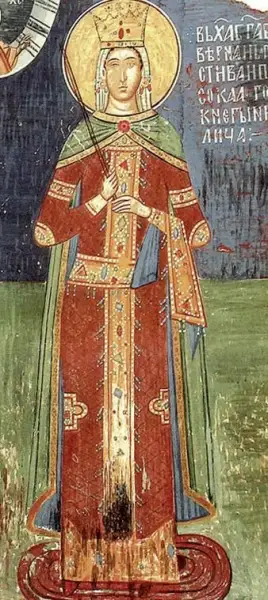
Princess Milica Hrebeljanović, née Nemanjić, known as Empress (Tsaritsa) Milica, was born around 1335 into the elder collateral branch of the Nemanjić dynasty, daughter of Prince Vratko Nemanjić, remembered in Serbian epic poetry as Jug Bogdan. She married Prince Lazar Hrebeljanović and bore him three sons and five daughters, binding the Lazarević line to the Nemanjić blood through her. When Lazar fell in the Battle of Kosovo in 1389, Milica took up the regency of Serbia, ruling from 1389 to 1393 until her son Stefan Lazarević came of age. Her regency, in the turbulent aftermath of Kosovo, was tested by Hungarian attacks under Sigismund, by the rivalry of Vuk Branković, and by the advance of the Ottomans, whose suzerainty she accepted in 1390 to preserve what could be preserved. Around 1390 she founded the Ljubostinja monastery, and about 1393 she took the monastic habit there as nun Eugenia, later serving as abbess under the name Euphrosine. As a writer she left prayers and religious poems of enduring importance, above all A Mother's Prayer, issued at Dečani with her sons in 1397, and the lament for her husband, My Widowhood's Bridegroom. She died on 11 November 1405 and was buried in her own monastery of Ljubostinja. The Serbian Orthodox Church numbers her among its saints.
The Complete Life
A Daughter of the Nemanjići
Milica was born around 1335 into the blood royal of medieval Serbia. Her father was Prince Vratko Nemanjić, the warrior remembered in the epic songs as Jug Bogdan, who stood in the elder, collateral branch of the Nemanjić dynasty through his descent from Vukan Nemanjić, Grand Prince of Serbia in the opening years of the thirteenth century. Through her father she was fourth cousin once removed to Dušan the Mighty, Emperor of the Serbs at the height of its medieval power. An inscription preserves the memory of her one recorded brother, župan Nikola, likewise a child of Vratko, who found burial in 1379 in the Monastery of St. Nicholas at Kuršumlija. Milica was given in marriage to Prince Lazar Hrebeljanović, the rising lord of Moravian Serbia, and bore him eight children — three sons and five daughters. The marriage bound her children to the Nemanjić lineage through their mother, so that the Lazarević dynasty which followed could claim descent from the old royal house. Contemporaries remembered her as a woman of commanding personality, a quality the chronicles of neighboring Ragusa also remarked in her daughter Jelena. It was a character formed for rule, though nothing yet suggested how soon and how heavily the burden would fall upon her.
§ Early life
Widowhood and Regency
In 1389 Prince Lazar fell in the Battle of Kosovo, the defeat that entered Serbian song and memory as the nation's great offering. His heir, Stefan, was still a boy, and Milica stepped into the breach, ruling Serbia as regent from 1389 until 1393. The times allowed her no gentle stewardship. Almost at once, in November 1389, King Sigismund of Hungary attacked, hoping to profit from Serbia's weakness after Kosovo: his troops overran fortress after fortress along Serbia's northern frontier and pushed south as far as Kragujevac, and though scholars dispute the outcome of that campaign and the fighting that followed, it may be that the Hungarians later abandoned those lands and Milica recovered some of them. Within her own borders she faced a subtler danger in Vuk Branković, one of Lazar's commanders at Kosovo, who had once accepted Lazar as overlord and now saw his chance, moving to overthrow the regency while the young prince remained of unripe years. Caught between two ambitious enemies who were even then negotiating toward an alliance, Milica answered with statecraft of every weapon she possessed. When the Ottomans themselves reached her border in the summer of 1390, she judged resistance hopeless and accepted Ottoman suzerainty, granting the Turks free passage through Serbian lands — a bitter bargain that kept a remnant of the realm alive for her son to inherit.
§ Regency
Diplomacy of a Nun
Milica's most lasting foundation was not political but spiritual: around 1390 she founded the monastery of Ljubostinja, the endowment whose frescoes would one day show her face and which would receive her body. About 1393, as her regency ended and Stefan took up rule, she withdrew from the world and took monastic vows at her own foundation, receiving the name Eugenia in religion, and in time she served the community as its abbess under the name Euphrosine. The habit did not retire her from the service of her family and realm. In 1398 or 1399 she traveled, as Eugenia, with Euphemia, the former Vasilissa of Serres, to the court of Sultan Bayezid I, taking part in the delicate diplomatic negotiations on which Serbia's survival under Ottoman overlordship depended. In 1403 she undertook a further embassy, going to the Sultan at Serres to plead the cause of her son Stefan in a tangled dispute that had arisen between her two sons and Vuk Branković. These journeys of an elderly abbess across the lines of a conquered but unbowed land made her one of the notable diplomatic figures of her generation, a princess who had traded the regent's seal for the nun's veil without laying down the burdens of either office.
§ Nun
Prayer and Poetry
Milica holds a place in Serbian letters as one of the earliest female voices of the medieval literature of her people. To the work of consoling a broken land she brought not only statecraft but poetry: she composed several prayers and religious poems, and two of them have carried her name across the centuries. The first is A Mother's Prayer, issued in 1397 at the Dečani monastery and published jointly with her sons — a text in which the widowed mother of a martyred husband and an endangered realm gave her grief the shape of intercession. The second is her famous poem of mourning for Prince Lazar, My Widowhood's Bridegroom, in which the widow addresses her slain husband as a bride awaits the bridegroom, wedding her sorrow to the hope of the resurrection. In the same year as A Mother's Prayer she saw to the restoration of Dečani's bronze horos, that great circular canopy-frame hanging within the church, a work of piety toward one of Serbia's holiest houses. Her monastic names, Eugenia and Euphrosine, betray the inward course of her later life: from princess to mourner, from mourner to nun, and from nun to abbess. The fresco of Ljubostinja, painted between 1402 and 1405, shows her at the end of that road, a tsaritsa in the habit of the community she founded.
§ Writer
Death and Burial at Ljubostinja
Milica died on 11 November 1405, having lived through the collapse of the old Serbian empire, the catastrophe of Kosovo, a hard-won regency, and the quiet transformation of her last years into monastic peace. She had arranged for her resting place long before: she was buried in Ljubostinja, the monastery of her own founding, among the hills near present-day Trstenik, where her frescoed image still looks down from the church walls. There her children's story had also been woven into the fabric of her endowment — the monastery stood as the memorial of her widowhood and the fruit of her prayers. Her daughters had married into the ruling houses of the Balkans, sealing alliances from Zeta to Bulgaria and even into the Ottoman court, where her youngest, Olivera, became the wife of Sultan Bayezid himself as a pledge of peace after Kosovo; her sons Stefan and Vuk carried on the burden of rule. But it is at Ljubostinja that her own story closes, in the community of women over which she had presided as abbess. The Serbian Orthodox Church has recognized her among its saints, and the memory of the princess-nun has remained alive in the land she governed and mourned.
§ Death and burial
Memory in the Serbian Land
The remembrance of Princess Milica has endured in the geography of Serbia itself. Streets across Central Serbia bear her name, and in Trstenik — the industrial town nearest her burial place at Ljubostinja — the principal thoroughfare running through the city center is called Kneginje Milice, the Street of Princess Milica. In Lazarevac, in the neighborhood of Lukavica, another Kneginje Milice street runs some two hundred and fifty meters, keeping her name in a town that honors her husband's. A statue of the princess stands at Trstenik, and her painted image survives in the early fifteenth-century fresco of Ljubostinja, one of the rare portraits of a medieval Serbian woman by her own endowment. In letters she is counted among the founding figures of medieval Serbian literature, and her A Mother's Prayer remains a classic of the nation's spiritual writing. In the epic tradition her figure stands beside that of her husband at Kosovo, the tsaritsa of the Kosovo songs, while the Church keeps her as a saint of the Serbian people — the queen who became a nun, the mother who became a poet, and the ruler who, in the darkest hour of her country, chose both the treaty that preserved it and the habit that sanctified her grief.
§ Legacy
Timeline
- 1335
Milica Nemanjić was born, daughter of Prince Vratko Nemanjić of the Nemanjić dynasty.
§ Early life
- 1379
Her only brother, the župan Nikola, was buried in the Monastery of St. Nicholas in Kuršumlija.
§ Early life
- 1389
Her husband Prince Lazar fell in the Battle of Kosovo, and Milica assumed the regency of Serbia for her underage son Stefan.
§ Regency
- Nov 1389
Hungarian forces under Sigismund attacked almost immediately, seizing Serbia's northern fortresses and penetrating as far south as Kragujevac.
§ Regency
- 1390
She founded the Ljubostinja monastery, her future burial place.
§ Nun
- 1390
With the Ottomans at her border, she accepted Ottoman suzerainty and allowed Turkish passage through Serbian lands.
§ Regency
- 1393
Her regency ended when Stefan Lazarević came of age, and around this time she took monastic vows at Ljubostinja as nun Eugenia.
§ Nun
- 1397
At Dečani monastery she published, jointly with her sons, A Mother's Prayer, and paid for the restoration of the church's bronze horos.
§ Writer
- 1398
As Eugenia she traveled with Euphemia, the former Vasilissa of Serres, to the court of Sultan Bayezid I for diplomatic negotiations.
§ Nun
- 1403
She went to the Sultan at Serres to argue the cause of her son Stefan in a dispute with Vuk Branković.
§ Nun
- 11 Nov 1405
Milica died and was buried in the Ljubostinja monastery she had founded.
§ Death and burial
The Record
- Major works
- A Mother's Prayer (Молитва матере), issued at Dečani in 1397·My Widowhood's Bridegroom (Удовству мојему женик), lament for Prince Lazar
- Canonization
- Canonized by the Serbian Orthodox Church
Prayer
Bibliography
Show 10 sources
- "Milica Nemanjic, Knegina and Regent". Genealogics.org.
- "Династија Немањића ::: Dinastija Nemanjića". Zaduzbine-nemanjica.rs.
- Godišnjak Društva istoričara Bosne i Hercegovine: Annuaire de la Société historique de Bosnie et Herzégovine (in Serbian). Društvo istoričara Bosne i Hercegovine. 1986. p. 130. Retrieved 18 January 2013.
- Vujić, Joakim (2006), "The transformation of symbolic geography: Characteristics of the Serbian people", in Trencsényi, Balázs; Kopeček, Michal (eds.), Late enlightenment emergence of the modern 'national idea', Budapest New York: Central European University Press, p. 115, ISBN 9789637326523.
- Fine, John V. A. (1994). The Late Medieval Balkans: A Critical Survey from the Late Twelfth Century to the Ottoman Conquest. University of Michigan Press. pp. 411, 413. ISBN 978-0-472-08260-5.
- Gavrilović, Zaga (2006), "Women in Serbian politics, diplomacy and art at the beginning of Ottoman rule", in Jeffreys, Elizabeth M. (ed.), Byzantine style, religion, and civilization: in honour of Sir Steven Runciman, New York: Cambridge University Press, pp. 75–78, ISBN 9780521834452.
- Ćirković, Sima M.; Korać, Vojislav; Babić, Gordana (1986). Studenica Monastery. Belgrade: Jugoslovenska Revija. p. 144. OCLC 17159580.
- Popovich, Ljubica D. (1994). "Portraits of Knjeginja Milica". Serbian Studies. 8 (1–2). North American Society for Serbian Studies: 94–95.
- Stevanović, Miladin (2005). Kneginja Milica Hrebeljanović. Knjiga-komerc. ISBN 9788677120795.
- Vasiljević, Marija (2016). "Генеалогије између историје и идеологије: пример порекла кнегиње Милице" (PDF). Историјски часопис. 65. Belgrade: Istorijski institut: 79–100.
Profile text adapted from the Wikipedia article, licensed CC BY-SA 4.0.
Pray with this saint every day
Save St. Milica of Serbia to your favorites, read the full profile, and get feast-day reminders in the Saints app.
Get the Saints AppFree on the App Store for iPhone and iPad