
died late 1st century (by tradition)·Feast January 18
St. Prisca
Child Martyr of Early Rome
Overview
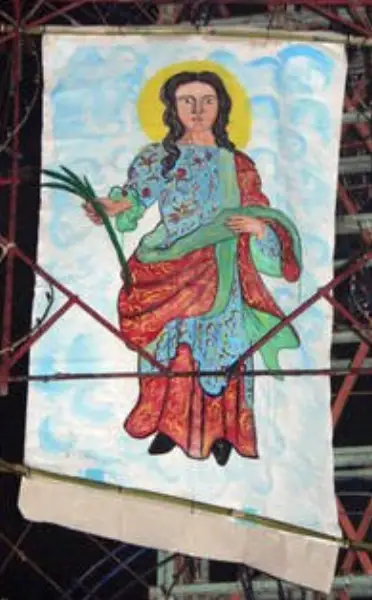
Prisca, a youthful Roman put to death with cruel torments for clinging to the Christian faith, is remembered above all in England as a child martyr; the Catholic Church, the Orthodox East, and the Anglican Communion all number her among the saints. When she was born, and when she died, no record tells, and her story reaches us chiefly through legend: a girl of noble family, baptized at thirteen by St. Peter himself, who refused the emperor's command to sacrifice to Apollo and was beaten, imprisoned, starved, racked, and finally beheaded on the road from Rome to Ostia. Scholars caution that the scattered information about her may refer to as many as three different people — a founder of the title church on the Aventine, a martyr buried in the Catacomb of Priscilla on the Via Salaria, and the heroine of a later romance that placed her in the age of the apostles. Whatever the resolution of that ancient puzzle, a martyr named Priscilla was commemorated at Rome on 18 January from the earliest records, her grave was named in all the seventh-century itineraries of the pilgrims, and her feast is kept to this day on that date.
The Complete Life
A Noble Girl of Rome
The legend that has carried Prisca's memory through the centuries tells of a girl born into a noble Roman family in the first age of the Church. At the age of thirteen she was baptized, so the story runs, by the apostle Peter himself, and she grew up a Christian in a city where the old gods still ruled the public square. Her trial came when the emperor Claudius commanded her to make sacrifice to Apollo. She refused because of her faith, and for that refusal she was beaten and sent to prison. The tale, cherished in England above all, made of her the model of the child martyr: a girl hardly grown who would not burn a pinch of incense to save her life. Historians caution that this narrative belongs to the realm of pious romance rather than record — the Acta S. Priscae, which set her passion under the emperor Claudius II in the late third century, has no more credibility than the legend that placed her beside Peter in Rome — yet the devotion that produced it rested on a genuinely ancient commemoration of a Roman martyr of this name.
§ Legend
Faith Before the Emperor
Prisca's vocation, in the form the tradition gives it, was sealed at her baptism and proved at the altar of Apollo. Ordered by Claudius to honor the god, she answered as a Christian, and the sentence that followed was a catalogue of torments meant to break a child's constancy. Three days of hunger in a slave's jail, the agony of the rack, and a bed of burning wood all failed to end her life. At the last she was exposed to a lion in the amphitheater, and the beast quietly lay down at her feet — the moment the Italian poet Martha Marchina seized in a pair of poems in her Musa Posthuma, contrasting the humane nature of the lion with the savagery of the men who watched. Only the sword ended what fire and famine and fangs could not, and it fell at the tenth stone along the Ostian Way, the highway from Rome to the sea. Whether every detail is historical or not, the Church saw in this endurance the very pattern of martyrdom: innocence defending faith against power, until power had nothing left to take.
§ Legend
The Martyr's Rest
Tradition points to more than one resting place for Prisca's remains. A legend relates that after her beheading on the Ostian road, Pope Eutychianus had her remains brought to the Aventine church bearing her name — a narrative scholars judge impossible in its details, yet one that preserves the memory of her cult at that ancient titular church. Yet another resting place, better attested, was shown in the Catacomb of Priscilla beside the Via Salaria: there a martyr Prisca was honored, and every seventh-century pilgrim itinerary to the tombs of Rome's martyrs names the spot. The early martyrology that bears Jerome's name likewise records, under 18 January, a Priscilla on the Via Salaria — plainly the catacomb's own Prisca — and since legend gives the same day as that of her execution, the martyr of the catacomb and the heroine of the legend are probably one in the Church's memory. A tradition from the eighth century further confused the picture by identifying the founder of the Aventine church with Priscilla, the friend of St. Paul.
§ Commentary
The Church on the Aventine
Prisca's name remains fixed in the topography of Rome. On the Aventine hill stands the church of St. Prisca, heir to one of Rome's earliest title churches, the Titulus Priscoe — attested by the 400s, likely raised in the 300s. Near it, in the eighteenth century, workmen uncovered a bronze tablet bearing an inscription of the year 224, recording that a senator named Caius Marius Pudens Cornelianus had been granted citizenship in a Spanish city; since such tablets were generally displayed in the house of the person honored, it is probable that the senator's palace stood where the church now rises, and probable too that the Prisca who established the title — or who by the 200s, it may be, placed rooms of the standing house at the young community's disposal — came of that same Cornelian line. Priscilla occurs too among the senatorial Acilii Glabriones, entombed in that very catacomb of the same name — a coincidence that makes the family tie likelier still among the figures these traditions preserve. It is difficult, scholars admit, to establish the martyr's true identity; the Church has simply kept her feast, on 18 January, and kept her memory green.
§ Commentary
The Record
- Symbols
- The lion that is said to have lain down at her feet
- Canonization
- Pre-congregation: revered as a martyr since antiquity
Prayer
Bibliography
Show 4 sources
- Kirsch, Johann Peter. "St. Prisca." The Catholic Encyclopedia Vol. 12. New York: Robert Appleton Company, 1911.
- Marchina, Martha (1662). Musa Posthuma. Rome.
- Brown, Abbie Farwell. "Saint Prisca, the Child Martyr." Baldwin Online Children's Project, June 13, 2009.
- Bargellini, Piero. "Santa Prisca", Santi e Beati, February 1, 2001.
Profile text adapted from the Wikipedia article, licensed CC BY-SA 4.0.
Pray with this saint every day
Save St. Prisca to your favorites, read the full profile, and get feast-day reminders in the Saints app.
Get the Saints AppFree on the App Store for iPhone and iPad