
1st century AD·Feast April 9
St. Prochorus
Deacon of Jerusalem, bishop and hieromartyr of Nicomedia
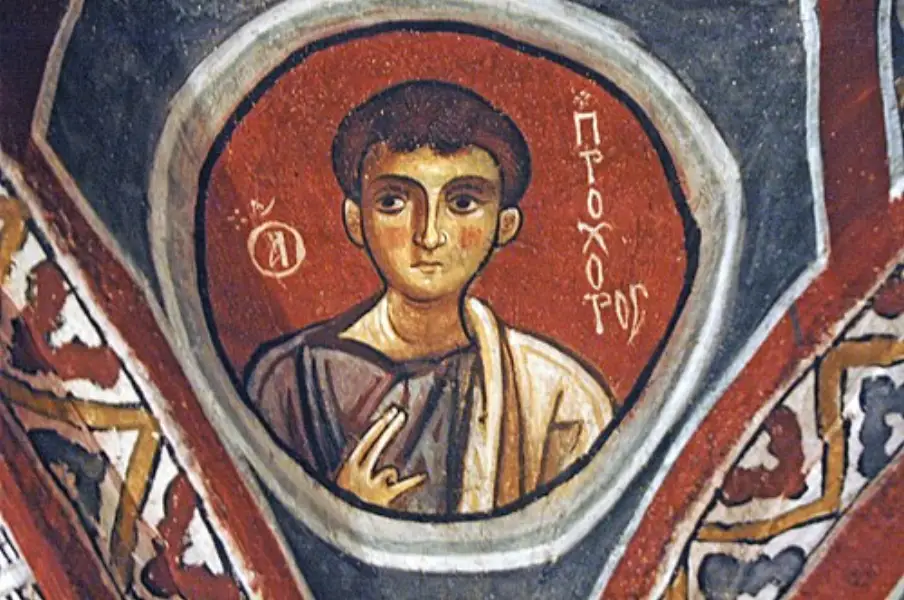
Overview
Prochorus was one of the Seven Deacons chosen by the first Christian community of Jerusalem to oversee the daily care of its poor, an office recorded in the sixth chapter of the Acts of the Apostles, which names him immediately after Stephen, Philip, and their companions. Holy tradition further reckons him among the Seventy Disciples whom Christ sent out to preach. Later accounts weave a rich legend around him: he is called the nephew of Stephen the Protomartyr, and is said to have accompanied Saint Peter, who ordained him bishop of Nicomedia; a variant tradition holds that Saint John the Apostle consecrated him to the same Bithynian see. In Orthodox memory he stands closest to John, whose scribe he is shown to be in countless icons, taking down the Book of Revelation at the evangelist's dictation. A tradition of later date makes him bishop of Antioch, and there he is said to have closed his life as a martyr in the first century. A pious medieval attribution gave his name to the apocryphal Acts of John, though modern scholars date that work to the end of the second century and do not credit him with its authorship. He is venerated by the Eastern Orthodox, Oriental Orthodox, and Catholic Churches, and four of the Seven Deacons, himself among them, share a common celebration on July 28 in the Orthodox calendar.
The Complete Life
Chosen Among the Seven
The first and most certain fact known about Prochorus comes from the Acts of the Apostles. When dissension arose in the young church of Jerusalem over the daily distribution to the needy, the Twelve asked the community to select seven men of good reputation, full of the Spirit and of wisdom, to take charge of that service, so that the apostles might devote themselves to prayer and the preaching of the word. The choice fell on Stephen, Philip, Prochorus, Nicanor, Timon, Parmenas, and Nicholas, and the seven were set apart by prayer and the laying on of hands. Prochorus stands third in the list, close to Stephen, whose name the same chapter makes the Church's first martyr. To this ministry of charity, later tradition added a further commission: the belief that Prochorus was also one of the Seventy Disciples whom the Lord sent out two by two before his face, as recorded in the tenth chapter of Luke's Gospel. Whether or not the identification can be verified, it expresses the memory of a man formed in the closest circle of the apostolic age, whose whole vocation was service — service to the poor of Jerusalem, service to the apostles, and at the last the service of testimony sealed with blood.
§ Prochorus (deacon)
Companion of Apostles, Bishop of Nicomedia
The traditions that grew around Prochorus bind him to the greatest figures of the apostolic age. One account calls him the nephew of Saint Stephen the Protomartyr, linking the deacon of charity to the first man who died for the name of Christ. Another tradition relates that he accompanied Saint Peter and was ordained by that apostle to be bishop in the city of Nicomedia, the chief town of Bithynia on the southern shore of the Black Sea. A variant form of the legend transfers this consecration to Saint John the Apostle, who is said to have made him bishop of the same Nicomedia. The variant is significant, for it belongs to a wider body of memory that placed Prochorus at the evangelist's side, above all as his attendant and scribe: in Orthodox iconography from the eleventh century onward, in frescoes and manuscripts from Cappadocia to Armenia, he is shown seated with tablet and stylus, receiving the dictation of the Book of Revelation from John the Theologian. A pious tradition went so far as to attribute to him the apocryphal Acts of John, a romance of the apostle's deeds; modern scholarship, however, dates that work to the end of the second century and disputes his authorship. Later still, tradition remembers him as bishop of Antioch.
§ Prochorus (deacon)
Martyrdom at Antioch
According to the later tradition preserved in the martyrologies, Prochorus closed his life under the martyr's palm at Antioch, the great city of Roman Syria where the followers of Christ were first called Christians. The tradition assigns his death to the first century, though it preserves neither the year nor the circumstances in detail: no account survives of the judge who condemned him, the manner of his execution, or the place of his burial. Antioch was a fitting scene for the closing act of his life. It was the city of the Seven Deacons' own predecessor Nicolas, a center from which the mission to the Gentiles had gone out under Paul and Barnabas, and one of the ancient sees of the Church. There the deacon of Jerusalem, by tradition bishop first of Nicomedia and then of Antioch, is said to have given the final witness. For this reason the calendars honor him as a hieromartyr, a bishop who died for the faith, and join him to the company of apostles and martyrs. The silence of the sources about the details of his passion has not dimmed the constancy of his cult, which the churches of East and West have preserved from antiquity to the present day.
§ Prochorus (deacon)
Veneration of the Apostolic Age
Prochorus belongs to that first company of saints whose veneration required no formal decree, having been honored by the Church from the apostolic generations onward. He is venerated in the Eastern Orthodox Church, in the Oriental Orthodox Churches, and in the Catholic Church alike. The Catholic calendar keeps his feast on April 9. The Orthodox Church, following its ancient practice regarding the Seven Deacons and the Seventy Apostles, celebrates him on July 28; on that day he is one of four deacons of the Seventy jointly commemorated. The Coptic Church remembers him on the twentieth day of the month of Tobi, according to the synaxarium of that Church. In art his memory took a distinctive and beautiful form: in an eleventh-century fresco preserved in the Dark Church at Göreme in Cappadocia, and again in an Armenian gospel manuscript of 1224, he appears beside Saint John, taking down the revelation granted on Patmos. This image of the listening scribe has made him, across the Orthodox world, the very type of the disciple who receives and transmits the apostolic word, and it has kept his name alive wherever the Book of Revelation is read and painted.
§ Prochorus (deacon)
The Scribe of the Theologian
Prochorus endures in Christian memory chiefly through an image rather than an institution. He founded no see whose annals recorded him at length and left no writings of his own; what he left was a place in the church's imagination as the man who stood at the evangelist's elbow while the heavens were opened. From the eleventh-century frescoes of Cappadocia to the gospel manuscripts of medieval Armenia, painters gave that place visible form: a quiet, attentive figure with tablet and pen, receiving from John the Theologian the words of the Book of Revelation. The image presupposes the whole legendary biography — the deacon of Jerusalem, nephew of the Protomartyr, bishop of Nicomedia, companion of the beloved disciple, martyr of Antioch — and it carried that biography across the Orthodox East and into the Catholic calendars of the West, where his feast is kept on April 9. Modern scholarship has pruned the legend, dating the apocryphal Acts of John that bore his name to the close of the second century and denying his authorship of it, but scholarship has not displaced him. He remains on the rolls of the saints of the East and West, one of the Seven whose election for the service of the poor is written in the Acts of the Apostles, and the Church's memory of him rests on the earliest and firmest of all his titles: that of a man chosen to serve.
§ Prochorus (deacon)
The Record
- Major works
- apocryphal Acts of John attributed to him by tradition, though modern scholarship assigns it to the late second century
- Patron of
- scribes
- Symbols
- depicted as a scribe taking dictation of the Book of Revelation from Saint John the Theologian
- Canonization
- Pre-congregation, venerated since the earliest centuries by the Eastern Orthodox, Oriental Orthodox, and Catholic Churches
Prayer
Bibliography
Show 5 sources
- "Toba 20 : Lives of Saints : Synaxarium - CopticChurch.net"
- Feasts and Saints – OCA
- Seven Deacons – Catholic Encyclopedia
- Ehrman, Bart D. (2003). Lost scriptures : books that did not make it into the New Testament. New York: Oxford Univ. Press. pp. 94. ISBN 978-0-19-514182-5.
- Ekkart Sauser. "Prochorus (deacon)". Biographisch-Bibliographisches Kirchenlexikon (BBKL) (in German).
Profile text adapted from the Wikipedia article, licensed CC BY-SA 4.0.
Pray with this saint every day
Save St. Prochorus to your favorites, read the full profile, and get feast-day reminders in the Saints app.
Get the Saints AppFree on the App Store for iPhone and iPad