
c. 985 – 1066·Feast February 12
St. Prochorus the Iberian
Georgian monk and founder of the Monastery of the Cross
Overview
Prochorus the Iberian, born George of Shavsheti around 985 in the Kingdom of the Iberians, was a Georgian monk who became the restorer of Georgian monasticism in the Holy Land and the founder of the Monastery of the Cross in Jerusalem. Raised in a local monastery, he took monastic vows and was ordained a priest before setting out, at about the age of thirty, for a life of asceticism and study in Palestine. He spent roughly a decade at the Lavra of Saint Sabas, the great desert monastery east of Jerusalem, mastering both the ascetic discipline and the administration of a large community. In the 1020s he moved to Jerusalem with the aim of gathering Georgian monks scattered among the Palestinian monasteries. His crowning work came in 1064, when, by order of King Bagrat IV of Georgia and with funds carried to Jerusalem by George the Hagiorite, he built the Monastery of the Cross in the Valley of the Cross, organized nearly eighty monks under a rule drawn from Saint Sabas, and endowed it with a decorated church and a hostel for pilgrims. Having finished his labor, he withdrew to the Arnon desert for a final life of solitude and died there in 1066. His feast is kept in the Eastern Orthodox Church on February 12.
The Complete Life
A Georgian Youth of Shavsheti
The Georgian Vita of Prochorus records that he was born around the year 985 in the Kingdom of the Iberians, under his baptismal name of George, and that his family belonged to the region of Shavsheti, a Georgian land in the mountain country south of the Caucasus. Nothing is preserved of his parents or of the circumstances of his childhood beyond the fact that he was raised in a local monastery. There he received the formation that would shape his entire life: he became a monk in the house that reared him, and in time he was advanced to the priesthood. This early passage from village to cloister was the common road of Georgian sanctity in the tenth and eleventh centuries, an age when the monasteries of the Caucasian frontier were at once schools, scriptoria, and nurseries of missionaries. The Vita presents the young George as a man formed entirely by the monastic tradition, without a period of secular life or worldly career between his upbringing and his vows. It was as a priest-monk, already mature in discipline, that he made the decision which would carry him away from his native land: to leave for the Holy Land, at about the age of thirty, in pursuit of a stricter monastic life and deeper spiritual study.
§ Life
Formation in the Desert of Saint Sabas
Between about 1010 and 1015 Prochorus made the journey from the Georgian lands to Palestine, drawn like countless monks before him to the desert east and south of Jerusalem. He remained some ten years within the Lavra of Saint Sabas, among the foremost houses of prayer in that desert, a foundation two centuries older than his coming, planted by Sabas the Sanctified in the wilderness of the Jordan valley. There the Georgian pilgrim was tested and refined. The Vita notes that he honed his ascetic practices in the Lavra and, equally significant, gained experience in monastic administration — an apprenticeship in both the interior and the practical arts of the cloister that would prove decisive for his later work. The Lavra of Saint Sabas was not merely a refuge for solitary prayer; it was a living institution with a rule, a liturgy, an economy, and a multinational population of monks. In serving it, Prochorus learned how a large community is governed, how its daily round is ordered, and how its traditions are handed on. By the 1020s he judged himself ready for a new undertaking, and he moved from the desert to Jerusalem itself, where a task waited that no other Georgian seemed able to perform: the gathering of a scattered nation of monks.
§ Life
Gathering the Georgians of the Holy Land
When Prochorus settled in Jerusalem around the 1020s, Georgian monks were dispersed across the monasteries of Palestine, without a house of their own in the holy city. His mission was to gather these dispersed monks and to set Georgian monastic life in the Holy Land on firmer ground. The decisive act came late in his life. According to the Vita, he raised the Monastery of the Cross in 1064, acting on the command of Bagrat IV, king of the Georgians, with funds that George the Hagiorite had carried to Jerusalem for the work. The site was the Valley of the Cross, a place hallowed by early Christian legend and by the tradition that it preserved a relic of the True Cross, from which the monastery took its name. Prochorus did more than rebuild and expand the buildings: he established rules and a monastic regimen explicitly modeled on the Lavra of Saint Sabas, and he organized nearly eighty ascetic monks under his guidance. He raised a church adorned with ornaments and icons, and he built a hostel for pilgrims, so that the house served both the spiritual needs of the brethren and the practical needs of the Georgian travelers who reached Jerusalem from the Caucasus. Under his hand the monastery became the center of a nation's prayer in the city of the Resurrection.
§ Life
Solitude in the Desert of Arnon
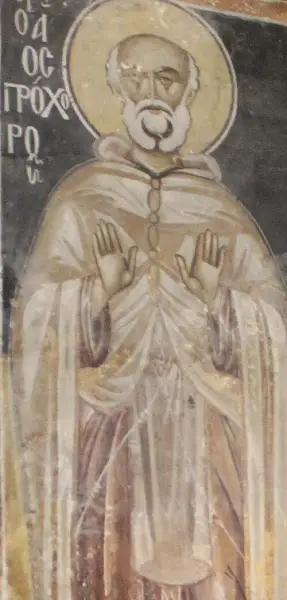
When the work in Jerusalem was complete, Prochorus did not remain to govern what he had built. Following the oldest instinct of desert monasticism, he withdrew from the monastery he had founded and retired to the Arnon desert, taking up his remaining years in solitude. The Arnon, named for the river gorge east of the Dead Sea, lay within the wilderness regions that had hosted monks since the earliest centuries, and the choice of such a retreat for his final years placed him squarely in the lineage of Sabas and the other desert fathers whose discipline he had spent a lifetime embodying. There, far from the house of eighty monks he had assembled and from the pilgrims who lodged in his hostel, he died in 1066, having lived some eighty years and nearly a half-century in the Holy Land. The Vita presents this retreat not as abandonment but as completion: the founder, having given the Monastery of the Cross its rule, its church, and its congregation, returned to the silence from which his vocation had first issued. The Eastern Orthodox Church commemorates him on February 12, and the original fresco of the saint from the Monastery of the Cross, cut from the wall and carried away, is now kept as an icon in the Svetitskhoveli Cathedral of Georgia.
§ Life
The House Beneath the Cross
Prochorus is remembered for two achievements that outlasted him. The first is the Monastery of the Cross itself, which flourished long after his death: during the fourteenth century it was the principal house of Georgian prayer and learning in Jerusalem, receiving monks, copyists, and clergy of that nation, and through the ages it kept alive the liturgical inheritance and books of Georgia. Only in the late seventeenth century, when financial difficulties overtook the house, did it pass under the jurisdiction of the Greek Orthodox Patriarchate, though the Georgian influence upon it remained culturally significant. The second legacy is subtler: the strengthening of Georgian monasticism in the Holy Land as a whole, which his gathering of the scattered monks made possible. His own writings testify to the range of the tradition he carried — a Menologium of his survives in the Bodleian Library, offering a window onto how Georgians prayed, how their scribes wrote, and how Christian books passed between cultures. He is thus honored both as a builder, whose monastery still stands in the Valley of the Cross, and as a link in the chain by which the texts and prayers of the Caucasus entered the wider Christian world. In Georgia he is venerated as a patron, and his feast falls on February 12.
§ Legacy
Timeline
- 985
First saw the light at Shavsheti in the Georgian realm of the Iberians, receiving the name George.
§ Life
- 1010
Left for the Holy Land at about age thirty to pursue monastic life and spiritual study.
§ Life
- 1020
Moved to Jerusalem to gather Georgian monks scattered across the Palestinian monasteries.
§ Life
- 1064
Constructed the Monastery of the Cross in Jerusalem by order of King Bagrat IV of Georgia.
§ Life
- 1066
Died in solitude in the Arnon desert after completing his work in Jerusalem.
§ Life
The Record
- Major works
- a Menologium preserved at the Bodleian Library·rules and monastic regimen of the Monastery of the Cross
- Patron of
- Georgia·Monastery of the Cross
- Symbols
- fresco of Prochorus from the Monastery of the Cross, kept as an icon at Svetitskhoveli Cathedral
- Canonization
- Pre-congregation, venerated as a saint in the Eastern Orthodox Church
Prayer
Bibliography
Show 4 sources
- Charkiewicz, Jarosław (2005). Gruzińscy święci. Warszawa: Warszawska Metropolia Prawosławna. ISBN 8392009371.
- Salia, Kalistrat (1983). History of the Georgian Nation. Paris: Académie Française.
- Tchekhanovets, Yana (2018). The Caucasian Archaeology of the Holy Land: Armenian, Georgian and Albanian Communities Between the Fourth and Eleventh Centuries CE. Handbook of Oriental Studies, vol. 123. Brill. ISBN 9789004362246.
- Gvelesiani, Giorgi (2013). Churches and Monasteries of Georgia. Kutaisi. pp. 75–96.
Profile text adapted from the Wikipedia article, licensed CC BY-SA 4.0.
Pray with this saint every day
Save St. Prochorus the Iberian to your favorites, read the full profile, and get feast-day reminders in the Saints app.
Get the Saints AppFree on the App Store for iPhone and iPad