
c. 390 – 446·Feast November 20
St. Proclus of Constantinople
Archbishop, preacher, and early Marian theologian
Overview
Proclus of Constantinople, born around 390, served as Archbishop of Constantinople from 434 until his death on July 24, 446, and stands among the foremost preachers and Marian theologians of the early Byzantine Church. Educated in rhetoric and the classical authors in the imperial capital, he entered church service as a reader and rose under Archbishop Atticus, who ordained him deacon and priest and employed him as scribe and ghost-writer. Passed over twice for the archiepiscopal throne — in 425, when the populace chose Sisinnius, and after 431, when canon law barred his transfer from the titular see of Cyzicus — he won fame instead as a popular preacher, compared already in his lifetime to John Chrysostom. When Nestorius began attacking the title Theotokos in late 428, Proclus withdrew from communion with him and, in 430, preached the celebrated panegyric on the Virgin Mary from the archbishop's own pulpit — a sermon later placed at the head of the Acts of the Council of Ephesus and judged the most renowned Marian discourse ever preached. As archbishop he governed in the aftermath of Ephesus, answered the Armenians with his Tome to the Armenians, received the relics of John Chrysostom back to Constantinople in 438, and died revered as a wise, moderate, and conciliatory pastor.
The Complete Life
A Reader in the Imperial City
Proclus was born around the year 390 in Constantinople, the cosmopolitan capital of the Eastern Roman Empire, and was presented for church service as a reader while still young. His education followed the classical pattern of the age: private tutors taught him rhetoric and the ancient authors, and he came under the sway of learned emigres from Alexandria then living in the capital, men who carried with them the exegetical and theological traditions of Egypt. This schooling gave him a rare combination of talents — a polished literary Greek, a trained orator's voice, and a mind formed in both classical and Christian learning. From that formation came the qualities for which his whole life would be remembered: a command of vivid imagery, rhythmic delivery, and logical argumentation that made him, in time, the most celebrated preacher in the capital. The later tradition that he was the friend and disciple of John Chrysostom during that father's archiepiscopate, and was ordained by him, has been shown to be a medieval construction; the true mentor of his youth and manhood was another archbishop, Atticus, under whom the talented reader would find both his vocation and his career.
§ Biography
Secretary to Archbishop Atticus
Proclus' ecclesiastical career unfolded under Archbishop Atticus of Constantinople, who governed the see from 406 to 425. Impressed by the young man's gifts as writer, rhetorician, and orator, Atticus ordained him first deacon and then priest, and quickly made him an essential part of the archiepiscopal administration. Because the archbishop was less eloquent and less intellectually versatile than his protégé, Proclus acted as both scribe and ghost-writer, drafting documents and discourses that went out under his bishop's name. On pastoral and diplomatic journeys to the court's residences he built the enduring ties with the ruling house that would later carry him to the patriarchal throne. He also assisted the archbishop in a quieter project of enduring consequence: Atticus was a pioneer of Byzantine Marian veneration, chiefly by founding the first Marian feast to receive official sanction, and scholars judge that Proclus lent him literary help in these undertakings. When Atticus died in 425, Proclus stood as a natural candidate for succession, but the populace preferred the elderly Sisinnius, valued for standing above local factions and for generosity toward the needy. Proclus accepted the outcome graciously, befriended the new archbishop, and waited.
§ Biography
Preacher Against Nestorius
Sisinnius consecrated Proclus Bishop of Cyzicus in 426, but the residents of that city refused to receive him and chose their own bishop unlawfully, leaving Proclus a titular bishop at Constantinople. Under Sisinnius' patronage his fame as a popular preacher grew, earning him comparison with John Chrysostom himself. When Sisinnius died, the contest between Proclus and Philip of Side grew so fierce that the emperor imposed an outsider, the Antiochene orator Nestorius. In late 428 Nestorius launched a persecution of heretical groups and began preaching against the propriety of calling Mary the Theotokos, a title over a century old and woven into the liturgical life of the capital. At first Proclus held back, but when a monastic deacon formally accused the archbishop of heresy, he withdrew from communion with him. In 430, invited by Nestorius himself to preach before a mixed crowd on a feast of the Theotokos, Proclus delivered his panegyric on the Virgin Mary, a masterpiece of exegesis and rhetoric judged the most renowned Marian discourse ever preached, placed afterward at the head of the Acts of the Council of Ephesus. He continued his homiletic attacks, received a warm acknowledgment from Cyril of Alexandria, and though he did not attend Ephesus, his preaching had done much to bring Nestorius down.
§ Biography
Theology of the Virgin Mother
Proclus' theology found its noblest expression in his teaching on the Mother of God. His homilies affirm the unity and duality of Christ's natures in language that anticipates the formula of Chalcedon: a union of divinity clothed with humanity, unconfused yet personally one, in which the Word made flesh dies sacrificially because man, who sinned, must pay sin's debt, and only the incarnate God can pay it. From this Christology his Mariology flows directly: the wonder of virginal motherhood guards the wonder of the incarnation. He championed the traditional title Theotokos, upheld the perpetual virginity, and taught the ancient Eve-Mary parallel, finding his proof-text in Ezekiel's vision of the closed gate of the sanctuary. His imagery draws on the Old Testament in dazzling series: Mary is an Eden of the spirit where the second Adam dwells, the new Eve who undoes the first disobedience, the Ark bearing the spiritual Noah, Jacob's ladder, Gideon's fleece, the burning bush unconsumed, the throne of the Cherubim, a harbour, a sea, a bridal chamber, more spacious than heaven, her womb wider than the heavens. His Homily 1 of 430 defined the rhetoric and rationale of Marian devotion for the whole Byzantine age, attained a de facto canonical status, and became the foundation upon which centuries of reflection would build.
§ Mariology
Archbishop and Peacemaker
Maximianus died on Great and Holy Thursday of 434, and to avoid fresh electoral disturbances the imperial government, now firmly anti-Nestorian, had Proclus enthroned at once by permission of Theodosius II and the assembled bishops. Both Cyril of Alexandria and John of Antioch approved his appointment by the usual synodical letters, though a portion of Eastern bishops who had seceded refused his consecration. His archiepiscopate was devoted to healing the wounds of Ephesus. When the bishops of Armenia consulted him in 436 about doctrines attributed to Theodore of Mopsuestia, he answered with the celebrated Tome to the Armenians, asking the Eastern bishops to condemn the doctrines but carefully declining to condemn any person; a rescript of Theodosius procured through his efforts, professing the emperor's desire that all live at peace and that none who died in the Church's communion be blamed, calmed the storm and brought a season of tranquility to the Eastern Churches. In 438 he brought home the relics of John Chrysostom from Comana and laid them with great honor in the Church of the Twelve Apostles, reconciling at last the aged preacher's estranged adherents. In his time the Trisagion came into liturgical use, its occasion said to be four months of violent earthquakes that drove the people of Constantinople to encamp in the fields. Proclus died on July 24, 446.
§ Biography
Veneration of the Archbishop
Proclus was never the subject of a formal canonization process; he belongs to the ages in which the Church recognized holiness by public and uninterrupted veneration. He is honored as a saint by the Catholic Church, the Eastern Catholic Churches, the Eastern Orthodox Church, and the Oriental Orthodox Churches. The calendars differ in their observance: the Eastern Orthodox and Oriental Orthodox Churches keep his feast on November 20, a date that places him ahead in honor of other great bishops of Constantinople such as Maximus, Anatolius, and Gennadius, while the Catholic Church lists him on October 24. His cult was nourished by the survival of his works — twenty sermons, seven letters, and his Christological homilies — which kept his voice alive in the churches long after his death, and by his portrayal in illuminated Byzantine manuscripts such as the Menologion of Basil II. Popular devotion also preserved vivid memories of his pontificate, including the tradition that connected the introduction of the Trisagion to the earthquakes of his episcopate. In modern times his standing as a theological authority received fresh recognition when Cardinal John Henry Newman cited him for his Marian doctrine and his resolute backing of the council's dogma on the Theotokos, a doctrine the whole Church had at last accepted.
§ Feast day
Father of Byzantine Mariology
Proclus' lasting monument is theological. His Homily 1 of 430, attached to the proceedings of the Council of Ephesus, defined the language and the logic with which Byzantium would speak of the Virgin for a thousand years; the great chorus of Old Testament images he assembled — the bush, the fleece, the ladder, the closed gate, the womb wider than the heavens — became the common property of preachers, hymnographers, and iconographers, and his identification of Mary as the one who renews the female sex and bridges God and humanity passed into the Church's standard doctrine. His five principal homilies were translated into English by Fr. Maximos Constas and published by Brill in 2002, testifying to the continuing scholarly interest in his achievement. As a churchman he left a different but equally important example: a model of orthodox firmness joined to genuine conciliation, the bishop who would condemn doctrines but not persons, and who sought to win the differing over by persuasion rather than force. The peace his moderation secured among the Churches of the East after the storms of Ephesus showed that the delicate settlement could hold. Above all he is remembered as the brilliant link between Chrysostom's golden age of preaching and the age of councils — the man who, from the pulpit of the imperial city, taught Christendom how to call the Virgin Mother of God.
§ Theology
Timeline
- 390
Born at Constantinople, and became a reader in the church there at a young age.
§ Biography
- 425
Was a leading candidate to succeed the deceased Archbishop Atticus, but the populace chose Sisinnius I.
§ Biography
- 426
Consecrated Bishop of Cyzicus by Sisinnius, though the city refused to receive him and he remained in Constantinople.
§ Biography
- 428
Nestorius was installed as Archbishop and soon began preaching against the title Theotokos for Mary.
§ Biography
- 430
Preached his celebrated panegyric homily on the Virgin Mary at a feast of the Theotokos in Constantinople.
§ Biography
- 431
Nestorius was deposed at the Council of Ephesus; Maximianus was elected archbishop instead of Proclus.
§ Biography
- 434
Enthroned as Archbishop of Constantinople by permission of Emperor Theodosius II upon Maximianus' death.
§ Biography
- 437
Answered the Armenians' doctrinal questions with the celebrated letter called his Tome to the Armenians.
§ Biography
- 438
Oversaw the translation of the relics of John Chrysostom from Comana to Constantinople.
§ Biography
- 439
At Caesarea's request, selected Thalassius as the new bishop of that Cappadocian city.
§ Biography
- 24 Jul 446
Died at Constantinople after twelve years as archbishop.
§ Biography
In Their Own Words
the only bridge between God and men
The Record
- Major works
- Homily 1 on the Virgin Mary (430), later inserted into the Acts of the Council of Ephesus·Tome to the Armenians·20 sermons (some of doubtful authenticity)·7 letters·8 homilies on Christology, 7 of them authentic
- Patron of
- preachers·Marian devotion
- Symbols
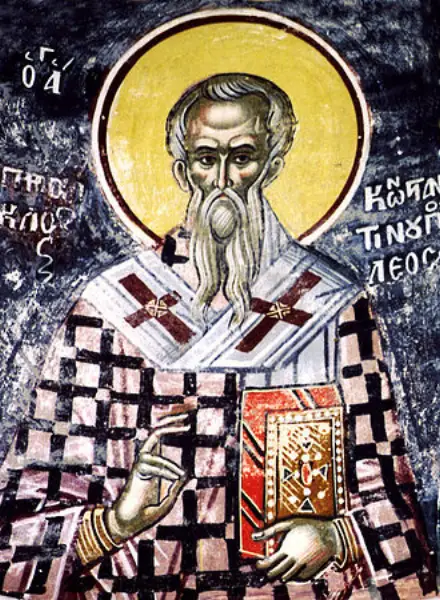
- portrayed in the Menologion of Basil II·fresco of an archbishop with homiletic books
- Canonization
- Pre-congregation, venerated since antiquity by the Catholic, Eastern Catholic, Eastern Orthodox, and Oriental Orthodox Churches
Prayer
Bibliography
Show 7 sources
- Constas, Nicholas (2003). Proclus of Constantinople and the cult of the Virgin in late antiquity: homilies 1–5, texts and translations. Brill. ISBN 90-04-12612-0.
- Schwartz, Eduard (1914). Acta conciliorum oecumenicorum. Vol. 4. Berlin: De Gruyter. pp. 187–195.
- O'Carroll, Michael (2000). Theotokos – a theological encyclopedia of the Blessed Virgin Mary. Wipf and Stock. pp. 296–297. ISBN 1-57910-454-1.
- Shoemaker, Stephen J. The First Christian Hymnal: The Songs of the Ancient Jerusalem Church – Parallel Georgian-English Texts. Brigham Young University.
- Meyendorff, John (1989). Imperial unity and Christian divisions: The Church 450–680 AD. Crestwood, NY: St. Vladimir's Seminary Press. ISBN 9780881410563.
- Bacchus, Francis Joseph (1911). "St. Proclus". In Herbermann, Charles (ed.). Catholic Encyclopedia. Vol. 12. New York: Robert Appleton Company.
- Daniel, F. H. Blackburne (1911). "Proclus, St. patriarch of Constantinople". In Wace, Henry; Piercy, William C. (eds.). Dictionary of Christian Biography and Literature to the End of the Sixth Century (3rd ed.). London: John Murray.
Profile text adapted from the Wikipedia article, licensed CC BY-SA 4.0.
Pray with this saint every day
Save St. Proclus of Constantinople to your favorites, read the full profile, and get feast-day reminders in the Saints app.
Get the Saints AppFree on the App Store for iPhone and iPad