
c. 970 – 1053·Feast July 14
St. Procopius of Sázava
Hermit and first abbot of Sázava Monastery
Overview
Procopius of Sázava, a Czech canon, priest, and hermit who died on March 25, 1053, became one of the chief patron saints of the Bohemian lands. Born around 970 at Chotouň, a village of central Bohemia near Kouřim, he was educated in Prague and received priest's orders in that city, living for a time as a married man, fathering a son named Jimram. He afterward entered the Benedictine order, probably at Břevnov Monastery, and withdrew to a cave on the banks of the Sázava River to live as a hermit. Disciples gathered around him, and in 1032 or 1033 the duke of the Bohemians gave the community the standing of a Benedictine house — the Sázava Monastery, whose first superior Procopius remained for twenty years until his death. Venerated locally within a century, he was canonized for the Latin Church on June 2, 1204, whether by Pope Innocent III or, as many scholars hold, by the ritual raising and removal of his body to an altar at Sázava, which then counted as canonization. He came to be regarded as the national saint of the Kingdom of Bohemia, his relics were translated to All Saints Church at Prague Castle in 1588, and in 2017 the Russian Orthodox Church added his name to its menologium as Venerable Procopius, Abbot of Sázava.
The Complete Life
A Priest of Bohemia
Little about the life of Procopius is known with certainty, and what follows comes chiefly from the hagiographical tradition that grew up after his death. According to that tradition he was born around the year 970 in Chotouň, a village of central Bohemia near the town of Kouřim, in a country then ruled by the Přemyslid dukes and only recently and imperfectly Christianized. He went to study in Prague, the seat of the bishops of Bohemia, and was ordained a priest in that city. His life took a turn unusual among the saints of the age: he was married, and a son was born to him, called Jimram or Emmeram. Only afterward did the direction of his life change toward the cloister. The record of his marriage and fatherhood, preserved without embarrassment by his biographers, marks him as a man whose vocation unfolded in stages — first the studies and orders of a secular priest, then the responsibilities of a household, and only at length the radical departure that made him a monk and a hermit. His son's name was remembered by the tradition alongside his own, a sign that the tie was never broken even when the father withdrew to the wilderness of the Sázava valley.
§ Life
From Cloister to Cave
After his years in Prague and family life, Procopius took the Benedictine habit, most likely at Břevnov, the ancient house by Prague founded at the close of the tenth century. There he learned the rule of Saint Benedict, its balance of prayer, reading, and labor, and the discipline of life in community. But the Benedictine vocation, in its oldest form, pointed beyond the cloister to the desert, and Procopius answered that call in its eremitical extremity: he retired to the wilderness and settled in a cave on the banks of the Sázava River, living as a hermit in the forests of Bohemia. His solitude did not long remain unbroken. Drawn by his reputation for holiness, a group of fellow hermits gathered around him, forming an informal community of solitaries united under his guidance. In this the Bohemian hermit followed the classic pattern of desert monasticism, in which the flight of one holy man becomes the seed of a monastery. The cave in the valley of the Sázava, remembered ever after as the Cave of Saint Procopius and rediscovered in the twentieth century, was thus the birthplace of the most distinctively Bohemian of monastic houses, and the first stage of the transformation by which a married priest of Chotouň became the spiritual father of a nation.
§ Life
Abbot of Sázava
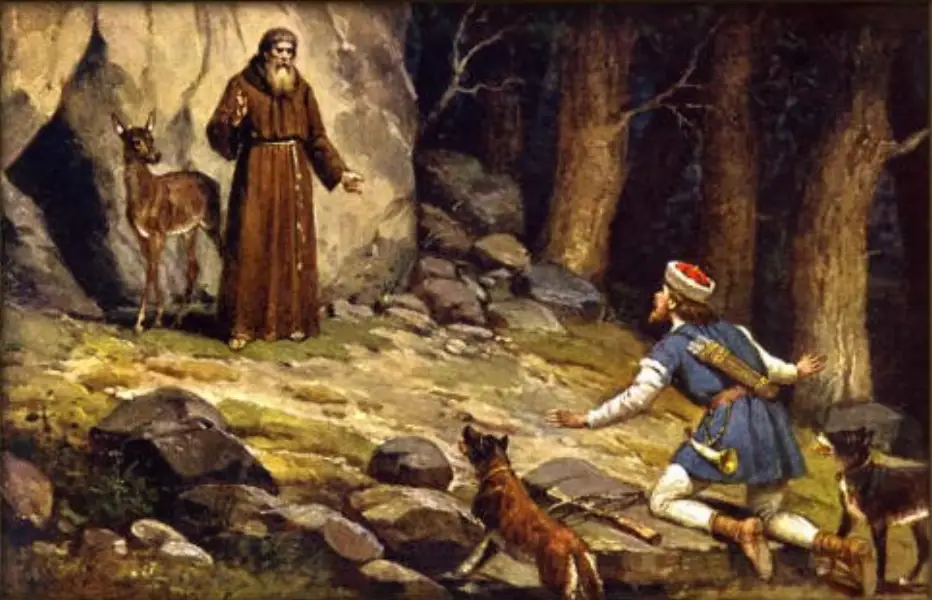
The community of hermits gathered around Procopius received from the Bohemian duke its charter as a Benedictine house in 1032 or 1033, the settlement now known as Sázava Monastery or St Procopius Monastery. The ducal act gave the wild settlement on the river banks the standing of a canonical religious house, with lands, obligations, and a place in the Christian order of the Bohemian state. Procopius governed it as first abbot through the twenty years that remained to him. As abbot he joined the eremitical austerity of the cave to the ordered discipline of the Benedictine cenobium: the hermit became the head of a community, charged with forming monks, administering the house, and representing it to the duke and the bishops. His abbacy fell in the generations when Bohemia was consolidating its Christian institutions, between the martyrdom of Saint Wenceslaus and the episcopate of Saint Adalbert's successors, and Sázava took its place among the young kingdom's principal monasteries. The later legend, painted on the walls of the monastery and in the pictures of later centuries, remembered the meeting of the hermit with Duke Oldřich during a hunt — the wild man of God recognized by the worldly power. Under his government the house grew so strong that it survived the troubles of the age and endured, in one form or another, for five centuries.
§ Life
Death and First Honors
Procopius governed Sázava for twenty years and died there on March 25, 1053, having led the monastery from a hermit's cave to an established Benedictine house. His death closed a life that had passed through three states — secular priest, monk, and abbot — each absorbed into the last. The monks who buried their abbot on the banks of the Sázava began almost at once to honor him as a saint, and local veneration is recorded with certainty for the twelfth century, when the first biography of his life, the Vita minor, was written. The community he founded continued as the custodian of his memory, keeping his tomb and celebrating his feast. Fifty years after his death Bohemia remembered him among its saints; a century and a half after it, the Church confirmed that memory in the rite of canonization. The circumstances of his passing are otherwise unadorned by the sources: no deathbed scene, no last testament, only the date and the place. Yet the plainness of the record belongs to his character. He had entered the wilderness to be hidden, and even his death was recorded not for its drama but for its date — the twenty-fifth of March — which the Bohemian Church would keep thereafter as the day of its hermit abbot.
§ Veneration
The Saint of the Bohemians
The faithful of Bohemia were honoring Procopius as a saint by the twelfth century, when the Vita minor, his earliest life, was set down. His formal canonization for the Roman Catholic Church followed on June 2, 1204; how it was performed remains a matter of debate. Some sources state that Pope Innocent III canonized him in that year; others hold that his canonization was accomplished in the solemn raising and transfer of his body to the altar at Sázava — a ceremony that then carried the weight of canonization. Whatever the exact form, the effect was decisive: after his canonization Procopius became venerated throughout Bohemia so widely that he was honored as the very national patron of the Bohemian kingdom. His deeds and marvels were rehearsed in the Vita antiqua of the late thirteenth century and the Vita maior of the fourteenth. In 1588 his remains were translated to All Saints Church in Prague Castle, bringing the hermit of the Sázava into the citadel of Bohemian princely power. Eight centuries later, on March 9, 2017, the Holy Synod of the Russian Orthodox Church added the name of Venerable Procopius, Abbot of Sázava, to the menologium of the Russian Church, extending his veneration into Eastern Orthodoxy, where his feast is kept on September 16.
§ Veneration
Furrow, Fresco, and Bridge
The memory of Procopius has shaped Bohemia in stone, paint, and story. Sázava Monastery itself, though destroyed in the Hussite Wars, was re-established as a church in the seventeenth century, and its monastery buildings were converted into a castle; there, beneath layers of nineteenth-century paint, Baroque frescoes of the saint's life — the Meeting of Hermit Procopius with Prince Oldřich and Abbot Procopius Giving Alms among them — were rediscovered in the 2000s. To him the pious Middle Ages attributed the Devil's Furrow, a Czech landform said to have been ploughed by the devil at his command, and the artists gave the legend a visible form in his emblem of a devil ploughing before him. The Cyrillic portion of the Reims Gospel was attributed to his hand in the fourteenth century, and Emperor Charles IV commissioned the manuscript's Glagolitic extension. An early eighteenth-century statue by Ferdinand Brokoff stands among the saints of the Charles Bridge in Prague, and Baroque statues and paintings of the saint are scattered through the Bohemian churches dedicated to him. In the eighteenth century the monk Hugo Fabricius wrote a new life of the wonderworker, and in modern times Czech poets Jaroslav Vrchlický and Vítězslav Nezval retold his story in verse, keeping the hermit of Sázava alive in the nation's imagination.
§ Veneration
Timeline
- 970
Born in the village of Chotouň near Kouřim in central Bohemia.
§ Life
- 1032
His community of hermits was incorporated as Sázava Monastery by the duke of Bohemia, with Procopius as first abbot.
§ Life
- 25 Mar 1053
Died at Sázava after twenty years as abbot of the monastery.
§ Life
- 2 Jun 1204
Canonized for the Roman Catholic Church by Pope Innocent III, or by the elevation and translation of his body at Sázava.
§ Veneration
- 1588
His remains were transferred to All Saints Church in Prague Castle.
§ Veneration
- 9 Mar 2017
The Holy Synod of the Russian Orthodox Church added his name to its menologium.
§ Veneration
The Record
- Major works
- Sázava Monastery (St Procopius Monastery), founded 1032/3
- Patron of
- Bohemia
- Symbols
- devil ploughing before him·abbot with a book and whip, devil at his feet·a stag or hind near him·hermit with a skull and a girdle of leaves·with Saints Adalbert, Ludmila, and Vitus
- Canonization
- Canonized 2 June 1204 by Pope Innocent III, or by liturgical elevation and translation of his relics at Sázava; added to the Russian Orthodox menologium on 9 March 2017
Prayer
Bibliography
Show 6 sources
- Kubín, Petr (1 January 2016). "Saint Procopius of Sázava between Reality and Fiction". Revue Mabillon. 27: 49–81. doi:10.1484/J.RM.4.2017004. ISSN 0035-3620.
- Mortensen, Lars Boje (2006). The Making of Christian Myths in the Periphery of Latin Christendom (c. 1000-1300). Museum Tusculanum Press. p. 88. ISBN 978-87-635-0407-2.
- Wratislaw, A. H. (1876). "St Procop of Bohemia: A Legend of the Eleventh Century". Transactions of the Royal Historical Society. 4: 439–448. doi:10.2307/3677929.
- Curta, Florin; Holt, Andrew (2016). Great Events in Religion: An Encyclopedia of Pivotal Events in Religious History. ABC-CLIO. p. 489. ISBN 978-1-61069-566-4.
- Hugo Fabricius, Požehnaná Památka Welikého Swěta Diwotworce Swatýho Prokopa, Kutná Hora (1780).
- Konzal, Václav (2014). "Svatý Prokop a Sázavský klášter" [Saint Procopius and Sázava Monastery]. The Cyril and Methodius Mission and Europe (in Czech). pp. 296–299. ISBN 978-80-86023-51-9.
Profile text adapted from the Wikipedia article, licensed CC BY-SA 4.0.
Pray with this saint every day
Save St. Procopius of Sázava to your favorites, read the full profile, and get feast-day reminders in the Saints app.
Get the Saints AppFree on the App Store for iPhone and iPad