
died 7 July 303·Feast July 8
St. Procopius of Scythopolis
Reader, exorcist, and martyr of Caesarea
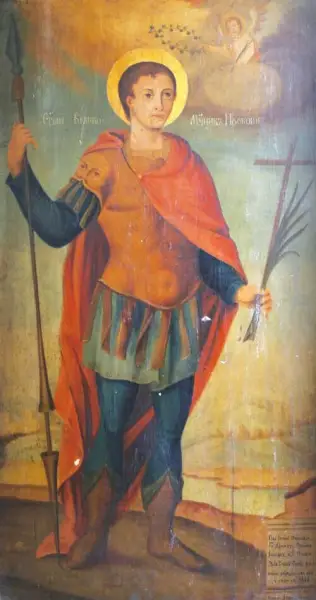
Overview
Procopius of Scythopolis was a fourth-century martyr put to death on July 7, 303, during the persecution of the Emperor Diocletian. Born at Jerusalem, he settled in Scythopolis in Palestine, where he held three ecclesiastical offices in the local church: reader, interpreter of the scriptures in the Syriac language, and exorcist who healed those possessed by evil spirits. He was famous alike for his ascetic discipline and for his theological learning, and his martyrdom was thought worthy of a written account by Eusebius of Caesarea, the father of Church history. Sent from Scythopolis to Caesarea Maritima with his companions, he refused the demands of the persecutors and was beheaded, the first Palestinian martyrdom of the great persecution recorded by Eusebius. In later centuries a web of legends grew around his name, portraying him as a soldier, a Persian, or a prince of Alexandria, and crediting him with fabulous victories won by showing the cross. The historical core, however, remained secure: his name entered Bede's Martyrology under July 8 and thence the Roman Martyrology, churches were raised in his honor from Caesarea to Constantinople, and in the East he is numbered among the Great Martyrs and remembered even in the Orthodox marriage dismissal.
The Complete Life
From Jerusalem to Scythopolis
Procopius was born at Jerusalem in the third century, in the city where the Church had been born at Pentecost and where the memory of the first martyrs still lived. At some point he left his native city and went to live in Scythopolis, the ancient Bethshan, a Greek city of the Decapolis lying west of the Jordan, which gave him the name by which history knows him. There he attached himself to the Christian community and progressed through the minor orders of the local church. The age was one of uneasy calm: the persecutions of the third century had come and gone, the Church had grown strong in Palestine, and a gifted young Christian could pursue both the study of the faith and a life of disciplined prayer. Later legends would invent for him an exotic past — a Persian birth, a princely rank at Alexandria, a career as a persecuting soldier — but the earliest and best source, Eusebius of Caesarea, knew nothing of these romances. He records simply a man born at Jerusalem who had made his home at Scythopolis, and who had already distinguished himself in the service of the Church there when the storm of Diocletian's persecution finally broke over Palestine.
§ Procopius of Scythopolis
Reader, Interpreter, Exorcist
In the church of Scythopolis Procopius held three ecclesiastical offices, a combination that marks him as one of the most useful and accomplished clergy of his city. As reader he was entrusted with the public recitation of the scriptures in the liturgical assembly. As interpreter he expounded the sacred text in the Syriac language, serving the Aramaic-speaking Christians of the region for whom the Greek scriptures and homilies needed translation; the office shows both his linguistic learning and the mixed population of the city. As exorcist he exercised the ministry of healing over those possessed of evil spirits, a charge that required prayer, fasting, and the confident invocation of the name of Christ. Beyond these offices, Eusebius records that Procopius was famous as an ascetic, living a discipline of renunciation that prepared body and soul for trial, and as an erudite theologian, formed in the doctrines of the Church. Such a man was a natural leader when persecution returned: he knew the scriptures he could cite before a judge, he had disciplined his body to endure pain, and he had already done battle with the powers of darkness. It was this triple preparation — the reader's word, the interpreter's tongue, the exorcist's faith — that he carried with him to Caesarea.
§ Procopius of Scythopolis
Martyrdom at Caesarea
When Diocletian's persecution swept Palestine in 303, Procopius and his fellow Christians were brought from Scythopolis to Caesarea Maritima, the provincial capital and seat of the Roman governor, there to be examined and to face the demand that he sacrifice to the gods of the empire. He refused, and on the seventh of July 303 he was decapitated, sealing with blood the offices he had so long exercised in peace. His death made a deep impression on the Christian world, for it was recorded by Eusebius of Caesarea himself, the eyewitness historian of the great persecution, who described the martyr as a man born at Jerusalem, resident of Scythopolis, and holder of three ecclesiastical offices — reader, interpreter in Syriac, and healer of the possessed. Eusebius's account circulated widely and survives not only in the original but in medieval Syriac, Georgian, and Latin translations, a measure of how far the memory of the Palestinian martyrdoms traveled. In time the austere historical record attracted legends: he was recast as a duke of Alexandria converted by a heavenly vision, betrayed by his own mother, tortured, and granted the name Procopius in prison. The legends adorned his cult, but the sober witness of Eusebius remains the foundation of everything certain about his end.
§ Accounts
Enrollment Among the Saints
Procopius was venerated from the moment of his death, as the honor paid to the martyrs of the Diocletianic persecution required no formal decree. His cult took root in Palestine itself: the Christians of Scythopolis dedicated a chapel in his honor in his adopted city, and at Caesarea Maritima, where he had died, the Emperor Zeno erected a church dedicated to him in the year 484, nearly two centuries after the martyrdom. His name passed into the calendars of East and West. In Western Europe he was first enumerated among the saints by the Venerable Bede, whose Martyrology listed him under the eighth of July, the day following his death, and from Bede's catalogue his name and date were carried into the Roman Martyrology. In the Christian East his veneration grew still stronger: he is honored as a Great Martyr, the rank given to those who endured the most heroic torments, and the Eastern Orthodox Church keeps his memory on the twenty-second of November. The Eastern churches gave his cult a place of unusual intimacy by remembering him in the marriage dismissal, the prayer of the rite of crowning, so that every Orthodox wedding invokes his intercession. He is also the patron saint of Prokuplje in Serbia, where his name lives in the town itself.
§ Veneration
Churches, Legends, and a Town's Name
The memory of Procopius spread across the Christian world in stone and story. In Constantinople alone four churches were dedicated in his honor, and his relics were translated to the Church of Saint Michael in Antioch in Syria, joining the martyr of Caesarea to the great shrines of the East. The legendary imagination enlarged him in every direction: one tradition made him a soldier who put around six thousand barbarian invaders to flight simply by showing them the cross; another, clearly borrowing from the life of the Apostle Paul, gave him the earlier name Neanias and made him a persecutor of Christians who, appointed duke of Alexandria by Diocletian, saw a vision on the road from Antioch and declared himself a follower of the Christ he had hunted. Medieval Syriac, Georgian, and Latin versions of Eusebius's account kept the historical core alive alongside these romances. In the Balkans his name took root in the earth itself: the Serbian town of Prokuplje bears his name and honors him as its patron, and an icon of the saint painted at Niš in 1816 shows the devotion he still commands. In the Orthodox marriage service his memory endures in the dismissal prayer, a quiet echo of a martyrdom preached eighteen centuries ago in the streets of Caesarea.
§ Veneration
Timeline
- 7 Jul 303
Beheaded at Caesarea Maritima after being sent there with his companions from Scythopolis.
§ Procopius of Scythopolis
- 484
Emperor Zeno erected a church in his honor at Caesarea Maritima.
§ Veneration
In Their Own Words
he was born at Jerusalem, but had gone to live in Scythopolis, where he held three ecclesiastical offices. He was reader and interpreter in the Syriac language, and cured those possessed of evil spirits.
The Record
- Patron of
- Prokuplje, Serbia
- Symbols
- the cross, with which he is fabled to have routed invaders·palm of the Great Martyrs
- Canonization
- Pre-congregation martyr, venerated since the early centuries by Catholic, Orthodox, Lutheran, and Anglican churches
Prayer
Bibliography
Show 5 sources
- Great Synaxaristes (in Greek): Ὁ Ἅγιος Προκόπιος ὁ Παλαιστίνιος. 22 Νοεμβρίου. ΜΕΓΑΣ ΣΥΝΑΞΑΡΙΣΤΗΣ.
- Martyr Procopius the Reader at Caesarea, in Palestine. OCA – Lives of the Saints.
- Kazhdan, Alexander; Ševčenko, Nancy Patterson (1991). "Prokopios, saint". In Kazhdan, Alexander (ed.). The Oxford Dictionary of Byzantium. Oxford and New York: Oxford University Press. p. 1731. ISBN 0-19-504652-8.
- "Prokopios the Great Martyr & his mother Theodosia the Martyr". Greek Orthodox Archdiocese of America. April 22, 2025.
- San Procopio di Cesarea di Palestina.
Profile text adapted from the Wikipedia article, licensed CC BY-SA 4.0.
Pray with this saint every day
Save St. Procopius of Scythopolis to your favorites, read the full profile, and get feast-day reminders in the Saints app.
Get the Saints AppFree on the App Store for iPhone and iPad