
died 8 July 1303·Feast July 8
St. Procopius of Ustyug
Fool for Christ and wonderworker of Veliky Ustyug
Overview
Procopius of Ustyug, who fell asleep on July 8, 1303, was a holy fool and miracle-worker of the Russian North, and by birth a merchant of Lübeck. Born in that Hanseatic city as a Roman Catholic, he embraced Eastern Orthodox Christianity during his travels and settled in Veliky Ustyug, where he took upon himself the ascetic path of the yurodivy, the holy fool who renounces worldly respectability for the sake of Christ. He is sometimes identified with one Jacob Potharst, son of a Lübeck merchant, but his worldly name, surname, and the date and place of his birth cannot be reliably determined. For sixty years he lived as a fool for Christ, and the tradition of the Russian North remembers him above all for a prophecy of 1290, when he foretold the fall of a meteorite near Veliky Ustyug together with a tornado and a conflagration that followed. The town, spared by his warning, came to venerate him as its protector. He was canonized by the Russian Orthodox Church in 1547, his universal celebration was established in 1818, and his incorrupt remains, unearthed during the 1700s beside the church of the Entrance of the Theotokos into the Temple, drew pilgrims for two hundred years. In the 1960s a church was raised in his honor in Hamburg, returning his memory to his native Germany.
The Complete Life
A Merchant of Lübeck
Procopius was born in Lübeck, the great free city of the Hanseatic League on the Baltic, and was brought up in the Roman Catholic faith of that German mercantile world. He was trained for the trade of a merchant, and it was in the course of his commercial travels that his life took its decisive turn. Tradition sometimes identifies him with one Jacob Potharst, the son of a Lübeck merchant, but the sources themselves confess uncertainty: his worldly name, his surname, and the date and place of his birth are not reliably determined. What is certain is the shape of the journey — a Catholic merchant of the Germanies who, traveling eastward along the trade routes toward the Russian lands, encountered the Eastern Orthodox Church and embraced it. His conversion made him one of the earliest and most remarkable figures of Western origin in the calendar of Russian sanctity: a man of the Hanseatic counting house who exchanged ledgers for asceticism, and the respectability of the merchant class for the deliberate scandal of the holy fool. He made his way at length to Veliky Ustyug, a town of the far Russian North, where the remaining sixty years of his life were to be spent.
§ Life
Fool for Christ
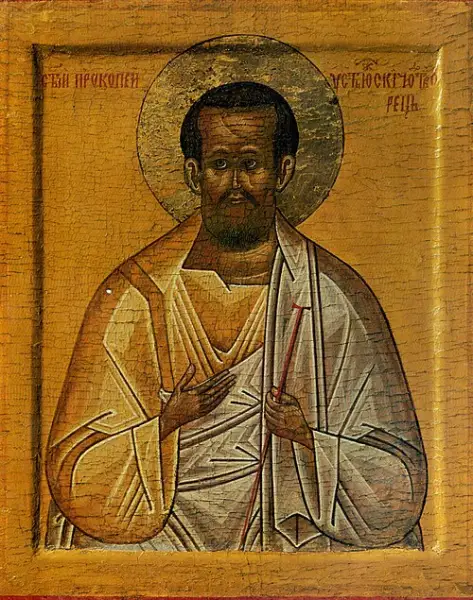
In Russia, Procopius embraced the strangest and most cherished of Orthodox ascetic paths: that of the yurodivy, the fool for Christ, who feigns madness or accepts contempt in order to renounce worldly pride and share the humiliation of the crucified Lord. The holy fool owns nothing, honors no convention, and speaks truths that the respectable dare not utter; the crowds mock him, and the Church afterward venerates him. Procopius lived in this way for sixty years at Veliky Ustyug, half a century and more of deliberate self-abasement, enduring cold, hunger, and derision in the streets of a northern town. His vocation was thus twofold in origin — the conversion of a Catholic merchant to Orthodoxy, and the passage from that conversion to a life of radical renunciation. The combination was noted with wonder by later generations: a foreigner by blood and birth, he became wholly a Russian saint, and the form his sanctity took was not scholarship or priesthood but prophetic folly. The Church of Russia would eventually rank him among its wonderworkers, and his icon, painted in the sixteenth century, shows the ascetic whose foolishness was wiser than the wisdom of men.
§ Life
The Prophecy of 1290
The tradition of Veliky Ustyug preserves one great deed of Procopius, and it is the deed by which the town knows him. In the year 1290, the saint foretold that a star would fall from the sky beside Veliky Ustyug, and that whirlwind and flames would follow to devastate the place. The holy fool, despised in life, proved in this hour a watchman for the city: his warning is remembered as that by which the people were turned from impending catastrophe. The legend has given the town its defining wonder story, and the Church has seen in it the classic pattern of the yurodivy's gift — the fool who sees what the wise do not, and who is heard only because he has renounced everything. Beyond this prophecy the sources preserve little of his activity, no sayings, no institutions, no writings; the sanctity of Procopius was of the kind that leaves no works behind, only a reputation for holiness sealed by sixty years of endurance and by a single interposition between a town and its destruction. He died at Veliky Ustyug on July 8, 1303, and the date became his feast in the Russian Church.
§ Life
Canonization and Universal Feast
The Russian Orthodox Church enrolled Procopius among its saints in 1547, in one of the solemn confirmations of local cults made by the Russian Church in that century, by which the wonderworkers venerated at particular towns were enrolled in the general calendar of the nation. His feast was set on July 8, the day of his death. For nearly three centuries his veneration remained largely local, centered on Veliky Ustyug and the shrines of the Russian North. In 1818, however, his observance was made universal, carrying his feast into every church of Russia. Thus the German merchant's son became, more than five centuries after his death, an object of devotion from the Baltic to Siberia. The Orthodox Church honors him under the titles by which his tradition knew him — wonderworker and fool for Christ — and commemorates him together with the company of Russian holy fools, whose strange office he exercised longer than almost any: sixty years between his conversion and his death. His cult stands as a singular monument of the reach of Russian sanctity, drawing into its calendar a man born a Catholic in a free imperial city of the West.
§ Veneration
Relics in Ustyug, a Church in Hamburg
The body of Saint Procopius proved as enduring as his memory. The incorrupt body of the saint came to light during the eighteenth century beside the church of the Entrance of the Theotokos into the Temple at Veliky Ustyug, and was set within it, lying in open view for two hundred years while the faithful honored it as a wellspring of many cures. Pilgrims continued to seek the wonderworker of the North at the shrine of the town his prophecy had saved. In the twentieth century his cult crossed back over the lands of his birth: in the 1960s the Russian Orthodox Church Outside of Russia built the church of St. Prokop in Hamburg, the great city near his native Lübeck, so that the fool for Christ of Ustyug received a house of prayer on German soil. A sixteenth-century Russian icon of the saint preserves his image from the century of his canonization, and the literature of the Russian North keeps alive the story of the meteor, the whirlwind, and the fire foreseen by the merchant turned ascetic. He remains one of the most curious figures in the communion of saints — a Hanseatic Catholic by origin, a Russian holy fool by vocation, and a wonderworker venerated alike in the cathedrals of the East and a parish church of Hamburg.
§ Veneration
Timeline
- 1290
Foretold that a meteorite would strike near Veliky Ustyug, with a whirlwind and fire to follow.
§ Life
- 8 Jul 1303
Died at Veliky Ustyug after sixty years as a fool for Christ.
§ Life
- 1547
Canonized as a saint by the Russian Orthodox Church.
§ Veneration
- 1818
His observance was extended to the whole Church as a universal feast.
§ Life
The Record
- Patron of
- Veliky Ustyug
- Symbols
- 16th-century Russian icon of the saint·depicted as a holy fool
- Canonization
- Canonized 1547 by the Russian Orthodox Church; universal celebration established in 1818
Prayer
Bibliography
Show 5 sources
- "Commemorated on July 8". Orthodox Church in America. Retrieved 20 July 2010.
- Владимир Станулевич — Прусский купец и русский святой Прокопий Устюжский — ИА REGNUM.
- Bushkovitch, Paul (28 May 1992). Religion and Society in Russia: The Sixteenth and Seventeenth Centuries. Oxford University Press. p. 81. ISBN 978-0-19-536152-0.
- "Righteous Procopius the Fool-For-Christ and Wonderworker of Ustya, Vologda". Orthodox Church in America.
- Ekkart Sauser (1994). "Prokopius von Ustjug". In Bautz, Traugott (ed.). Biographisch-Bibliographisches Kirchenlexikon (BBKL) (in German). Vol. 7. Herzberg: Bautz. cols. 994–995. ISBN 3-88309-048-4.
Profile text adapted from the Wikipedia article, licensed CC BY-SA 4.0.
Pray with this saint every day
Save St. Procopius of Ustyug to your favorites, read the full profile, and get feast-day reminders in the Saints app.
Get the Saints AppFree on the App Store for iPhone and iPad