
died c. 304
St. Proculus of Bologna
Roman soldier martyred at Bologna under Diocletian
Overview
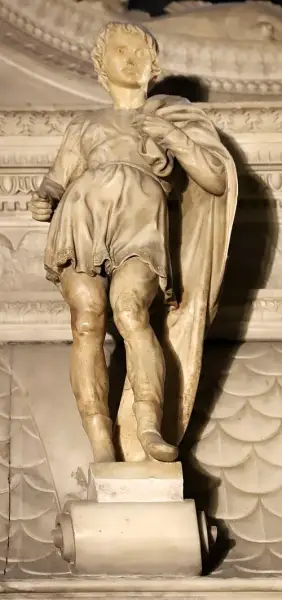
Proculus of Bologna, often called Proculus the Soldier, is an Italian saint whose death is placed around the year 304, in the final persecution of the emperor Diocletian. Tradition remembers him as an officer of the Roman army who used his position to advance the Christian faith, and who ultimately paid for that zeal with his life at Bologna. Two separate legends grew up around his name. In the more famous account, an official named Marinus was dispatched to Bologna to carry out the imperial edict against the Christians; provoked by the cruelty of his measures, Proculus took up an axe, killed Marinus in his own house, and was afterward condemned and beheaded in his turn, carrying his severed head to the spot where a church in his honor would one day rise. A second tradition tells of a bishop of Terni who, fleeing before Gothic invaders, reached Bologna only to lose his life by decapitation there. The Bolognese have honored Proculus from the most ancient times, and his remains are kept in the church of San Procolo in the city. He counts among the patrons of Bologna, and Michelangelo's statue of him stands in the Basilica of San Domenico.
The Complete Life
A Soldier of the Empire
The earliest layer of the tradition presents Proculus as a serving officer of the Roman army, a man of rank and discipline whose faith transformed the way he exercised his duties. He is sometimes distinguished by the name Proculus Soldato, the soldier, a title that set him apart from the other holy men of the same name honored in Italy. His military standing gave him both protection and opportunity: as a Christian within the imperial system he could move among officials and garrisons, and the sources describe him as active in spreading the Christian message while he wore the uniform of Rome. When the emperor Diocletian's edicts against the Church reached the cities of the Po valley, the province was ordered to enforce them, and it was precisely this machinery of persecution that brought the soldier's double loyalty into the open. The church of Bologna had long since claimed him as one of her own patrons, and the memory of the officer who served two masters, the emperor above and Christ within, became one of the founding stories of the city's Christianity.
§ Traditional Narrative
The Axe and the Edict
The first legend makes the crisis of the Diocletianic persecution the turning point of Proculus's life. One Marinus was sent to Bologna with the task of enforcing the emperor's edict against the Christians, and the cruelties of his administration enraged the soldier-saint. Unable to endure the sight of the faithful being destroyed, Proculus went to the official's house and struck him down with an axe. The act was at once a rebellion and a confession: no Roman tribunal could have doubted where the officer stood after it. A second and quite different story attaches to the same name and city. In this account the martyr was a bishop of Terni who, attempting to escape the persecution of the Goths, made his way to Bologna and was there seized and decapitated. Whether the soldier or the bishop is the true Proculus of Bologna, the tradition never decided; the two legends have lived side by side, both witnesses to a martyr's blood shed on Bolognese soil and both absorbed into the single cult that the city has maintained for its patron. Both narratives, whatever their historical weight, agree that the martyrdom was a decapitation suffered in loyalty to Christ rather than to the empire.
§ Traditional Narrative
Martyrdom and Burial
The price of Proculus's defiance was exacted quickly. Condemned for the killing of Marinus and for his refusal to renounce the faith, the soldier was beheaded, in the tradition the usual sentence for a Roman citizen of standing who had committed violence against an imperial official. The legend adds a circumstance beloved of early hagiography: the martyr himself carried his severed head to the place where a church would afterward be dedicated to God under his name, a sign that found its fulfillment in the medieval church of San Procolo, which still rises in Bologna. There, in that church, his remains have been preserved and venerated, making it the chief center of his cult. The devotion of the Bolognese to their martyr is described as reaching back to very ancient times, older than the surviving documents, and his place among the patron saints of the city was never forgotten. In death, as in the legends of his life, Proculus remained bound to Bologna, its defender in the memory of the faithful and its intercessor before God. Around his grave the piety of the earliest Christian generations gathered, and it has never ceased to gather there.
§ Traditional Narrative
Memory in Stone and Sculpture
Proculus's cult left its mark on the art of Italy as well as on the topography of Bologna. The most famous image of the saint is the statue that Michelangelo carved for the Basilica of San Domenico in Bologna, where the young master worked at the beginning of his career; the sculpture stands in the church as a permanent testimony to the soldier-martyr honored by the Dominican friars. His likeness also ascended to the sky of Lombardy, for a statue of the saint rises above the south transept of Milan's Duomo, showing that his cult traveled beyond the city of his martyrdom. Within Bologna itself the church of San Procolo keeps his remains and preserves the memory of the ancient devotion of the people, while the neighboring tradition of Saints Vitalis and Agricola belongs to the same early Christian soil. As one of the patrons of Bologna, Proculus has been invoked for the city through plague, war, and renewal, and the two legends of his martyrdom, the soldier's axe and the bishop's exile, continue to be told together as a single inheritance of faith.
§ Traditional Narrative
The Record
- Patron of
- patron of Bologna
- Canonization
- Pre-congregation martyrdom under Diocletian; venerated at Bologna from very ancient times
Prayer
Bibliography
Show 4 sources
- "St Proculus", Michelangelo.org
- Benigni, Umberto. "Bologna." The Catholic Encyclopedia. Vol. 2. New York: Robert Appleton Company, 1907.
- Menzies, Lucy. The Saints in Italy: A Book of Reference to the Saints in Italian Art and Dedication, Medici Society Limited, 1924, p. 369
- "St. Proculus", Duomo di Milano
Profile text adapted from the Wikipedia article, licensed CC BY-SA 4.0.
Pray with this saint every day
Save St. Proculus of Bologna to your favorites, read the full profile, and get feast-day reminders in the Saints app.
Get the Saints AppFree on the App Store for iPhone and iPad