
died c. 305·Feast October 18 (Roman Martyrology); November 16 in Pozzuoli
St. Proculus of Pozzuoli
Deacon and martyr of the Solfatara with St. Januarius
Overview
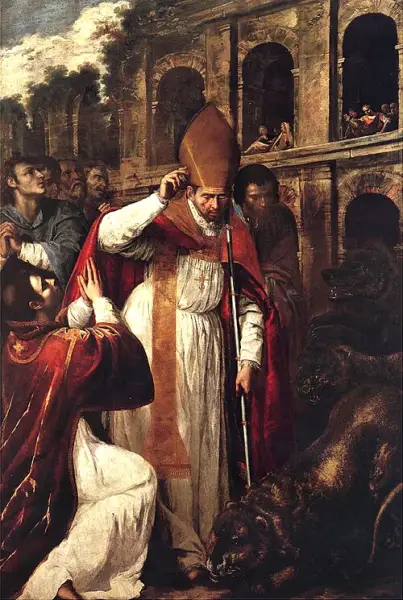
Proculus of Pozzuoli, known in Italian as San Procolo, was a deacon who suffered martyrdom around the year 305, in the persecution of Diocletian, together with Bishop Januarius of Benevento and their companions. The group included Sossius, deacon of Miseno, the lectors Festus and Desiderius, and the laymen Eutyches and Acutius. According to the legend preserved in the Atti Bolognesi, Sossius was denounced as a Christian and condemned to face wild beasts in the amphitheater; when Januarius, Festus, and Desiderius came to visit him in the lockup by the sulphur pits beneath the Solfatara, they too were seized, and the beasts refused to harm them, so all were sentenced to beheading. As the condemned were led to execution, Proculus, Eutyches, and Acutius protested the sentence, and for this protest the three were themselves decapitated near the Solfatara on September 19. The relics of the martyrs were divided among the churches of Campania over the following centuries: Proculus was first buried in the Calpurnian temple, later the cathedral of Pozzuoli. His Acts and those of his companions, the Atti Puteolani and the Acta s. Proculi, survived in the archives of Pozzuoli and were first printed in Paris in 1867. He remains the patron saint of the town and diocese of Pozzuoli.
The Complete Life
A Deacon of the Church of Pozzuoli
Proculus belonged to the Christian community of Pozzuoli, the ancient Greek colony on the bay then called Puteoli, and served it in the order of deacons. His companions in martyrdom show the shape of that community: Sossius, deacon of the neighboring port of Miseno, Festus and Desiderius, both lectors, the bishop Januarius of Benevento, and two laymen, Eutyches and Acutius. The group is first encountered in the writings connected with the life of Saint Januarius, and the earliest writings about them, the Atti Puteolani together with the Acta s. Proculi, survived in the keeping of the Curia of Pozzuoli until the Bollandist Stilting printed them in Paris in 1867. A further witness, the Atti Bolognesi, survives in a codex of 1180 from the Celestine monastery of Santo Stefano in Bologna, and its legend of Proculus rests on accounts reaching back at least to the seventh century. Through these texts the deacon of Pozzuoli appears not as a solitary figure but as one member of a band of ministers and faithful who shepherded the churches of Campania in the last and fiercest of the imperial persecutions.
§ Proculus of Pozzuoli
Protest Before the Executioner
The legend of the Atti Bolognesi sets Proculus's martyrdom within the story of Januarius. During the Diocletianic persecution the bishop of Benevento came to Pozzuoli unrecognized, staying in contact with Sossius from Miseno and with Festus and Desiderius, a deacon and a lector of the local church. When Sossius's faith came to light, the judge Dragontius condemned him to be torn by wild bears in the amphitheater, and when his three friends risked a visit to the prison at the sulphur mines near the Solfatara they were seized as well. The beasts sent against them refused to attack, falling affectionately at their feet, and the authorities therefore condemned the whole company to beheading. At this point Proculus stepped forward. Together with the laymen Eutyches and Acutius, he protested the sentence while the condemned were being led away to die. The protest cost the three men their lives, for the judge ordered them decapitated with the others. The deacon's final act was thus an act of witness on behalf of others: he died not for a crime of his own but for speaking against the killing of his bishop and fellow ministers of the Church.
§ Legend
Death Beside the Solfatara
The execution of the martyrs took place near the Solfatara, the smoking volcanic crater above the sulphur mines of Pozzuoli, on the nineteenth of September, according to the tradition that fixes their death in the year 305. Proculus and his two companions were beheaded there with the bishop and ministers whose sentence they had protested, and the ground of the Phlegraean Fields became the resting place of the whole company. The bodies were gathered by the local Christians and buried separately: Proculus was laid to rest in the Calpurnian temple, destined to become the mother church of Pozzuoli, so that the martyr slept beneath the altar of the city's cathedral. Eutyches and Acutius received burial at the praetorium Falcidii, beside the early Christian basilica of Santo Stefano. The spot of the execution and the tombs of the martyrs made Pozzuoli one of the holy places of Campania, joined to the cult of Januarius at Naples, and the anniversary of the beheading was kept by the whole region as the common feast of the seven martyrs of the Solfatara. September 19, the traditional day of the execution, remained the common feast of all seven martyrs in the Roman Martyrology.
§ Legend
Feast Days of the Martyr
Proculus was never canonized by formal process, for his death in the persecution of Diocletian placed him among the saints from the first ages of the Church, and he is venerated today in both the Roman Catholic and Eastern Orthodox communions. The Roman Martyrology preserves the ancient arrangement of the celebrations: the entire group of martyrs shared September 19, the feast of Januarius himself; Festus and Desiderius were honored on September 7; Sossius on September 23; and Proculus with Eutyches and Acutius on October 18. In Pozzuoli, however, the official feast of the city's patron fell on November 16, a date so often marked by rain that the people affectionately gave the saint the nickname 'o pisciasotto, the pants-pisser, in joking recognition of his watery feast day. The townspeople also kept his celebration on the second Sunday of May. In the East his memory is attached to the other feasts of the company, on April 21 and September 19. The layering of these dates shows a cult celebrated simultaneously by the universal Martyrology, by the diocese of Pozzuoli, and by the Orthodox churches.
§ Feast days
Relics, Archives, and Memory
The remains of the martyrs of the Solfatara traveled widely in the centuries after their death. Proculus slept first in the Calpurnian temple that became Pozzuoli's cathedral, while the relics of his companions were carried to Benevento, Montevergine, Naples, and Frattamaggiore. One ninth-century writing, judged by a modern scholar to be an invented tale, claims that in 871 a knight from Swabia carried the martyrs Januarius, Proculus, Eutyches, and Acutius away to Reichenau Island in Lake Constance; the bones preserved there were inspected repeatedly over the centuries, and in 1964 they were judged to be spurious, unconnected to the Italian martyrs. The literary legacy proved more durable than the translations of the relics: the Atti Puteolani and the Acta s. Proculi survived in the Curia's archive at Pozzuoli until their first publication in Paris in 1867, and the codex of 1180 at Santo Stefano in Bologna carried the legend through the Middle Ages. The martyrs also entered art, appearing in a ninth-century fresco in the Catacombs of San Gennaro at Naples, while Pozzuoli has never ceased to honor Proculus as the patron of its town and diocese.
§ Veneration
Timeline
- 19 Sep 305
Beheaded near the Solfatara with Januarius, Eutyches, and Acutius after protesting the martyrs' death sentence.
§ Legend
- 871
A ninth-century account, later judged fictitious, tells how a Swabian knight carried the remains of Januarius and three fellow martyrs off to Reichenau Island.
§ Veneration
- 1180
The Atti Bolognesi, a codex preserving the legend of Proculus, is dated to this year and kept at the Celestine monastery of Santo Stefano in Bologna.
§ Proculus of Pozzuoli
- 1867
The Atti Puteolani and the Acta s. Proculi, long kept in the archive of the Curia of Pozzuoli, were published for the first time in Paris by the Bollandist Stilting.
§ Proculus of Pozzuoli
- 1964
Examination of the bones kept on Reichenau Island determined that they were not the remains of the Italian martyrs.
§ Veneration
In Their Own Words
[...] when the animals came near the Saints, they fell affectionately at their feet and refused to harm them.
The Record
- Patron of
- patron saint of the town and diocese of Pozzuoli
- Canonization
- Pre-congregation martyrdom under Diocletian, c. 305; venerated in the Roman Catholic and Eastern Orthodox churches
Prayer
Bibliography
Show 6 sources
- "Santi Procolo, Eutiche e Acuzio"
- "Hieromartyr Januarius, bishop of Benevento, and his companions: Sosius, Proclus and Festus, deacons, Gantiol, Eutychius, Acutius, and Desiderius, at Puzzuoli (305)"
- "Miseno: The Church of St. Sossio"
- "A Silver Masterpiece of 18th Century Neapolitan Statuary: St. Proculus Patron Saint of the Town and Diocese of Pozzuoli". Campi Flegrei. Archived from the original on 2007-03-11.
- "Feast of the Dedication of St. John Lateran". St. Patrick Catholic Church. Archived from the original on 2007-02-06. Retrieved 2012-03-08.
- "Mostra – Romana Pictura, foto". Archived from the original on 2006-10-01. Retrieved 2008-04-03.
Profile text adapted from the Wikipedia article, licensed CC BY-SA 4.0.
Pray with this saint every day
Save St. Proculus of Pozzuoli to your favorites, read the full profile, and get feast-day reminders in the Saints app.
Get the Saints AppFree on the App Store for iPhone and iPad