
died c. 320·Feast December 9
St. Proculus of Verona
Bishop of Verona who outlived the persecutions
Overview
Proculus of Verona, honored in Italian as San Procolo, was bishop of Verona in the age of the Great Persecution, and died around the year 320 after living through the storms that had destroyed so many of his brother bishops. When Diocletian's edicts were enforced at Verona, Proculus went to the prison to encourage the confessors Firmus and Rusticus, and was himself bound and dragged with them before the consul Anulinus. Because of his advanced age the magistrate judged him unworthy of attention: he was released after a beating and driven from the city, and so he survived the persecution that martyred the two young men he had gone to cheer. Later tradition adds that he traveled on pilgrimage to Jerusalem, suffered capture, was sold into slavery while journeying back, recovered his liberty, and came home to his see, where he died a natural death. His feast is kept on December 9 by the Catholic and Eastern Orthodox churches. His relics rest at Verona in the church of San Procolo beside the Basilica of San Zeno, and his head is venerated at Bergamo, where Sebastiano Ricci painted him for the cathedral in 1704.
The Complete Life
Bishop in the Age of Diocletian
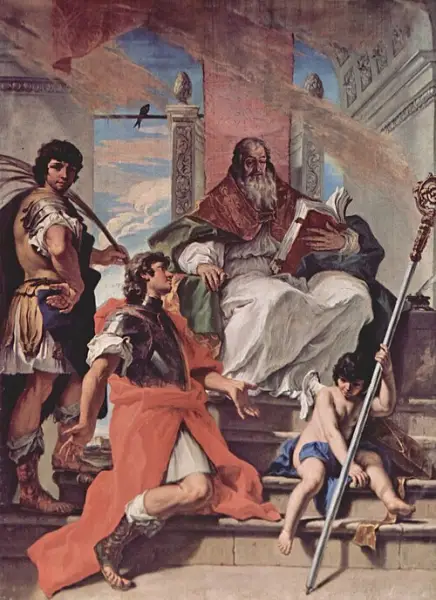
Proculus governed the church of Verona as its bishop during the last great assault of the Roman empire on Christianity. His episcopate therefore fell in the years when fidelity to the Gospel could cost a man his office, his freedom, or his life, and the bishop who led the Veronese flock had to be prepared for all three. The sources place him in the company of the martyrs Firmus and Rusticus of Verona, whose passio became the most celebrated witness of the city, and in the memorials of the local church he appears seated among the saints beside them, as in Sebastiano Ricci's later canvas. He is commemorated on December 9 and is honored in both the Roman Catholic and Eastern Orthodox churches. Whatever else his years in office contained, the tradition has preserved the essential outline: a shepherd who stood with his confessors when the imperial officials came to Verona, who survived the persecution that killed the best of his clergy, and who guided his see into the peace that followed the conversion of the empire, dying in his episcopal city around the year 320.
§ Traditional narrative
Before the Consul Anulinus
The decisive scene of Proculus's life came during the Diocletianic persecution, when the Christians Firmus and Rusticus were imprisoned at Verona. The aged bishop went to their cell to encourage them for the contest they were about to face, an act that the authorities treated as complicity in their defiance. He was seized, bound, and brought before the consul Anulinus together with the two confessors, so that the shepherd stood trial at the side of his sheep. The magistrate, however, took a different view of the three prisoners. Judging the old man scarcely worth his attention, Anulinus withheld the extreme penalty: instead of the death sentence pronounced on the young men, the bishop was set free after a beating and driven from the city. The sentence was meant as contempt, but the tradition has read it as providence, for the beating and exile left the church of Verona with a living bishop while Firmus and Rusticus won the crown of martyrdom. Proculus had risked everything to stand with his people, and the persecution spared him only to make him a witness of what he could not prevent.
§ Traditional narrative
Jerusalem, Captivity, and Return
The later narrative of Proculus's life carries him far from his see before it restores him to it. After the persecutions ended, he is said to have made the pilgrimage that so many fourth-century Christians longed for, visiting the holy places of Jerusalem. On the return journey misfortune overtook him: he fell into the hands of captors, was sold as a slave, and endured the loss of liberty that he had escaped when Anulinus declined to condemn him. In time he regained his freedom and made his way back to Verona, where he resumed the care of the church he had never ceased to serve. There he died of natural causes, probably around the year 320, one of the bishops who had led their communities through the persecution and lived to see the dawn of Constantine's peace. His tomb became the center of the devotion that the Veronese paid him, and the chapel that now houses his remains stands attached to the Basilica of San Zeno, the great abbey church of the city, linking the confessor-bishop forever to the holiest ground of his diocese.
§ Traditional narrative
An Ancient and Universal Cult
Proculus has been venerated since the earliest Christian generations in Verona, and his recognition as a saint belongs to the age before formal canonization: he was honored as a confessor-bishop by the very community he had led. His feast is kept on December 9, and both the Roman Catholic Church and the Eastern Orthodox Church number him among the saints. The seat of his cult is the church of San Procolo, attached to the Basilica di San Zeno in Verona, which houses his relics. The building is ancient, dating from the sixth or seventh century and raised in the Christian necropolis across the Via Gallica, though it is first mentioned in writing only in 845; the relics themselves were brought to light in 1492 during renovations of the church. Devotion to him spread well beyond Verona: his head is venerated at Bergamo, and the Venetian church of San Zaccaria displayed a life-size wooden statue of the saint of Verona from 1451. The cult thus joined the diocese of his pastoral care, the lagoon city that honored his image, and the Lombard cathedral that claimed his head.
§ Veneration
The Saint in Art and Memory
The memory of Proculus of Verona has been carried down the centuries as much by artists as by hagiographers. Within Verona, the church of San Procolo beside San Zeno enshrined his relics, discovered in 1492 when the building was renovated, and kept alive the local pilgrimage to the bishop's tomb. Venice honored him with the life-size wooden statue placed in San Zaccaria in 1451, evidence that his cult had reached the mainland's greatest city. At Bergamo, where his head is venerated, the painter Sebastiano Ricci was commissioned in 1704 to execute a canvas of San Procolo for the cathedral, and Ricci's larger composition of Saints Firmus and Rusticus of Verona with an angel shows the bishop seated in glory beside the martyrs he had encouraged in prison. Writers of the learned tradition, from the compilers of early dictionaries of the saints to the Bollandist scholarship of later centuries, collected the fragments of his story: the prison visit, the trial before Anulinus, the beating and banishment, the pilgrimage and slavery, and the peaceful death at Verona around 320. Together these witnesses preserve a bishop remembered for faithfulness under trial.
§ Veneration
Timeline
- 320
Died in peace at Verona after surviving the Diocletianic persecution and enduring exile, captivity, and slavery.
§ Traditional narrative
- 845
The church of San Procolo at Verona, built in the Christian necropolis across the Via Gallica, is first mentioned in the sources.
§ Veneration
- 1451
A life-size wooden statue of Proculus of Verona was made for the church of San Zaccaria in Venice.
§ Veneration
- 1492
His relics were discovered during renovations of the church of San Procolo at Verona.
§ Veneration
- 1704
Sebastiano Ricci painted a canvas of San Procolo in Venice for the cathedral of Bergamo.
§ Veneration
The Record
- Canonization
- Pre-congregation saint; confessed the faith under persecution and died in peace at Verona
Prayer
Bibliography
Show 6 sources
- Odden, Per Einar. "Den hellige Proculus av Verona (d. ~320)", Den katolske kirke
- Holweck, Frederick George. A Biographical Dictionary of the Saints, B. Herder, 1924, p. 834
- Baring-Gould, Sabine. The Lives of the Saints, J. Hodges, 1874
- A Dictionary of Christian Biography, Vol. 4 (William Smith, ed.) Little, Brown & Company, 1887, p. 489
- Biancolini, Giambatista. Notizie storiche delle chiese di Verona, Parte Prima, (1749) p. 2
- Menzies, Lucy. The Saints in Italy: A Book of Reference to the Saints in Italian Art and Dedication, Medici Society Limited, 1924, p. 370
Profile text adapted from the Wikipedia article, licensed CC BY-SA 4.0.
Pray with this saint every day
Save St. Proculus of Verona to your favorites, read the full profile, and get feast-day reminders in the Saints app.
Get the Saints AppFree on the App Store for iPhone and iPad