
1859 – 1923·Feast Sunday before the Exaltation of the Holy Cross (September 7–13)
St. Prokopios Lazaridis
New-hieromartyr and Metropolitan of Iconium
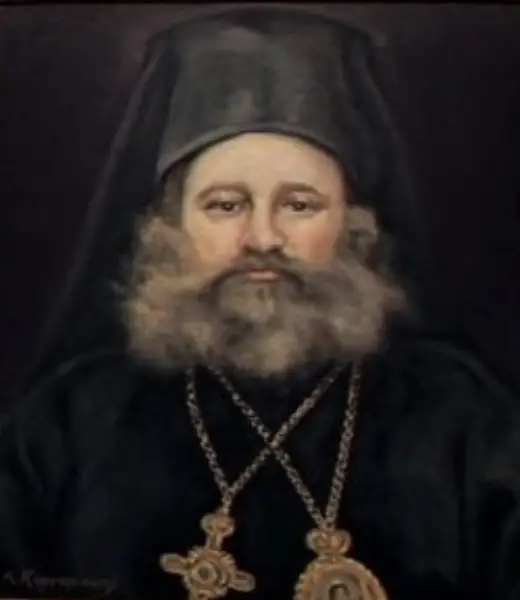
Overview
The hierarch Prokopios Lazaridis (1859–1923) occupied a series of metropolitan thrones across the late Ottoman world and died a martyr's death in a Turkish prison. Born at Tyana in the province of Konya, he studied at the Halki Seminary in Constantinople and rose through the hierarchy of the Ecumenical Patriarchate: Metropolitan of Dyrrachium in what is now Albania from 1899, of Philadelphia in Asia Minor from 1906, and of Iconium, the modern Konya, from 1911. His final decade was consumed by the struggle over the future of Anatolia's Orthodox Christians. During and after the Greco-Turkish War, the nationalist authorities sought to bring the Orthodox church under their control by creating a Turkish Orthodox Church under Papa Eftim at Kayseri. Prokopios resisted these designs, was imprisoned by the government of Mustafa Kemal in September 1920 along with the Armenian bishop of Konya, and spent from October 1920 to May 1922 in the prison of Erzurum. After a brief liberty, in which he appealed in person to Mustafa Kemal in Ankara, he was forced to preside at a council proclaiming the Turkish Orthodox Church in January 1923, then arrested again. He died in detention at Kayseri on 20 April 1923. The Church of Greece canonized him in 1992 as a new-hieromartyr.
The Complete Life
From Cappadocian Tyana to Halki
Prokopios Lazaridis was born in 1859 at Tyana, the ancient Cappadocian city in the Ottoman province of Konya, into the Greek Orthodox world of central Anatolia. For his formation he was sent to the Theological School of Halki, the patriarchal seminary on an island in the Sea of Marmara outside Constantinople, which he entered in 1875. Halki was the principal nursery of the late Ottoman episcopate, and there the boy from Konya Province received the education in Scripture, liturgy, and church administration that carried him into the service of the Ecumenical Patriarchate. His career would in time circle back toward the region of his birth, for the crowning of his service came at Iconium, the modern Konya, the metropolis of his own home province. The whole of his life thus belonged to the Greek-speaking Christianity of Anatolia: formed in its patriarchal capital, tested in its Balkan and Anatolian sees, and finally consumed in its death agony after the Greco-Turkish War, when the Orthodox communities of the interior were uprooted and deported and their shepherds were left to face the new nationalist state alone.
§ Life
Metropolitan of Three Sees
Prokopios's episcopal service unfolded across three demanding jurisdictions of the late Ottoman church. In 1899 he was raised to the metropolitan throne of Dyrrachium, the ancient port on the Adriatic whose successor is Durrës in central Albania; there he labored among the Orthodox communities of the western Balkans and won a reputation for significant pastoral activity. In 1906 he was transferred to the interior of Asia Minor as head of the bishopric of Philadelphia, the modern Alaşehir, one of the historic Greek cities of Lydia. Five years later, in 1911, he achieved the see with which his name is forever joined: the metropolitanate of Iconium in central Anatolia, the region of his own birth. To lead this succession of dioceses required the varied gifts of a patriarchal bishop, administrator among the Albanian Orthodox, pastor of the Cappadocian and Lydian faithful, and defender of a Christian population whose position in the Ottoman Empire grew more precarious with each crisis of the Balkan wars and the First World War that broke over the region in the years of his tenure. Each translation deepened his experience of the Orthodox world over which the patriarchate watched from Constantinople.
§ Life
The Struggle for the Church of Anatolia
The defining conflict of Prokopios's tenure at Iconium began during the Greco-Turkish War of 1919 to 1922. The nationalist Turkish authorities, determined to Turkify public life and to bring the Orthodox church under their complete control, founded a Turkish Orthodox Church at Kayseri and installed Papa Eftim at its head. The move struck directly at the canonical order of the Ecumenical Patriarchate in Anatolia, and Prokopios set himself against it, working for a settlement that would preserve the administration of the Orthodox church in the region. His resistance brought him into open collision with the government of Mustafa Kemal. On September 20, 1920, he was arrested with the Armenian bishop of Konya, and he was subsequently transferred to the prison of Erzurum, where he languished from October 1920 until May 1922. Freed at last, he traveled to Ankara and appealed in person to Mustafa Kemal to abstain from the ecclesiastical dispute over the projected Turkish Orthodox Patriarchate, pleading his own grave ill health; the proposal was refused. The shepherd of Iconium had spent himself utterly, and the trial of his church was not yet finished.
§ Life
Coercion, Council, and Prison
The last months of Prokopios's life were marked by a final, bitter humiliation. In January 1923 he presided over an ecclesiastical council at which he was compelled to proclaim the Turkish Orthodox Church, the very institution he had resisted at the cost of two years in prison. The forced council, however, soon lost its purpose: Turkish interests in the project subsided after the Greek defeat in Anatolia and the deportation of the Greek Orthodox communities from the peninsula, which removed the Christian population the dispute had been fought over. The government had no further use for the broken metropolitan, and no further patience with him. He was arrested once more and confined in the prison of Kayseri, the city where the schismatic church had been inaugurated, and there he died in detention on April 20, 1923, worn out by illness, imprisonment, and the catastrophe of his flock. He had governed the church of Iconium for twelve years, and he ended as its last confessor-bishop, sealing with his life the witness he had given for the freedom of the Orthodox church in Anatolia.
§ Life
Canonization and Feast
The Greek Orthodox Church honored Prokopios Lazaridis as a hieromartyr, a bishop who shed his blood for the faith, and gave his cause its formal completion on November 4, 1992, when the Church of Greece inscribed him among the saints. He is commemorated under the title of the new-hieromartyr Prokopios of Iconium, joining the company of twentieth-century confessors who died under the persecutions that followed the collapse of Ottoman Christianity. Because his witness belongs to the modern calendar, his feast is kept on a movable day: the Sunday preceding the feast of the Exaltation of the Holy Cross, which falls each year between September 7 and September 13, a placement that binds his memory to the feast of the Cross he bore in prison. In the synaxaria he stands with the new martyrs of the East, the clergy and laity who perished in the wars and deportations that emptied Asia Minor of its ancient Christian population. His canonization came almost seventy years after his death, when the Church of Greece formally recognized in the metropolitan's endurance the mark of apostolic martyrdom. The Church of Greece thereby set his witness beside that of the other new martyrs of the twentieth century.
§ Prokopios Lazaridis
Memory of the Last Metropolitan
Prokopios Lazaridis is remembered as one of the last metropolitans of the Greek church in the heart of Anatolia, a hierarch whose career traced the whole arc of Ottoman Orthodox history from its late flowering to its violent end. His service at Dyrrachium in Albania, at Philadelphia, and finally at Iconium linked the Balkan and Anatolian branches of the patriarchate in a single life, and his resistance to the Turkish Orthodox Church made him a symbol of canonical fidelity in the face of state-engineered religion. The account of his sufferings has been preserved through the scholarship of historians of the patriarchate, notably Demetrius Kiminas's annotated catalogs of the metropolitan sees, and through Greek theological studies of the Church's offering in Asia Minor between 1912 and 1922, such as the Thessaloniki dissertation of Theodorou Tsiri that records his arrests and his death at Kayseri. Canonized in 1992 by the Church of Greece, he is invoked as the new-hieromartyr of Iconium on the movable Sunday that precedes the feast of the Exaltation of the Cross. For the Orthodox faithful of Turkey and Greece alike he embodies the faithfulness of the shepherds who stayed with their persecuted flocks to the end.
§ Life
Timeline
- 1859
Born at Tyana in the Ottoman province of Konya.
§ Life
- 1875
Entered the Halki Seminary in Constantinople to prepare for the priesthood.
§ Life
- 1899
Became Metropolitan of Dyrrachium, modern Durrës in central Albania, serving the local Orthodox communities.
§ Life
- 1906
Installed as head of the bishopric of Philadelphia, modern Alaşehir, in Asia Minor.
§ Life
- 1911
Assumed the metropolitan throne of Iconium, the metropolis of central Anatolia.
§ Life
- 20 Sep 1920
Imprisoned by the nationalist authorities of Mustafa Kemal, together with the Armenian bishop of Konya.
§ Life
- Oct 1920
Transferred to the prison of Erzurum, where he was held until the spring of 1922.
§ Life
- May 1922
Released from Erzurum and afterwards traveled to Ankara to plead with Mustafa Kemal, who rejected his proposal.
§ Life
- Jan 1923
Obliged to preside at an ecclesiastical council proclaiming the Turkish Orthodox Church.
§ Life
- 20 Apr 1923
Died in detention in the prison of Kayseri after being arrested again.
§ Life
- 4 Nov 1992
Canonized by the Church of Greece as the new-hieromartyr Prokopios of Iconium.
§ Prokopios Lazaridis
The Record
- Canonization
- Canonized 4 November 1992 by the Church of Greece
Prayer
Bibliography
Show 2 sources
- Kiminas, Demetrius (2009). The Ecumenical Patriarchate: A History of Its Metropolitanates with Annotated Hierarch Catalogs. San Bernardino, CA: Borgo Press. p. 100. ISBN 9781434458766.
- Tsiri, Theodorou (2008). "Η Προσφορά της Εκκλησίας και του Ιερού Κλήρου στη Μικρά Ασία 1912-1922" (PDF) (in Greek). Thessaloniki: University of Thessaloniki, Department of Theology. pp. 91–102. Retrieved 19 October 2012.
Profile text adapted from the Wikipedia article, licensed CC BY-SA 4.0.
Pray with this saint every day
Save St. Prokopios Lazaridis to your favorites, read the full profile, and get feast-day reminders in the Saints app.
Get the Saints AppFree on the App Store for iPhone and iPad