
died c. 466·Feast June 25
St. Prosper of Reggio
Fifth-century Bishop of Reggio Emilia and protector of the city
Overview
Prosper of Reggio, remembered in Italian as San Prospero, led the church of Reggio Emilia as its bishop during the fifth century, and documentary evidence confirms that he held that office at that time. Tradition assigns him twenty-two years of service to the diocese, a ministry marked above all by charity toward the poor and the weak. Popular memory attached to him a dramatic episode from the age of Hunnish invasions: when Attila's forces threatened the city, Prosper was said to have called down a miraculous fog that concealed Reggio from the attackers, sparing it from destruction. He founded a church in the city, dedicated it to Saint Apollinaris, and it became the building that preserved the memory of his episcopate. He died at Reggio Emilia, by tradition on 25 June around 466. His tomb became a center of pilgrimage, his relics were honored in successive churches across the centuries, and he remains the principal patron of the city he once shepherded.
The Complete Life
A Bishop in a Broken Age
Prosper shepherded the church of Reggio Emilia in the fifth century, an age in which the western Roman Empire was disintegrating and Italian cities faced repeated waves of invasion. Documentary sources, though sparse, confirm that a bishop named Prosper truly held the see of Reggio Emilia in this period, which grounds even the most legendary elements of his story in a historical ministry. Tradition credits him with twenty-two years of leadership, a long tenure that would have carried his flock through decades of uncertainty. What his memory chiefly preserves is his charity: later generations defined his holiness not by writings or doctrinal battles but by his care for the suffering people of his city. As bishop he undertook the construction of a church within Reggio, which he dedicated to Saint Apollinaris, the martyred bishop of Ravenna whose cult was spreading across the Po valley. That building, repeatedly rebuilt over the centuries, remains the monument that anchors his episcopate in the fabric of the city. The written record, thin as it is, holds firm on the essentials: documents attest that a bishop named Prosper truly governed Reggio in the fifth century, and the span of more than two decades that tradition assigns him implies a tenure of rare steadiness for so unsettled an era.
§ Introduction
Shield of the City
The most celebrated story attached to Prosper belongs to the era of the Hunnish terror, when Attila's armies swept across northern Italy and cities either burned or, by legend, were saved by their holy bishops. When the Huns threatened Reggio Emilia, Prosper was said to have cried out to heaven, and a dense fog descended over the city, hiding it from the invaders and turning them away. The tradition further relates that Geminianus, bishop of Modena and patron of that neighboring city, worked the same miracle for his own people, so the two bishops stand together in regional memory as defenders of the Emilian plain. Whatever the historical kernel, the legend expresses how deeply Prosper's protection came to be trusted: he was not merely an administrator of a diocese but the city's guardian in its hour of greatest danger. This reputation secured his place as patron saint of Reggio Emilia, the title in which the city honors him to the present day, even though its cathedral bears another dedication. The same protective office endures in the civic identity of Reggio itself, where the Piazza San Prospero still opens before the basilica that bears his name and keeps his memory at the center of the city's life.
§ Veneration
An Enduring Cult
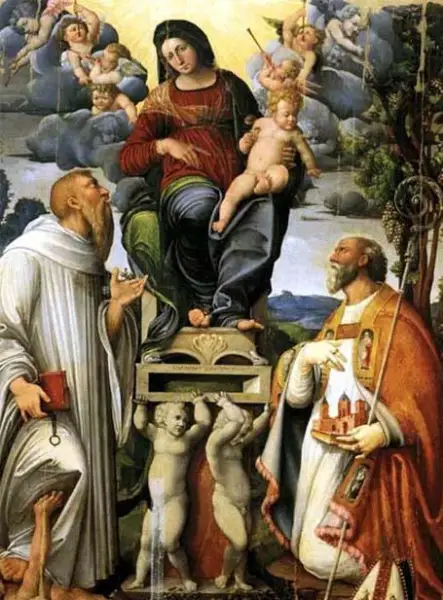
Prosper's cult is ancient, and from the eleventh through the fourteenth centuries it spread well beyond the city of his episcopate. His cult reached Parma, Bologna, Lucca, and other towns of northern and central Italy, and medieval devotion raised some thirty-one churches and chapels under his name. Once the Council of Trent had reviewed and consolidated the local cults, his veneration contracted again to Reggio itself, where it has remained constant ever since. The diocese keeps his feast locally on 24 November, while 25 June stands on general calendars as his principal feast day. His relics, translated in 703 to a church raised in his honor, were later moved for safety to the cathedral of Santa Maria when seaborne raids endangered the city, and finally laid to rest in the great Renaissance rebuilding of the church of San Prospero, where his body rests beneath the high altar. A sixteenth-century painting by Giovanni Soncini depicting Prosper alongside Saint Bernard of Clairvaux preserves his image and remains that artist's only known work. The great church of San Prospero, rebuilt in the sixteenth century, remains the spiritual heart of the city, and the memory of its fifth-century bishop has proved stronger than every suppression and contraction of his cult.
§ Veneration
Timeline
- 25 Jun 466
Died at Reggio Emilia after a traditional episcopate of twenty-two years; documents attest his fifth-century tenure as bishop
§ Introduction
- 703
Bishop Thomas raised a new church in his honor and had the relics moved into it, laying them beside those of Venerius the Hermit and Cosmas and Damian
§ Relics
- 979
The church dedicated to Prosper, begun under Bishop Ermenald, was completed by his successor Tenzo
§ Relics
- 997
Pope Gregory V consecrated the completed church of San Prospero in Reggio Emilia
§ Relics
The Record
- Major works
- Church of San Prospero at Reggio Emilia, built by Prosper and dedicated to Saint Apollinaris
- Patron of
- Reggio Emilia
- Symbols
- Book·Model of Reggio Emilia·Episcopal dress
- Canonization
- Pre-congregation; ancient cult confirmed by enduring local veneration in Reggio Emilia
Prayer
Bibliography
Show 3 sources
- "San Prospero di Reggio Emilia". Santiebeati.it (in Italian). 2002-01-22. Retrieved 2026-03-09.
- "La Basilica di San Prospero". Diocesi Reggio Emilia - Guastalla (in Italian). 2024-05-28. Retrieved 2026-03-09, entry for the Basilica of San Prospero.
- "La Madonna col Bambino in trono fra i santi Bernardo e Prospero" [The Madonna and Child Enthroned between Saints Bernard and Prospero]. musei.comune.re.it. Archived from the original on 2007-09-28. Retrieved 2026-03-09.
Profile text adapted from the Wikipedia article, licensed CC BY-SA 4.0.
Pray with this saint every day
Save St. Prosper of Reggio to your favorites, read the full profile, and get feast-day reminders in the Saints app.
Get the Saints AppFree on the App Store for iPhone and iPad