
died c. 343·Feast November 24
St. Protasius of Milan
Fourth-century Archbishop of Milan and defender of Nicaea
Overview
Protasius, known in Italian as Protaso, served as Archbishop of Milan in the first half of the fourth century, holding the see from 328 until his death around 343. Almost nothing survives about his origins or early life, but his episcopate falls in the decisive years after the Council of Nicaea, when the church of Milan, then under the shadow of the imperial court, had to define its fidelity to the Nicene faith against the rising power of Arianism. Protasius did so in two documented ways: he stood alongside Athanasius of Alexandria when that great defender of Nicaea confronted the emperor Constantius II, and he attended the Council of Sardica in 343, where he signed the decrees against the Arian party. He died on 24 November, around 343, and his remains found a grave in the Milanese church of San Vittore al Corpo, where Christians still venerate them. The church honors him as a saint across Catholic, Orthodox, Lutheran, and Anglican traditions, with his feast kept on the day of his death.
The Complete Life
Called to the Ambrosian See
In 328 the church of Milan chose Protasius as its bishop, making him successor to Maternus in the most important see of northern Italy. The election came barely three years after the Council of Nicaea had defined the divinity of Christ, and Milan, frequently the residence of the emperors, was destined to become one of the chief battlegrounds on which the Nicene settlement would be tested. Very little is recorded of Protasius before or beyond his episcopate; his origins are unknown, and a late tradition assigning him to the Milanese family of the Algisi has no historical basis. What the sources do establish is the span of his service: he led the Milanese church from 328 until his death about fifteen years later, and upon his death the see passed to Eustorgius I. In an era when the episcopal succession of Milan was itself a matter of doctrinal struggle, Protasius's long and peaceful tenure marks him as a figure of stability who held the church steady between the age of Maternus and the generation before Ambrose. That Athanasius thought him worth naming, at a moment when every episcopal allegiance was being weighed, shows that the Milanese bishop's fidelity was noticed far beyond his own province.
§ Life
Witness Against Arianism
Two episodes from Protasius's episcopate are preserved, and both place him on the Nicene side of the century's great controversy. The first comes from Athanasius of Alexandria himself, who in his Apologia ad Constantium recalled that Protasius was with him when he presented his cause before the emperor Constantius II; the meeting can be dated to about 342 or 343. To stand at Athanasius's side before an emperor who favored the Arian party was no small act of courage, and it identified the Milanese church openly with the exiled champion of Nicaea. The second episode followed almost immediately: in 343 Protasius traveled to the Council of Sardica, the great assembly convened to settle the Arian dispute, and there he signed the council's decrees, which condemned the Arian position and defended the Nicene faith. The western bishops at Sardica stood largely firm, and Protasius's signature enrolled the church of Milan among them. These two recorded acts, one of personal solidarity and one of conciliar fidelity, constitute the whole of his documented public career. Both testimonies come to us through writers close to the events, and together they show a bishop ready to spend his standing on the embattled Nicene cause even while the imperial court inclined toward its opponents.
§ Life
Death and Veneration
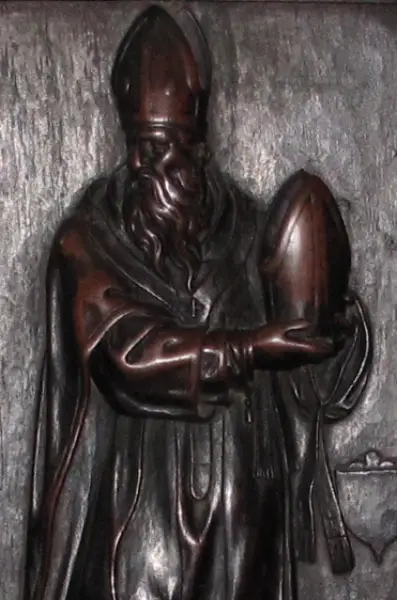
Protasius died at Milan about 343, on 24 November, the date that his feast day still commemorates. His body was laid to rest in the church of San Vittore al Corpo, dedicated to Saint Victor Maurus, and there his tomb remained an object of veneration through the centuries that followed. The continuity of that cult is remarkable: the same church that received his remains in the fourth century is still named as the place where they are honored. His memory was also attached to the Oratorio di San Protaso, and a wooden statue of the saint survives among the devotional treasures of Milan. He is venerated not only by the Catholic Church but also by the Eastern Orthodox Church, Lutheranism, and the Anglican Communion, a breadth of recognition fitting for a bishop whose public witness was expended on the cause of the whole church's faith rather than on any local cause. In the long catalogue of the archbishops of Milan, his name stands recorded between Maternus and Eustorgius I, a quiet but steadfast link in the chain of the Ambrosian church.
§ Life
Timeline
- 328
Elected bishop of Milan, succeeding Maternus in the principal see of northern Italy
§ Life
- 342
Stood with Athanasius of Alexandria when the bishop spoke before Emperor Constantius II, an episode datable to about 342 or 343
§ Life
- 343
Attended the Council of Sardica and signed its decrees, opposing the Arians and upholding the faith of Nicaea
§ Life
- 24 Nov 343
Died at Milan; his body was buried in the church of San Vittore al Corpo, where it is still venerated
§ Life
The Record
- Symbols
- Episcopal dress·Wooden statue tradition at the Oratorio di San Protaso
- Canonization
- Pre-congregation; venerated since antiquity in the Catholic, Orthodox, Lutheran, and Anglican traditions
Prayer
Bibliography
Show 4 sources
- Ruggeri, Fausto (1991). I Vescovi di Milano. Milano: NED. pp. 9-10. ISBN 88-7023-154-2. (in Italian)
- Pasini, Cesare (1992). "Protaso di Milano, santo (sec. IV)". Dizionario della Chiesa Ambrosiana. Vol. 5. Milano: NED. pp. 2969-2971. ISBN 88-7023-102-X. (in Italian)
- Athanasius. "Apologia ad Constantium, par 3". New Advent. Retrieved 17 October 2011.
- Cazzani, Eugenio (1996). Vescovi e arcivescovi di Milano. Milano: Massimo. p. 15. ISBN 88-7030-891-X. (in Italian)
Profile text adapted from the Wikipedia article, licensed CC BY-SA 4.0.
Pray with this saint every day
Save St. Protasius of Milan to your favorites, read the full profile, and get feast-day reminders in the Saints app.
Get the Saints AppFree on the App Store for iPhone and iPad