
died 457·Feast February 28
St. Proterius of Alexandria
Patriarch of Alexandria and hieromartyr of the Chalcedonian conflict
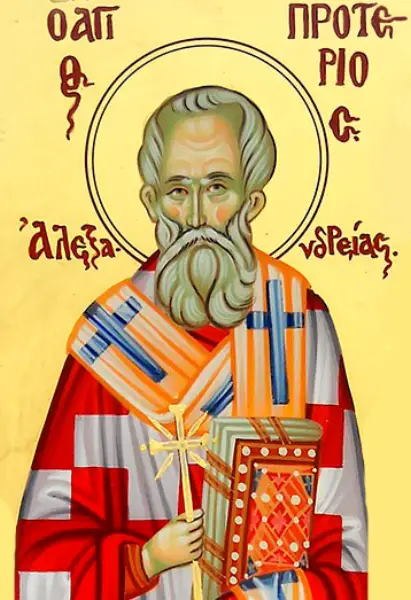
Overview
Proterius served as Patriarch of Alexandria from 451 until his violent death in 457, a pontificate defined from its first hour by the Christological turmoil that followed the Council of Chalcedon. When the council deposed Dioscorus of Alexandria for his opposition to its teaching, it chose Proterius to govern the great Alexandrian see in his place. The decision divided the city and the church of Egypt: the Alexandrian church stood largely with the anti-Chalcedonian party, and Proterius, a Chalcedonian, was never able to reconcile his flock to the council's settlement. His accession opened the schism of 451, under which the Coptic Orthodox and the Greek Orthodox patriarchates of Alexandria traces rival successions that have never fully healed. In 457 the anti-Chalcedonian party elected Timothy Aelurus as patriarch in his place, and Proterius was killed, either by a Coptic mob or by the Byzantine garrison, according to differing ancient accounts. The Eastern Orthodox and Catholic Churches honor him as a hieromartyr, keeping his feast on 28 February.
The Complete Life
Chosen by a Council
Proterius came to the patriarchate of Alexandria not through the ordinary channels of local election but by the decision of an ecumenical council. In 451 the Fathers gathered at Chalcedon deposed Dioscorus of Alexandria, who had opposed the council's Christological definition, and appointed Proterius to govern the see in his stead. The choice made him the first Greek Orthodox patriarch of Alexandria in the new order that Chalcedon created, but it also bound his fate inseparably to a settlement that the church of Egypt largely rejected. Alexandria had been the stronghold of Dioscorus and of his predecessors Cyril and Athanasius, and the deposition of a beloved patriarch by a council dominated by imperial and Antiochene interests was received in the city as an outrage. Proterius thus assumed the most difficult office in eastern Christendom, representing in his own person the authority of Chalcedon to a people who regarded that council as a betrayal. Every day of his six-year pontificate was spent inside that contradiction. Nothing is recorded of his life before the council raised him up; the silence of the sources leaves his earlier career unknown. What is certain is the weight of the task he accepted, for no patriarch of the age took office under darker skies.
§ History
A Divided City and an Unhealed Schism
The violence of Proterius's reception revealed the depth of the division. A riot greeted him when he reached Alexandria, and hostility toward him never died down. The Alexandrian church stood mostly with the anti-Chalcedonian cause, so Dioscorus's removal and the raising of a Chalcedonian successor stirred violent resistance from the outset. With him began the schism of 451, the rupture under which the Coptic Orthodox Church and the Greek Orthodox Church each came to maintain their own patriarch of Alexandria, rival successions that have never been completely resolved. For six years Proterius held the see amid this hostility, sustained by imperial support but lacking the affection of his flock. In 457, when the Emperor Theodosius II's successor Marcian was dead and imperial attention was fixed elsewhere, the anti-Chalcedonian party moved at last: it gathered and elected Timothy Aelurus, a zealous opponent of Chalcedon, as Patriarch of Alexandria in open opposition to the occupant of the throne. Installed openly as the council's man, he could govern only while imperial power stood behind him, and any slackening of that support left the patriarch exposed to a population that had never consented to his rule.
§ History
Martyrdom and Veneration
The end came in 457, and the ancient sources disagree about its exact circumstances. Evagrius Scholasticus records that Proterius was martyred by a Coptic mob; Zachariah of Mitylene reports instead that he was murdered by the Byzantine garrison in Alexandria. Whichever account is true, his death was violent, political, and bound to his fidelity to Chalcedon, and the church received him among its martyrs. The murder was noted far beyond Egypt: groups of bishops from several Roman provinces, including Galatia Prima, wrote letters to the emperor Leo I the Thracian commenting on it, evidence that the fall of the Alexandrian patriarch was felt throughout the Christian world. Both the Eastern Orthodox Church and the Catholic Church regard him as a saint and hieromartyr, keeping his memory on 28 February. The Coptic Orthodox Church, however, does not recognize him as a legitimate pope of Alexandria; in its chronology the see during those years belonged to Dioscorus and then to Timothy, the very men the imperial church deposed or opposed. In the Roman Martyrology his name stands among the saints, and the feast of 28 February keeps the memory of his witness alive in both the churches that claim him.
§ Veneration
The Schism That Endured
Proterius's brief patriarchate fixed the shape of Alexandrian church history for the following fifteen centuries. The rival successions that began with his installation in 451 became permanent: the Greek Orthodox line, of which he stands as the first patriarch, continued alongside the Coptic Orthodox line descended from Dioscorus and Timothy, and both traditions preserved unbroken lists of popes and patriarchs of Alexandria down to the present day. The division, born of the controversy over the Council of Chalcedon's definition of the two natures of Christ, outlived every attempt at reconciliation, and modern efforts toward doctrinal agreement between the Chalcedonian and Oriental Orthodox churches have had to reckon with the legacy of those years. Within the Greek Orthodox succession, Proterius's memory as a hieromartyr gave the line a founding witness: the first of its patriarchs had died for the council that established it. In the Coptic memory, by contrast, the same events are remembered through Dioscorus, the exile whom the council deposed. One episcopate thus stands at the head of two living traditions. For this reason his six short years in the patriarchate have drawn more attention from historians than the decades of many of his successors, as the hinge on which the religious history of Egypt turned.
§ History
Timeline
- 451
The Council of Chalcedon chose him as Patriarch of Alexandria after deposing Dioscorus from the see
§ History
- 451
Arrived in Alexandria to take up the patriarchate and was met by a riot; his accession opened the schism of 451 between the Coptic and Greek Orthodox lines
§ History
- 457
Alexandria's anti-Chalcedonian party chose Timothy Aelurus as a rival patriarch against Proterius
§ History
- 457
Killed in Alexandria, either martyred by a Coptic mob or murdered by the Byzantine garrison, according to differing ancient sources; bishops across the Roman provinces wrote to Emperor Leo I about the murder
§ History
The Record
- Symbols
- Byzantine-rite iconography depicting him as a hieromartyr
- Canonization
- Pre-congregation; venerated as a hieromartyr by the Eastern Orthodox Church and the Catholic Church
Prayer
Bibliography
Show 6 sources
- Keough, Shawn W. J. (2011). "Episcopal Succession as Criterion of Communion: The Rise of Rival Episcopal Genealogies in Alexandria according to Liberatus of Carthage". In Leemans, Johan; Van Nuffelen, Peter; Keough, Shawn W. J. (eds.). Episcopal Elections in Late Antiquity. De Gruyter. pp. 389-410.
- Evans, J. A. S. (2002). The Age of Justinian: The Circumstances of Imperial Power. Taylor & Francis.
- Wilde, Clare (2022). "The Qurʾānic Rūm: A Late Antique Perspective". In van den Bent, Josephine; van den Eijnde, Floris; Weststeijn, Johan (eds.). Late Antique Responses to the Arab Conquests. Brill. pp. 32-55.
- Meyendorff, John (1989). Imperial unity and Christian divisions: The Church 450-680 A.D. The Church in history. Vol. 2. Crestwood, NY: St. Vladimir's Seminary Press. ISBN 9780881410563.
- Pearse, Roger. "Zachariah of Mitylene, Syriac Chronicle (1899). Book 4". www.tertullian.org. Retrieved 2018-10-02.
- Martirologio Romano (PDF). p. 287.
Profile text adapted from the Wikipedia article, licensed CC BY-SA 4.0.
Pray with this saint every day
Save St. Proterius of Alexandria to your favorites, read the full profile, and get feast-day reminders in the Saints app.
Get the Saints AppFree on the App Store for iPhone and iPad