
died 586·Feast February 25
St. Prætextatus of Rouen
Merovingian bishop tried by kings and killed in his own church
Overview
Prætextatus, known in French as Prétextat or Saint Prix, held the bishopric of Rouen from 549 down to his murder in 586, and those long decades in office placed him at the center of the storms that shook the Frankish church in the sixth century. A frequent participant in church councils, including the Council of Paris of 557 and the Council of Tours of 566, he became the unwilling protagonist of one of the era's most famous dramas when in 575 he presided over the marriage of Merovech to the Visigothic princess Brunhild, a union King Chilperic regarded as both incestuous and politically threatening. Summoned before a council of forty-five bishops in Paris in 577, Prætextatus was accused of conspiracy, sacrilege, and theft, and was exiled to the island of Jersey. He returned to his diocese only after Chilperic's death in 584, was reinstated through the intervention of Bishop Ragnemond of Paris, and was slain in his own church at Rouen on 24 February 586. Gregory of Tours, his defender at the trial, strongly implies that Queen Fredegund arranged his murder.
The Complete Life
A Bishop of the Frankish Church
Prætextatus shepherded the church of Rouen from 549 onward, in the generations when the Merovingian kingdoms of the Franks were consolidating their rule over Gaul and the episcopate stood among the most powerful institutions of the new order. His career is inseparable from the conciliar life of the Gallican church: he was present at the Council of Paris in 557, which ruled that wedlock between relatives within the forbidden degrees was incest, and at the Council of Tours of 566. Such assemblies were far more than liturgical gatherings, as modern historians of the period have emphasized; they were a political stage on which bishops contended over power, control, and prestige, and on which kings and their agents settled accounts with bishops they judged unfaithful. Prætextatus's readiness to take part in them placed him among the governing class of the Frankish church, and it was precisely this prominence that drew him into the dynastic quarrels of the royal house. His episcopate would span nearly four decades, ending not in old age and quiet but in trial, exile, and blood. Attendance at such gatherings also kept a bishop in touch with the principal men of the realm, and for Prætextatus it created the acquaintances and the enmities that would later decide his fate.
§ Biography
The Wedding, the Trial, and the Isle of Jersey
The catastrophe of Prætextatus's later years began with a marriage. In 575 he presided as minister over the wedding of Merovech, son of King Chilperic I of Neustria, to Brunhild, widow of Sigebert I of Austrasia and Merovech's own aunt, a ceremony performed in his diocese of Rouen. Chilperic opposed the marriage, both for its incestuous character under the canons he had seen affirmed at Paris and for its threat to his own dynastic plans, and he moved against the bishop who had blessed it. Accused of bribing the people of Rouen with gifts to turn them against their king, Prætextatus suffered a temporary banishment, while a gathering of bishops met at the Parisian church of Saint Peter the Apostle in 577 to determine his fate. There Chilperic added charges of conspiracy, violation of the canons, and theft, accusations that Gregory of Tours strongly implies were false. Gregory himself rose to defend the accused with a long speech, but the outcome was engineered: Prætextatus confessed his crimes, apparently under manipulation, forged canons demanding his excommunication were produced, and the bishop was sent into exile on the island of Jersey.
§ Biography
Restoration and Assassination
Exile ended only with the death of Chilperic in 584. Summoned back by the people of Rouen, Prætextatus sought from King Guntram of Burgundy an investigation into the proceedings of 577. The widowed queen Fredegund opposed his restoration, arguing that a sentence confirmed by forty-five bishops could not be undone, but before the council Guntram proposed could meet, Bishop Ragnemond of Paris spoke in the old man's favor, observing that the proper canonical remedy would have been penance rather than exile. Prætextatus was reinstated as bishop of Rouen, and about this time he appeared at the Council of Mâcon, where he read prayers he had composed during his years on Jersey; the assembly received them coolly, though a modern liturgical historian has cited the episode as an example of the era's liturgical creativity. The restoration did not disarm his enemies. On 24 February 586 he was murdered within his own Rouen church, not long after a bitter exchange of words with Fredegund, who visited him on his deathbed and heard him accuse her of organizing the deed. She later had the assassin beaten, and under that treatment he implicated her in the plot, though King Guntram judged the question still open to investigation.
§ Death
Witness of an Age
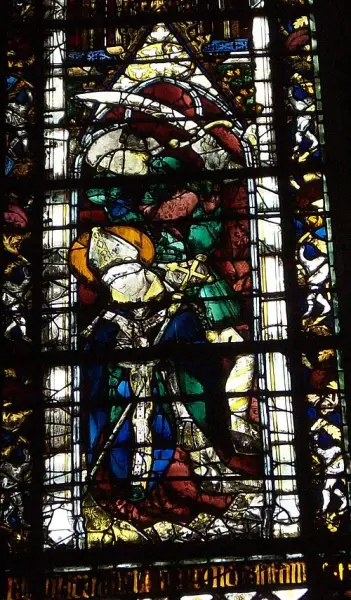
Prætextatus's historical importance rests on the prominence he won within Gregory of Tours's Histories, the principal source for his life and one of the masterpieces of Merovingian literature. He appears in many of its most notable passages, and the story of his trial and death has shaped modern understanding of Merovingian law, the rivalry of kings and bishops, the working of church councils, and the power of queens. His trial in particular has drawn the attention of historians: Gregory Halfond has observed that even a bishop accused of treason and the theft of royal property still had to face an episcopal tribunal, a fact that measures the strength of the Merovingian church against kings as aggressive as Chilperic. Martin Heinzelmann has treated Gregory's speech in the bishop's defense as the chief example of the historian's pedagogical purpose, presenting instructive models of proper church practice, while Joaquin Martinez Pizarro has read the bishop's struggle with the Jezebel-like Fredegund as part of a typological tradition echoing the Old Testament contests of prophets and kings. The Roman Catholic Church canonized him, and his figure survives in the stained glass of Rouen Cathedral.
§ Legacy
Timeline
- 549
Became bishop of Rouen, the see he would hold for the rest of his life
§ Introduction
- 557
Attended the Council of Paris, which declared marriages within certain degrees of consanguinity incestuous
§ Biography
- 566
Attended the Council of Tours as part of his heavy participation in the church councils of sixth-century Gaul
§ Biography
- 575
Presided over the wedding of Merovech of Soissons and Brunhild, widow of Sigebert I and Merovech's own aunt, in his diocese of Rouen
§ Biography
- 577
Tried by a council of bishops in the Church of Saint Peter the Apostle in Paris on charges brought by Chilperic, and sent into banishment on the island of Jersey
§ Biography
- 584
Recalled to Rouen by its own inhabitants once King Chilperic was dead
§ Return from Exile
- 25 Feb 586
Assassinated at his own church in Rouen in an attack Gregory of Tours strongly implies was arranged by Queen Fredegund
§ Death
The Record
- Major works
- Prayers composed during his exile on Jersey, read at the Council of Mâcon
- Symbols
- Depicted in the stained glass of Rouen Cathedral
- Canonization
- Canonized by the Roman Catholic Church
Prayer
Bibliography
Show 6 sources
- Gregory of Tours, Histories, trans. L. Thorpe, Gregory of Tours: The History of the Franks (Harmondsworth, 1974).
- Heinzelmann, M, 'Gregory of Tours: The Elements of a Biography' in A.C. Murray, A Companion to Gregory of Tours (Leiden, 2016), pp. 7-34.
- Hen, Y, 'The Church in Sixth-Century Gaul' in A.C. Murray, A Companion to Gregory of Tours (Leiden, 2016), pp. 232-255.
- James, E, 'Beat pacifici: bishops and the law in sixth-century Gaul' in J. Bossy (ed.), Disputes and settlements: law and human relations in the west (Cambridge, 1983), pp. 25-46.
- Pizarro, J.M., 'Gregory of Tours and the Literary Imagination: Genre, Narrative Style, Sources, and Models in the Histories', in A.C. Murray, A Companion to Gregory of Tours (Leiden, 2016), pp. 337-374.
- Halfond, G.I., The Archaeology of Frankish Church Councils, AD 511-768 (Leiden, 2010), p. 118.
Profile text adapted from the Wikipedia article, licensed CC BY-SA 4.0.
Pray with this saint every day
Save St. Prætextatus of Rouen to your favorites, read the full profile, and get feast-day reminders in the Saints app.
Get the Saints AppFree on the App Store for iPhone and iPad