
died c. 300·Feast December 23 (Coptic Church); December 21 in some other churches
St. Psote
Bishop of Ebsay beheaded in the Diocletianic Persecution
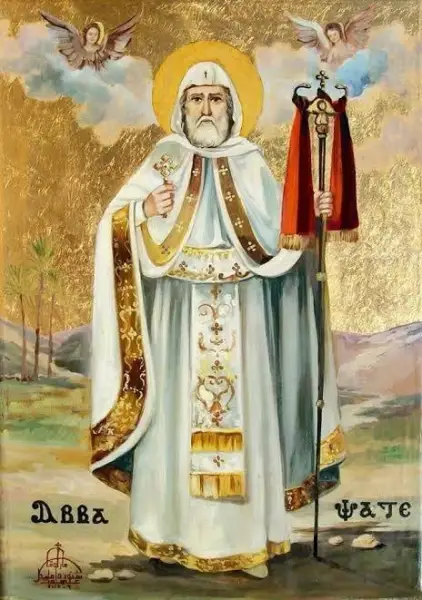
Overview
Psote, remembered in the Coptic tradition also as Bisada, Besada, Psate, Abashadi, Abassadius, or Beshada, shepherded the see of Ebsay in Upper Egypt and gave his life in the great persecution of Emperor Diocletian around the year 300. Born into a devout Christian family in the ancient city of Psoi, he showed from childhood a deep spiritual awareness and a quick grasp of the Scriptures, qualities that raised him to the episcopate of his native city. As bishop he was celebrated for eloquent preaching and for the strength he lent a frightened church: with his fellow bishop Callinico he traveled through Upper Egypt, teaching, confirming the Christian communities, and comforting those who suffered under the imperial edicts. His reputation drew followers from across the whole region and finally the attention of the Roman state. The governor Arianus reported his influence to Diocletian, an ultimatum was issued, and officers came to arrest Psote while he stood celebrating the Liturgy on a Sunday. He asked only time to prepare his people for his death, then went to Antinoe, where he was beheaded for his refusal to sacrifice to the Roman gods.
The Complete Life
A Bishop Raised from the Faithful City
Psote came from the ancient city of Psoi in Upper Egypt, raised in a family whose Christianity shaped him from his earliest years. The Coptic accounts of his life describe a boy who showed a deep spiritual awareness and an ardent dedication to God long before he could have earned distinction in any other way. His wisdom and his understanding of the Scriptures set him apart among the Christians of the city, and in due course he was ordained bishop of Psoi, the flock among whom he had been formed. The episcopate he assumed was no honor but a charge: he is also counted as bishop of Ebsay in Upper Egypt, and the names under which the tradition remembers him, from Bisada and Besada to Abashadi and Beshada, testify to how widely and how long his memory circulated in the Coptic Church. He became known above all for his eloquence in preaching, the gift by which he would hold his people together in the years of trial that were coming upon the Egyptian church. The tradition preserves his episcopal dignity in both of its forms, counting him among the bishops of Ebsay and among the shepherds of Psoi, and it is this double memory that the Coptic Church honors in his feast.
§ Life
Shepherd in a Time of Repression
The years of Psote's episcopate coincided with the Diocletianic Persecution, the most severe and systematic assault the Roman Empire ever launched against Christianity. While edicts stripped Christians of their rights, destroyed their churches, and demanded sacrifice to the Roman gods, Psote refused to hide his office or mute his voice. Together with his fellow bishop Callinico, he traveled throughout the region of Upper Egypt, spreading the word of God, reinforcing the Christian communities, and bringing consolation to believers ground down by the oppression. His preaching drew crowds and renowned for piety and wisdom, he drew disciples from all across Upper Egypt, so that his influence reached far beyond the bounds of his own diocese. In an age when many bishops were in flight or in prison, the two bishops' circuit through the threatened villages made them the visible backbone of the church. It was precisely this visible success that brought them to the attention of the Roman authorities, who watched the Christian population of Egypt refuse, under their shepherds' encouragement, to return to the old gods. In an age when apostasy was purchased by threat and martyrdom by refusal, such labors among the villages of the Thebaid were themselves a form of confession, and they won the two bishops a place in the affection of the whole region.
§ Life
The Sunday of His Arrest
The Roman governor Arianus, alarmed by reports of the two bishops' growing influence and their power to draw converts away from the Roman gods, wrote to Emperor Diocletian about them. The emperor's answer was an ultimatum: Psote and Callinico were to renounce their faith and offer sacrifice to the Roman gods, or die. The test came on a Sunday, while Psote stood celebrating the Liturgy and Roman officials arrived bearing the emperor's letter. Conscious of what refusal would cost, the bishop refused anyway, declaring his unwavering commitment to Christ. He asked only a brief reprieve, not to escape but to prepare himself and his followers for the martyrdom that awaited him. Then he turned to his congregation and urged them to hold firm to the faith once he was gone. His congregation, overcome with grief, wept to think of parting from the shepherd they loved. From there he was led to Antinoe, the administrative center of Upper Egypt and a place of many martyrdoms in those years, and there he was beheaded, sealing his episcopate with his blood around the year 300. December 23 thus marks for Coptic Christians not merely the death of a bishop but the witness of one who went to execution from the very altar where he had been feeding his people.
§ Persecution
Memory in the Coptic Church
The martyrdom of Psote passed quickly into the liturgical memory of the Coptic Orthodox Church, which venerates him as one of the episcopal martyrs of the Diocletianic era, His feast is observed on 23 December in the Coptic Church, while some other churches keep it on 21 December. The multiplicity of his names, preserved in the Coptic sources as Bisada, Besada, Psate, Abashadi, Abassadius, and Beshada, reflects the broad diffusion of his cult across Egypt and the centuries. His memory found a lasting home in monastic Egypt: the monastery of Saint Samuel the Confessor in the desert of the Thebaid maintains his shrine, linking the martyr bishop to the great tradition of Coptic monasticism that grew up among the confessors of his own generation. The Coptic dossier of his martyrdom was gathered and published in a modern critical edition by Tito Orlandi, testimony that the texts of his passion remained alive in Egyptian libraries down to modern times. The survival of his passio in Coptic, studied and translated in the modern edition of Tito Orlandi, assures that the account of his Sunday arrest and his beheading at Antinoe remains accessible to readers today, more than seventeen centuries after the events it remembers.
§ Introduction
The Record
- Canonization
- Pre-congregation; venerated as a martyr from antiquity in the Coptic Orthodox Church
Prayer
Bibliography
Show 3 sources
- "Saint Psoté". Retrieved 2018-03-14.
- Orlandi, Tito (1978). Il Dossier copto del martire Psote: testi copti con introduzione e traduzione. Cisalpino Goliardica. ISBN 88-205-0122-8.
- Holweck, F. G. A Biographical Dictionary of the Saints. St. Louis, MO: B. Herder Book Co. 1924.
Profile text adapted from the Wikipedia article, licensed CC BY-SA 4.0.
Pray with this saint every day
Save St. Psote to your favorites, read the full profile, and get feast-day reminders in the Saints app.
Get the Saints AppFree on the App Store for iPhone and iPad