
died c. 125·Feast January 22
St. Publius
First Bishop of Malta and martyr of Athens
Overview
Publius, known also as Publius of Malta and Publius of Athens, was an early Christian bishop whom memory ranks as the first bishop of the Maltese church and among the earliest bishops of Athens; the Maltese venerate him as the first of their island's saints. Christian tradition identifies him with the Publius whom the Acts of the Apostles calls the chief or prince of the island, the man who received Paul the Apostle as his guest for three days after the shipwreck on Malta, and whose father, sick with fever and dysentery, was healed by Paul's prayer and the laying on of hands. According to Maltese belief, it was through his conversion that Malta became the first nation of the West to embrace the Christian faith. He led the island's church from about 60 to about 90, then passed to Athens, where he succeeded Dionysius the Areopagite, or by the Eastern reckoning Narcissus, as bishop. The date and emperor of his martyrdom vary in the sources: about 112 under Trajan, about 125 under Hadrian, or during the persecution of Marcus Aurelius after 161. He died at Athens, and is venerated with a lion beside him in his iconography.
The Complete Life
The Prince of the Island
Publius enters history through the closing chapters of the Acts of the Apostles, which describe him as the chief, or prince, of the island of Malta, a man of standing whose lands lay in the vicinity of the shore where the apostle Paul and his companions came ashore after their shipwreck. The Greek of his name and the Latin dignity of his position have suggested a Roman official or landowner of the island's governing class, the Maltese tradition has claimed him from the beginning as its own. Of his family the Acts preserve one detail: his father lay sick of a fever and of dysentery when Paul arrived at his house. Publius welcomed the shipwrecked company cordially and entertained them as his guests for three days, and Paul, visiting the sick man, prayed, laid his hands upon him, and healed him. When word of this spread, everyone else on the island who lay ill sought the apostle out and found healing, and when the voyagers at last prepared to sail, the islanders furnished them with everything the journey required. In that exchange of hospitality and healing, the Maltese Church was born, with Publius at its head.
§ History and tradition
First Bishop of Malta
The conversion of Publius carried consequences far beyond his own household. Maltese Christian tradition holds that through him Malta became the first Christian nation in the West, an entire island received into the faith through the ministry performed under his roof. The same tradition, with one voice from the earliest enumerations onward, makes him the first Bishop of Malta, the founding bishop of a church that traces itself to the winter of Paul's stay on the island. His episcopate on Malta is conventionally dated from about 60 to about 90, the years that connect the apostolic landing with the organized church of the sub-apostolic age, and at its end he was succeeded by Quadratus of Malta. He is thus reckoned Malta's first canonized saint, the firstfruits of an island's holiness. A dignity of this kind in the first generation of a national church carried burdens as well as honors: the bishop of a newly planted community stood between a pagan empire and a small flock, and could expect that fidelity to the gospel would one day be tested at cost. For Publius, tradition says, that test came at the other end of the Mediterranean.
§ History and tradition
Bishop of Athens
After his Maltese episcopate, Publius appears in the tradition of Greece. He is counted among the first Bishops of Athens, and the sources differ on his place in the Athenian succession. The Roman Martyrology, keeping his feast on 22 January, follows the line that makes him the successor of Dionysius the Areopagite, the convert of Paul's Areopagus sermon, and dates his assumption of the Athenian church to about 112. The Eastern Orthodox Church, which keeps his memory on 13 March, places him instead as the successor of Narcissus of Athens, citing an epistle of Dionysius, Bishop of Corinth, and dating his martyrdom to the persecution under Marcus Aurelius, who reigned from 161 to 180. The old Latin witness sings of his Athens years in high terms, praising alike the radiance of his virtues and the brilliance of his scholarship, and praising the noble governance he gave the church of the city of philosophy. Whether he sat on the Athenian throne in the time of Trajan or of the later Antonines, the tradition agrees that he shepherded one of the oldest churches of Greece after leading the youngest church of the West.
§ Veneration
Martyrdom at Athens
Publius closed his life as a martyr at Athens, in the Roman province of Achaea. The circumstances of his death are among the most disputed facts of his story, for the traditions assign it to three different reigns. The reckoning that follows the Roman Martyrology and makes him Dionysius' immediate successor dates his martyrdom to about 112, under the emperor Trajan. Catholic sources of another line date it to about 125, during the persecution of Emperor Hadrian, whose journeys through Greece brought imperial attention to the old cities of Achaea. The Great Synaxaristes of the Orthodox Church, placing him after Narcissus, assigns his passion to the persecution of Marcus Aurelius, between 161 and 180. What all three traditions hold in common is the essence: the bishop who had welcomed an apostle to his table died for the faith he had received, crowned, as the old martyrology says, for having borne testimony to Christ. Athens, the city that had heard Paul preach the unknown God, became the place of the island bishop's final witness, and his feast days in East and West alike have kept the memory of that witness alive.
§ History and tradition
Veneration in East and West
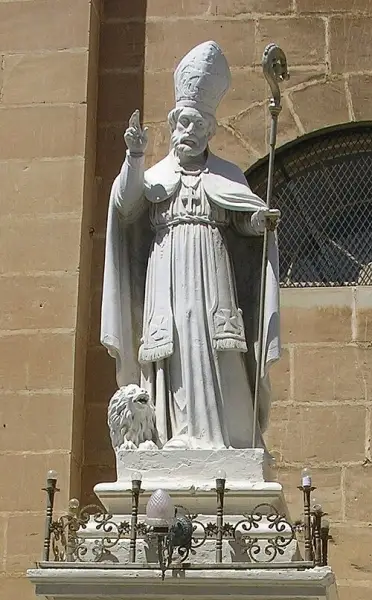
Publius is venerated in the Catholic Church and in the Eastern Orthodox Church, in which he is honored as a Venerable Hieromartyr. The two communions keep his memory on different days: the Catholic feast falls on 22 January, the Orthodox on 13 March. His cult at Malta is immemorial, rooted in the claim that he was the island's first bishop and its first canonized saint, and in the Acts narrative that made the conversion of Malta begin in his own house. He shares the patronage of the island with St. Paul the Apostle, the shipwrecked apostle who converted it, and St. Agatha of Sicily, so that Publius ranks beside them as a third patron of the island nation, while Floriana, the town whose parish church rises beside his statue, honors him as its own particular protector. His iconography shows him in episcopal vestments with a crozier, and with a lion next to him, the emblem of the martyrdom tradition. In the Orthodox reckoning his feast of 13 March joins him to the long line of the bishops of Athens, the church he nobly governed until he was gloriously crowned for his testimony.
§ Veneration
Streets, Statues and a Poem of Victory
The memory of Publius is written into the landscape of Malta. Streets bearing his name are found across the island, in Sliema, Rabat, Mellieħa, Saint Paul's Bay, Naxxar and Floriana, a mapping of devotion into everyday addresses. Beside the Floriana Parish Church stands the statue erected in 1811 by the sculptor Vincenzo Dimech, a landmark of the town that takes him as its patron. His presence in Maltese letters proved unexpectedly enduring: the historian Giovanni Bonello has highlighted how Gregorio Xerri's poem Inno della Vittoria, written after 1565, set before his readers Publius as an emblem of victory that was wholly Maltese, passing over the foreign religious figures and beginning, in Bonello's judgment, a cultural reclamation of the saint who had been underrepresented in devotional and liturgical contexts. In 2025, a study by James Aaron Ellul recalled this literary tradition and noted contemporary calls, marking roughly nineteen hundred years since his martyrdom, to re-embed Publius in the national and ecclesiastical memory of Malta. The prince of the island who hosted an apostle, the tradition thus keeps insisting, belongs at the center of the nation's story.
§ Cultural Reemergence
Timeline
- 60
Tradition makes him the first Bishop of Malta, with his episcopate dated from about this year.
§ History and tradition
- 90
His tenure as first Bishop of Malta ended, and he was succeeded by Quadratus of Malta.
§ History and tradition
- 112
By the Catholic reckoning, which makes him successor of Dionysius the Areopagite, he became Bishop of Athens around this year.
§ Veneration
- 125
Martyred at Athens around this year, during the persecution of Emperor Hadrian.
§ History and tradition
- 1811
A statue of Saint Publius by Vincenzo Dimech was placed beside the Floriana Parish Church.
§ Legacy
- 2025
Historians highlighted Gregorio Xerri's victory hymn and renewed calls arose to restore Publius to Malta's national and ecclesiastical memory.
§ Cultural Reemergence
In Their Own Words
At Athens, the birthday of St. Publius, bishop, who, as successor of St. Denis the Areopagite, nobly governed the Church of Athens. No less celebrated for the lustre of his virtues than for the brilliancy of his learning, he was gloriously crowned for having borne testimony to Christ.
The Record
- Patron of
- Patron of Malta, one of its three patron saints·Patron of Floriana·Patron of Athens, Greece
- Symbols
- Shown with a lion next to him·Episcopal vestments·Crozier
- Canonization
- Malta's first canonized saint; venerated since antiquity in the Catholic and Eastern Orthodox Churches
Prayer
Bibliography
Show 8 sources
- The Roman Martyrology. Transl. by the Archbishop of Baltimore. Last Edition, According to the Copy Printed at Rome in 1914. Revised Edition, with the Imprimatur of His Eminence Cardinal Gibbons. Baltimore: John Murphy Company, 1916. p. 21.
- "Publius of Malta". Catholic Online. Retrieved April 22, 2011.
- Great Synaxaristes: "Ὁ Ἅγιος Πούπλιος ὁ Ἱερομάρτυρας Ἐπίσκοπος Ἀθηνῶν". 13 Μαρτίου. ΜΕΓΑΣ ΣΥΝΑΞΑΡΙΣΤΗΣ.
- Anglorus, Fr. Andrew. "Orthodox Europe: Orthodox Malta". St John's Orthodox Church, Colchester.
- "St Publius of Malta (1)". Times of Malta. 2007-06-22. Retrieved 2025-03-09.
- AnaStpaul (2024-01-21). "Saint of the Day – 21 January – St Publius of Athens (2nd Century) Bishop and Martyr". Retrieved 2025-03-09.
- Ellul, James Aaron (2025-05-04). "San Publju: Simbolu ta' Identità Maltija". NETnews. Retrieved 2026-05-03.
- "Publius 21 Jan". Latin Saints of the Orthodox Patriarchate of Rome.
Profile text adapted from the Wikipedia article, licensed CC BY-SA 4.0.
Pray with this saint every day
Save St. Publius to your favorites, read the full profile, and get feast-day reminders in the Saints app.
Get the Saints AppFree on the App Store for iPhone and iPad