
died under Nero (54–68)·Feast May 19
St. Pudens
First-century Roman senator and martyr
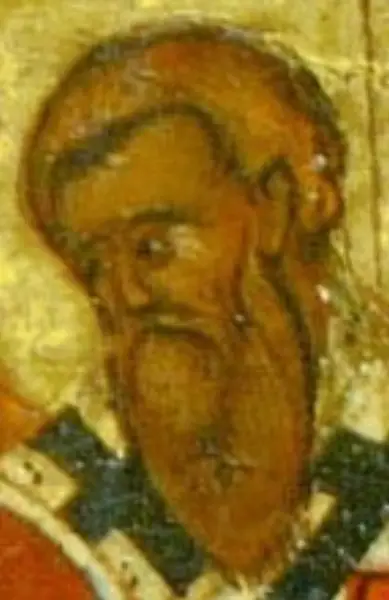
Overview
Pudens was a Christian of the apostolic age in Rome, named as a layman of the Roman Church in the Second Letter to Timothy, where the writer sends greetings from Pudens, Linus, Claudia and the brethren. Tradition gives him for father Quintus Cornelius Pudens, who sat in the Roman Senate, and for mother that senator's wife Priscilla; both parents stood among the first whom Peter drew to the faith in Rome, and Peter himself, a guest beneath their roof, baptized their son. Wealthy and well born, possibly of the Gens Cornelia, Pudens held a seat in the Roman Senate; two sons, Novatus and Timotheus, were born to him, and legend adds two daughters, Praxedes and Pudentiana, both remembered in the tituli of ancient Rome. He died a martyr in the persecution unleashed under the emperor Nero, who reigned from 54 to 68, and was buried in the Catacomb of Priscilla on the Via Salaria. A church in Rome, the titulus Pudentis, attested at the synod of Pope Symmachus in 499, stands as the enduring monument of his family's faith.
The Complete Life
Born into Rome's Christian Household
Pudens came of one of the most remarkable families of early Roman Christianity. He was the son of Quintus Cornelius Pudens, a member of the Roman Senate, and of Priscilla, his wife; tradition ranks both parents among the first inhabitants of Rome converted by the Apostle Peter. The family was wealthy and of high standing, and is thought to have belonged possibly to the ancient Gens Cornelia, one of the noble houses of the Republic and early Empire. Into this household Peter himself was received as a guest, and there, according to the tradition preserved of him, he baptized their son. The home of the Pudens family thus belonged to the small circle of first-generation houses in which the Roman Church first took visible shape, a place where the apostolic preaching was heard at first hand and the sacraments of the new faith were administered years before the Church of Rome possessed its great basilicas. A child of such a house absorbed the faith of the first generation of Roman believers, and carried it into the public life of the city.
§ Life
A Layman Named in Scripture
Whatever else his life contained, Pudens is fixed in Christian memory by a single verse of the New Testament. The Second Letter to Timothy, written from prison, closes with personal greetings, and among those who send their greetings to Timothy the writer names Pudens, together with Linus, Claudia and all the brethren. He is thus presented as a layman of the Roman Church, a believer known personally to the apostolic circle in the city's last years of freedom. Tradition and later enumeration place him among the disciples of that age whom the Church honors as saints. His own vocation was not to office or writing but to visible discipleship in dangerous circumstances: a senator who professed Christ while the imperial government turned hostile, a householder whose home sheltered the chief of the apostles. He married and raised a family; his sons Novatus and Timotheus are named by the tradition, and two daughters, Praxedes and Pudentiana, are ascribed to him by legend and commemorated in the ancient churches that bear their names. His faith was a family inheritance passed down through a noble Roman line.
§ Life
Faith in a Senate of Suspects
To be a Christian senator under the Julio-Claudian emperors was to stand with one foot in the most privileged class of the empire and the other in a persecuted sect. Pudens' public identity was that of a Roman senator; his deeper allegiance was to a community whose founder had been crucified and whose apostle had been beheaded in the same city. The memory preserved of him joins these identities without embarrassment: a man of the Gens Cornelia by descent, a member of the Senate by office, a baptized Christian by the hand of Peter, and a father raising children in the faith. His house, the tradition holds, was one of the places where the first Roman Christians could gather, and the titulus that eventually grew from it retained the authority to administer the sacraments, an indication of an organized community on the site from an early date. The mission of such a man was precisely his endurance in place: he sanctified a social position that could have been an obstacle, and made of a noble household a refuge for the apostolic Church in the capital of the empire.
§ Life
Martyr of the Neronian Persecution
Pudens died a martyr in the persecution that broke out under the emperor Nero, who reigned from 54 to 68. The Neronian persecution, remembered as the first great assault of the Roman state on the Church, made confession of Christ in the capital a capital offense, and Pudens, prominent enough to be known and Christian enough to be condemned, was among its victims. His body was laid in the Catacomb of Priscilla, beside the Via Salaria, the burial ground bound up with his own family, in which his mother Priscilla's memory also endures. Resting there with the martyrs of the first age, he belonged to that company of Roman believers whose blood, in the Church's ancient conviction, had been the seed of the city's later Christian glory. The date of his death is not recorded; what the tradition preserves is its character, a death borne for the faith and received as witness. The churches of Santa Prassede and Santa Pudenziana, which rose in Rome in connection with his family's memory, kept alive for every later generation the account of the senator's household that had given its head to the persecutor's fury.
§ Life
The Church That Bears His Name
The surest monument of Pudens is a building. The acts of the synod of Pope Symmachus, held in 499, record the existence in Rome of the titulus Pudentis, a church with authority to administer the sacraments, known also as the ecclesia Pudentiana. The designation ties the church to the name of Pudens and testifies that by the fifth century the community gathered there was ancient, organized and legally acknowledged among the titular churches of the city. From the same family memory came the neighboring churches of Santa Prassede and Santa Pudenziana, honoring the daughters ascribed to him by legend and containing some of the most celebrated mosaics of Christian Rome. His own liturgical memory divided along the traditions of East and West: the Eastern Orthodox and Eastern Catholic Churches commemorate him on 14 April, and also on 4 January, while the Dominican Martyrology keeps his feast on 19 May. Nearly two millennia after a verse of Scripture preserved his name beside Linus and Claudia, the senator of the first generation is still named at the altars of the Church that grew from houses like his.
§ Life
The Record
- Canonization
- Pre-congregation: venerated as a martyr from the earliest Christian centuries
Prayer
Bibliography
Show 8 sources
- "Pudens". The Cyclopedia of Biblical, Theological, and Ecclesiastical Literature. James Strong and John McClintock, eds. Harper and Brothers; NY; 1880.
- Chandlery, Peter Joseph. Pilgrim Walks in Rome: A Guide to the Holy Places in the City and Its Vicinity. America Press, 1908, p. 104.
- "Apostle Pudens of the Seventy". OCA.
- Herbermann, Charles, ed. (1913). "St. Novatus". Catholic Encyclopedia. New York: Robert Appleton Company.
- "Praxedes and Pudentia". Catholic Encyclopedia. Retrieved 26 October 2010.
- Martial, Epigrams, ed. & trans. D. R. Shackleton Bailey, Harvard University Press, 1993.
- George Edmundson (1913), The Church in Rome in the First Century, Note C: The Pudens Legend.
- William Smith (1884), Smith's Bible Dictionary.
Profile text adapted from the Wikipedia article, licensed CC BY-SA 4.0.
Pray with this saint every day
Save St. Pudens to your favorites, read the full profile, and get feast-day reminders in the Saints app.
Get the Saints AppFree on the App Store for iPhone and iPad