
2nd century·Feast May 19
St. Pudentiana
Virgin and martyr of second-century Rome
Overview
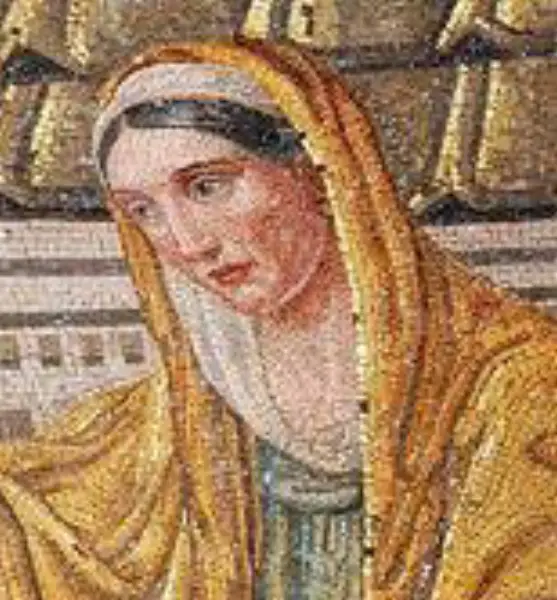
Pudentiana was a Christian virgin of second-century Rome, honored as the elder daughter of the senator Pudens, a friend of the Apostles, and as sister of the martyr Praxedes. Her memory is sometimes clothed in the local form of her name, Potentiana. Tradition, preserved in her acta and in the Martyrology of Reichenau, relates that together with Praxedes and Pope Pius I she fitted out a baptistry in the church kept within her father's house, and there helped bring pagans to the waters of baptism. She refused to offer worship to the emperors Marcus Aurelius and Antoninus Pius, and died for her faith at sixteen years of age. She was laid to rest beside her father in the cemetery of Priscilla on the via Salaria. The ancient basilica of Santa Pudenziana in Rome is dedicated to her, and her name remains in the Roman Martyrology on the nineteenth of May, though historians have found no direct evidence for her life apart from the devotion that grew up around her.
The Complete Life
A Senator's Daughter in the Early Church
The daughter of a Roman senator, Pudentiana grew up in a household that stood close to the Apostles themselves. In such a home the faith was not an ornament of rank but the substance of daily life, and the children of the house learned it before they learned the world. Her father Pudens is numbered among the early friends of the faith, and her sister Praxedes would be honored alongside her as a martyr. The old records, above all her acta and the Martyrology of Reichenau, describe her simply as a virgin of the early church, and it is under that title that devotion to her took shape. In Rome her memory also kept a second form of her name, Potentiana, by which she is still sometimes known in local usage. The family into which she was born gave the Church more than one saint, and the house of Pudens became, in the words of the tradition, a place where Christians gathered and where the sacraments were administered. Whatever the historians may say of the details, the picture the tradition preserves is of a young woman formed in a home where faith was practiced openly at a time when practicing it carried real danger.
§ Legend
Baptistry in the Father's House
The work with which Pudentiana's name is chiefly associated belongs to the life of the first Christian communities at Rome. Together with her sister Praxedes and Pope Pius I, she fitted out a baptistry inside the church that met within her father's house, and there the two sisters set about baptizing pagans who came to the faith. It was a quiet enterprise of conversion, carried on in a private dwelling rather than a public sanctuary, at a season when the sacraments had no buildings of their own. The same tradition gives her refusal a public edge: she declined to worship the emperors Marcus Aurelius and Antoninus Pius as gods, holding the faith of Christ above the demand of the imperial cult. In the memory of the Church these two things belong together, the font in the family house and the refusal before the throne, for both sprang from the same conviction that Christ was Lord. Her particular part in the work was that of a young woman of rank who spent her short life bringing others to the water of life.
§ Legend
Death at Sixteen and Burial on the via Salaria
Pudentiana died while still a girl of sixteen, and the tradition reckons her among the martyrs of her generation, those who sealed their refusal of the imperial worship with their lives. She was buried beside her father Pudens in the cemetery of Priscilla, along the via Salaria, where so many of the early Roman Christians found their resting place. Later ages have weighed the evidence for her story carefully. While the existence of Pudens is supported by testimony, no direct record of Pudentiana or of Praxedes has come to light, and some scholars have suggested that the Ecclesia Pudentiana, the church of Pudens named for its owner's house, may have been mistaken in time for a saint of that name. Yet the devotion itself is ancient and unbroken. A cult that filled a Roman basilica, kept a fixed date in the general calendar for centuries, and crossed the sea to crown a newly baptized Christian city was not built on nothing, whatever the scholars conclude about its beginnings. Whatever the resolution of the scholarly question, the Church has never ceased to keep her memory, and the girl the tradition describes, who died young rather than worship the emperors as gods, remains among the honored virgin martyrs of Rome.
§ Legend
A Basilica, a Calendar, and a Nation's Patroness
The chief monument of her cult stands in Rome itself: the basilica of Santa Pudenziana, one of the city's ancient title churches, is dedicated to her and preserves her name in its very stones. Her commemoration held a fixed place in the General Roman Calendar on May 19 until the reform of 1969, and the Roman Martyrology still records her on that date. Her patronage traveled far beyond the Tiber. When the conquistador Miguel López de Legazpi took possession of Manila on May 19, 1571, the feast of the saint known in Spanish as Potenciana, he declared her patroness of the city he had founded. That patronage endured: in 1942 Pius XII, through the apostolic letter Impositi Nobis Apostolici issued on September 12 and answering a petition from the bishops of the islands, raised Mary, conceived without sin, to be the country's chief heavenly patroness, and named Pudentiana and Rose of Lima as patronesses of the second rank, the documents of record showing Pudentiana honored there since the sixteenth century. A fresco of the fifteenth century in the church of Santa Pudenziana at Narni keeps her image before the faithful still.
§ Veneration
Timeline
- 19 May 1571
Miguel López de Legazpi takes possession of Manila on her feast day and declares Pudentiana patroness of the city.
§ Veneration
- 12 Sep 1942
Pope Pius XII names Pudentiana a secondary patroness of the Philippines, alongside Rose of Lima, under the Virgin Mary as principal patroness.
§ Veneration
- 1969
Her commemoration is removed from the General Roman Calendar in that year's revision, though the Roman Martyrology keeps her name on May 19.
§ Veneration
The Record
- Major works
- The baptistry built within her father Pudens' house-church, where she and Praxedes baptized converts with Pope Pius I
- Patron of
- Basilica of Santa Pudenziana in Rome·Philippines (secondary patroness, with Rose of Lima)
- Symbols
- Oil lamp·Laurel wreath (for Christ)
- Canonization
- Pre-congregation canonization; venerated as a virgin martyr since the age of the early Church.
Prayer
Bibliography
Show 5 sources
- Ἡ Ἁγία Πουδενδιάνα ἡ Μάρτυς [Saint Pudentiana the Martyr], synaxarion.gr, retrieved 3 April 2024
- Mysterii Paschalis (February 14, 1969), Paul VI
- The Roman Martyrology — May
- The Church before it became a Cathedral: 1571, Manila Metropolitan Cathedral-Basilica
- Annuario Pontificio 2013 (Libreria Editrice Vaticana 2013, ISBN 978-88-209-9070-1), p. 956
Profile text adapted from the Wikipedia article, licensed CC BY-SA 4.0.
Pray with this saint every day
Save St. Pudentiana to your favorites, read the full profile, and get feast-day reminders in the Saints app.
Get the Saints AppFree on the App Store for iPhone and iPad