
398 or 399 – July 453·Feast September 10
St. Pulcheria
Virgin empress and advocate of Chalcedon
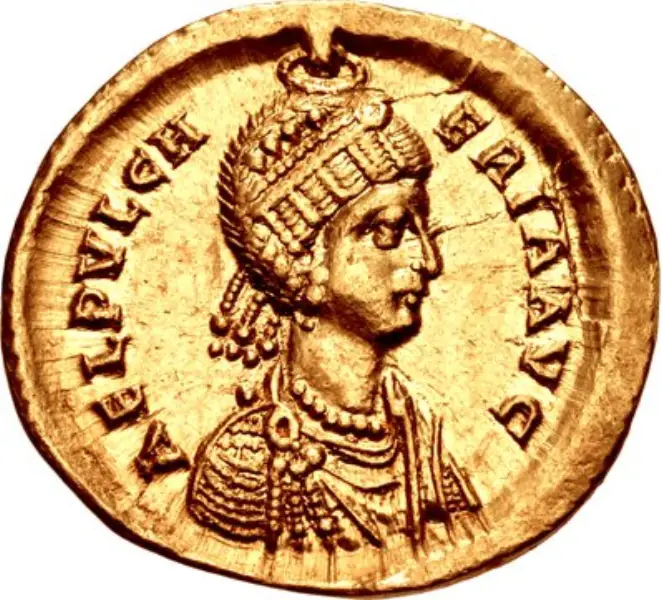
Overview
Aelia Pulcheria was born in Constantinople on 19 January, in 398 or 399 by differing accounts, the second child of the emperor Arcadius and the empress Aelia Eudoxia and the oldest of their children to survive. Orphaned young — her mother died in 404, her father in 408 — she watched over her brother Theodosius II, who wore the crown from the age of seven. On 4 July 414, at fifteen, she made a vow of perpetual virginity, was proclaimed Augusta, and acted as guardian of the young emperor and his government. Her palace took on the character of a monastery: psalmody, the reading of scripture, fasting twice a week, almsgiving on a princely scale. She trained Theodosius in the business of rule and steered ecclesiastical policy through the christological storms of the age, championing the title Theotokos against Nestorius at the Council of Ephesus in 431 and guiding the Church toward the Council of Chalcedon in 451, which she and Marcian convened and at which she was hailed as a new Helena. When Theodosius died in July 450, she conferred dynastic legitimacy on the general Marcian by marrying him, her vow of virginity remaining intact. She died in July 453, left her wealth to the poor, and was honored as a saint in East and West alike.
The Complete Life
A Childhood in the Theodosian Palace
Pulcheria belonged by birth to the Theodosian house, the branch of which reigned over the East from Constantinople in the empire's later age. Her father was the emperor Arcadius and her mother the empress Aelia Eudoxia, whose bitter rivalry with the archbishop John Chrysostom convulsed the capital in her earliest years; the quarrel over a silver statue of the empress raised outside Hagia Sophia ended in Chrysostom's deposition. Around her gathered an older sister, Flaccilla, born in 397 but probably dead young, and younger siblings Arcadia, born in 400, and Theodosius II and Marina, both born in 401. Eudoxia died in 404 and Arcadius followed in 408, leaving four young children and an empire to the seven-year-old Theodosius, nominal co-emperor since 402 and now sole ruler. At first the praetorian prefect Anthemius conducted the affairs of state, while the chamberlain Antiochus directed the boy's education, until the emperor, reaching adulthood, dismissed him. Into this court of orphans and ministers stepped Pulcheria, still a child herself, about to assume a place over the imperial family whose consequences neither the Church nor the state could have foreseen.
§ Early life
The Vow of 414
On 4 July 414, at fifteen, Pulcheria bound herself by a vow of virginity and received proclamation as Augusta. Her sisters took the same resolve, and the act was deliberately public: Sozomen records that she called God, the priests, and the whole body of Roman subjects as witnesses of her dedication. Perpetual virginity carried political logic as well as piety. An unmarried empress deterred suitors whose ambitions might have enveloped her young brother, and a husband at court could have wielded overbearing influence over the emperor or threatened him outright, while marriage itself would have obliged her to relinquish power. From that day forward she acted as guardian of Theodosius and his government until he reached adulthood. Sozomen paints the palace she ruled as a household of prayer, where the emperor's sisters kept one manner of life, attended the house of prayer constantly, showed marked charity to strangers and the poor, and divided day and night in singing God's praises. The imperial establishment, in his telling, had taken on a more monastic tone than the regime that preceded it, with the empress at its head.
§ Vow of virginity
Defender of the Theotokos and Mother of Councils
Pulcheria's hand lay heavily on the Church affairs of her brother's reign. Pope Leo I praised her piety and her contempt for the errors of heretics, and she needed both in the christological wars that filled the middle of the fifth century. When Nestorius, archbishop of Constantinople, moved to diminish the doctrine of the Theotokos, he struck at the devotion of a virgin empress whose image and altar cloth stood at the altar; a rivalry followed in which he waged a smear campaign against her, while she answered with allies such as Eusebius of Dorylaeum and with Cyril of Alexandria, who condemned Nestorius and wrote to the court in the title's defense. The Council of Ephesus in 431, filled with Cyril's supporters, condemned Nestorius; after seeking a middle way the emperor sided with Cyril, decreed the title orthodox, and banished Nestorius to a monastery near Antioch. Controversy flared again in 449, when a second council at Ephesus turned violent and Flavian of Constantinople was beaten so severely that he died of his injuries; Pope Leo branded the synod a robber council. In the aftermath Pulcheria restored what violence had broken, reinstating bishops unjustly ejected and bringing back with honor the remains of Flavian, and she also retrieved the relics of John Chrysostom and set them in the church as an act of thanksgiving for his holy life.
§ First Council of Ephesus
A Palace of Prayer and a Devotion to Mary
The daily texture of Pulcheria's faith was fixed early: the chanting and recitation of scripture in the palace chapel, fasting twice a week, the renunciation of the luxurious jewelry and apparel worn by other women of the court, and unfailing care of the poor and of strangers at the imperial gates. The psalmody of her sisters filled the hours, and contemporaries remarked that the palace had assumed something of a monastery's discipline. Her devotion settled above all on the Mother of God. As a virgin empress she found in the Theotokos both a model and a patroness, and she defended the title at Ephesus when Nestorius sought to diminish it. Her last years she devoted expressly to the Virgin: three churches of Constantinople stood dedicated to Mary under her care: the Chalkoprateia, the Church of St. Mary of Blachernae, and the Monastery of the Panagia Hodegetria. Her charity took built form in numerous churches and houses of shelter for the destitute, within the city and in the country about it, works so extensive that the eleventh region of the city came to be called the Pulcherianai in her honor. Her virginity she regarded as dedication to God, witnessed by priests and people, and she kept it whole even within marriage.
§ Vow of virginity
The Marriage of 450 and the End of the Reign
Discontent with her influence surfaced in the late 440s. Theophanes the Confessor, writing centuries later, relates that Eudocia and the powerful chamberlain Chrysaphius persuaded Theodosius to lean on his wife rather than his sister, and that Pulcheria withdrew from the palace to the Hebdomon, a port on the sea some seven miles outside the capital; the chronology of Eudocia's own departure for Jerusalem, however, does not support that reconstruction. The crisis resolved itself abruptly in 450, when Theodosius fell from his horse while hunting, injured his spine, and died two days later, on 26 July. What passed in the weeks that followed is uncertain: some historians hold that Pulcheria reigned alone for about a month, arranging the dead emperor's public funeral, while others picture tense negotiation among the factions of the court. She held the decisive card. With no surviving male heir, dynastic legitimacy could be conferred by her marriage, and she conferred it on Marcian, a tribune and close associate of the general Aspar, a man of low status by imperial standards but a Roman, and therefore eligible for the throne. Marcian respected her vow of virginity as the union's one condition, and the Church declared that Christ himself had sponsored the union, so that it might raise no scandal in the state. Marcian took the throne on 25 August 450; Chrysaphius was put to death; and three years later, in July 453, Pulcheria died.
§ Wife of Marcian
The Saint of Chalcedon
Her death fell hard on Constantinople. A lifetime of generosity and building had woven a deep tie between the empress and the men and women of the city, and her passing struck them as a personal bereavement. Her final act of giving was written into her will, which distributed her remaining wealth among the poor. The Church's answer followed: she was declared a saint, a title preserved in the memory of both the Roman Catholic and the Eastern Orthodox churches, heirs of the undivided Church of her own age. In Constantinople the faithful kept her memorial each year on September 10, remembering, as the historian Kenneth Holum summarizes the ancient tribute, her faith and her virginity, her generosity and her building, and above all her crowning achievement: bringing about the great council at Chalcedon. Few women of the imperial house received so durable an honor, and few saints owed their recognition so plainly to a public record: it was as empress, guardian, virgin, and advocate of the council that the Church remembered her holiness, and the annual feast of the capital kept that judgment alive for centuries after the empire she served had passed away.
§ Death and veneration
Memory in Ivory, Stone, and Creed
The memory of Pulcheria has traveled in art as well as in liturgy. The Trier Adventus Ivory, preserved in the treasury of Trier Cathedral in Germany, depicts a procession of royal figures, and historians have long identified the small woman clothed as an Augusta at its head as Pulcheria, depositing the holy relics she had brought to the churches of Constantinople; Kenneth Holum read the scene as her cortege, with Theodosius himself reduced to a ceremonial attendant. Other scholars dispute this and see instead the eighth-century empress Irene, who sponsored the renovation of the church shown. At Chalcedon the assembled bishops had saluted her and Marcian as a new Helena and a new Constantine, binding the imperial pair to the memory of the first Christian dynasty, and the council's work, which clarified the creed of Nicaea by proclaiming Christ fully God and fully human at every moment after the Incarnation, remained her deepest monument, even though it opened an irreconcilable gulf between Chalcedonians and Miaphysites that divided the Church for centuries. Modern popular culture has reached her too: in the 2001 miniseries Attila she was portrayed by Janet Henfrey, a small afterlife for an empress whose chief stage was a church council.
§ In art
Timeline
- 19 Jan 399
Born in Constantinople on 19 January; the sources give the year as 398 or 399.
§ Early life
- 404
Her mother, the empress Aelia Eudoxia, dies.
§ Early life
- 408
Her father Arcadius dies, and the seven-year-old Theodosius II becomes sole emperor.
§ Early life
- 4 Jul 414
On 4 July she makes a vow of virginity, is proclaimed Augusta, and becomes her brother's guardian.
§ Vow of virginity
- 7 Jun 421
Theodosius marries the Athenian Athenais, who takes the name Eudocia.
§ Relationship with Aelia Eudocia
- 421
The empire fights Sassanid Persia after King Yazdegerd I executes a Christian bishop; an inscription credits victory to the emperor's sisters' vows.
§ War with Persia
- 431
The Council of Ephesus decrees the title Theotokos orthodox, deposes Nestorius, and banishes him to a monastery near Antioch.
§ First Council of Ephesus
- 449
At the Second Council of Ephesus Flavian of Constantinople is beaten and dies of his injuries; Pope Leo denounces the assembly as a robber council.
§ Second Council of Ephesus
- 26 Jul 450
Theodosius II dies on 26 July, two days after injuring his spine in a fall from his horse while hunting.
§ Wife of Marcian
- 25 Aug 450
Marcian ascends the imperial throne on 25 August.
§ Wife of Marcian
- 25 Nov 450
She marries Marcian on 25 November, his respect for her vow of virginity a condition of the union.
§ Wife of Marcian
- 451
She and Marcian convene the Council of Chalcedon, where 452 bishops condemn Nestorius and Eutyches and uphold the Theotokos; she is hailed as a new Helena.
§ Council of Chalcedon
- Jul 453
She dies in July, probably at Constantinople, and her will distributes her remaining wealth to the poor.
§ Death and veneration
In Their Own Words
She devoted her virginity to God, and instructed her sisters to do likewise. To avoid cause of scandal and opportunities for intrigue, she permitted no man to enter her palace.
They all pursue the same mode of life; they are sedulous in their attendance in the house of prayer, and evince great charity towards strangers and the poor…and pass their days and their nights together in singing the praises of God.
In it you clearly show how much you love the Catholic faith and how much you despise the errors of heretics.
The Record
- Major works
- Churches and charitable buildings in and around Constantinople, so extensive that the city's eleventh region was named the Pulcherianai·Monastery of the Panagia Hodegetria, dedicated to the Virgin Mary·Church of St. Mary of Blachernae, dedicated to the Virgin Mary·Chalkoprateia, a Constantinople church dedicated to the Virgin Mary
- Canonization
- Declared a saint by the undivided Church; recognized by both the Roman Catholic and Eastern Orthodox churches.
Prayer
Bibliography
Show 10 sources
- Cameron, Averil. The Mediterranean World In Late Antiquity AD 395–600. London: Routledge
- Duckett, Eleanor. Medieval Portraits from East and West. Ann Arbor: The University of Michigan Press, 1972
- Garland, Lynda. Byzantine empresses: women and power in Byzantium, AD 527–1204. London: Routledge, 1999
- Holum, Kenneth G. Theodosian Empresses: Women and Imperial Dominion in Late Antiquity. Berkeley and Los Angeles: University of California Press, 1982
- Jones, A.H.M, J.R. Martindale, and J. Morris. The Prosopography of the Later Roman Empire. Cambridge: Cambridge University Press, 1971
- Pope St. Leo the Great. St. Leo the Great: Letters. Translated by Brother Edmund Hunt, C.S.C. New York: Fathers of the Church, Inc., 1957
- Sozomen. The Ecclesiastical History of Sozomen: Comprising a History of the Church from A.D. 324 to A.D. 440. Translated by Edward Walford. London: Henry G. Bohn, 1855
- Teetgen, Ada B. The Life and Times of Empress Pulcheria: A.D. 399–A.D. 452. London: Swan Sonnenshein & Co., 1907
- Limberis, Vasiliki. Divine Heiress: The Virgin Mary and the Creation of Christian Constantinople. London and New York: Routledge, 1994
- "Pulcheria", Robert W. Hewsen. Women in World History: a Biographical Encyclopedia. Waterford, CN: Yorkin Publications, 1999–2002, Vol. 12: O-Q, pp. 839-844
Profile text adapted from the Wikipedia article, licensed CC BY-SA 4.0.
Pray with this saint every day
Save St. Pulcheria to your favorites, read the full profile, and get feast-day reminders in the Saints app.
Get the Saints AppFree on the App Store for iPhone and iPad